Product waste is one of the biggest hidden costs on any packaging line. Even small losses per bottle, pouch, or jar add up to thousands of dollars every month. For factory owners and production managers, learning how to reduce product waste in filling machine operations is no longer optional. It directly affects profit margins, customer satisfaction, and overall production efficiency.
In this guide, we will walk through the real causes of filling machine product loss and share practical filling machine waste reduction tips that you can apply right away. Whether you run a liquid, powder, or granule line, these insights will help you tighten control over every fill.
Why Reducing Product Waste Matters for Your Business
Every drop, gram, or pellet that misses the container is lost revenue. Beyond raw material loss, waste also creates secondary costs such as cleaning labor, downtime, contamination risks, and rejected packs at quality checks.
When you reduce overfilling in filling machines, you also reduce:
- Raw material consumption per unit
- Cleaning and sanitation time
- Floor spillage and slip hazards
- Customer complaints about underfilled packs
- Rework and rejected batches
In short, controlling waste is one of the fastest ways to improve margins without raising prices.
Common Causes of Filling Machine Product Loss
Before you fix the problem, you need to understand where the loss is coming from. Most filling machine waste falls into a few clear categories.
1. Poor Calibration and Inaccurate Fill Volumes
When the machine is not calibrated properly, it will consistently overfill or underfill. Overfilling means you are giving away free product. Underfilling means rejected packs and possible regulatory issues.
2. Wrong Nozzle Type for the Product
A water-thin liquid and a thick sauce cannot use the same nozzle. Using the wrong nozzle leads to dripping, splashing, foaming, and inconsistent fills.
3. Product Viscosity Changes
Temperature, batch differences, and storage time can change product viscosity. If the machine settings stay the same while the product behavior changes, waste increases quickly.
4. Worn Seals, Gaskets, and Pistons
Mechanical wear is a silent enemy. A slightly worn piston seal can cause small losses on every cycle. Over a full shift, that adds up to significant volumes.
5. Operator Errors and Manual Adjustments
Manual overrides, rushed changeovers, and skipped checks all contribute to spillage during the filling process.
Practical Ways to Reduce Product Waste in Filling Machine Operations
Now let us move to the solutions. Here are proven steps that work on real production floors.
1. Match the Machine to the Product
The single biggest decision is choosing the right machine for your product type. A liquid filling machine is built for thin to medium liquids, while a viscous liquid filling machine handles thick creams, sauces, and gels with far less drip and waste.
For dry products, a powder filling machine controls fine particles using augers, while a granule filling machine is designed for free-flowing solids like rice, sugar, or pellets. Matching the technology to the product is the foundation of waste control.
2. Calibrate Regularly and Document Every Change
Calibration should not be a one-time event. Set a fixed schedule, for example:
- Daily quick checks at shift start
- Weekly full calibration with certified weights
- Recalibration after every product or container changeover
Keep a calibration log. This helps you spot drift early and improve filling accuracy and reduce waste over time.
3. Use the Right Nozzle and Anti-Drip Features
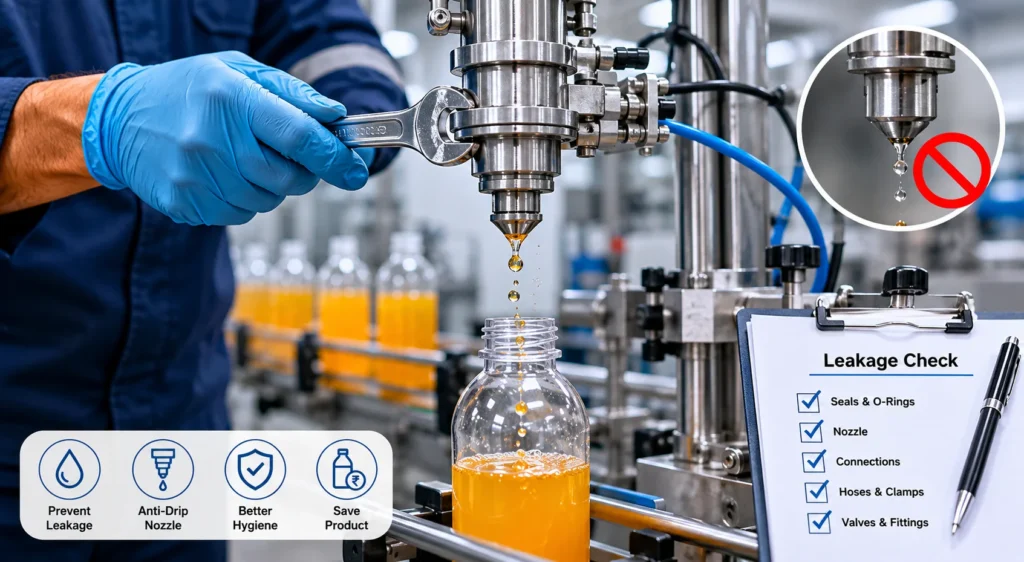
Different products need different nozzle designs. Bottom-up filling nozzles work well for foaming liquids. Diving nozzles reduce splash. Anti-drip nozzles are essential for sticky or low-viscosity products.
For thick products, piston filling machines offer precise volumetric control and minimal product carryover, which directly cuts waste.
4. Control Product Temperature and Viscosity
Many factories ignore the link between temperature and waste. A small change in temperature can change how the product flows. To stabilize this:
- Keep storage tanks at a consistent temperature
- Use jacketed hoppers for temperature-sensitive products
- Mix or agitate gently to keep viscosity uniform
When the product behaves the same every shift, the machine performs the same every shift.
5. Move to Automation Where It Makes Sense
Manual lines have more variation, more spills, and more operator-dependent errors. An automatic filling machine uses sensors, servo motors, and PLC controls to deliver repeatable accuracy on every cycle.
Automation typically helps you:
- Hit target weights within tight tolerances
- Reduce overfilling in filling machines
- Cut spillage during the filling process
- Increase output without adding labor
6. Train Operators on Waste-Aware Habits
Even the best machine needs a trained operator. Simple habits make a big difference:
- Always check container alignment before the cycle starts
- Never skip the daily cleaning routine
- Report unusual dripping or splashing immediately
- Use the recommended speed settings, not the maximum
A short daily huddle focused on waste numbers keeps the team engaged.
7. Maintain the Machine Before It Fails
Preventive maintenance is much cheaper than reactive repairs. Worn seals, loose fittings, and tired pistons all cause silent product loss. Build a maintenance plan that covers:
- Seal and gasket inspection
- Piston and cylinder wear checks
- Nozzle cleaning and replacement
- Sensor calibration
- Lubrication of moving parts
How to Measure Your Waste Reduction Progress
You cannot improve what you do not measure. Track these simple metrics weekly:
- Average fill weight versus target
- Number of underfilled or overfilled packs
- Volume of product collected from drip trays
- Cleaning waste per shift
- Rejected packs at quality control
Even a one percent improvement in filling accuracy can translate into major annual savings for high-volume lines.
A Quick Real-World Example
Consider a sauce filling line running 12,000 bottles per shift with a 2 ml overfill per bottle. That is 24 liters of product lost every shift. Over a month of 25 working days, that is 600 liters of free product going to customers. After switching to a piston-based viscous filler and tightening calibration, that loss can drop to under 0.5 ml per bottle, saving roughly 450 liters per month.
This is the kind of return that waste reduction projects deliver when planned correctly.
FAQs
Q1: What is the most common cause of product waste in filling machines?
The most common cause is poor calibration combined with the wrong nozzle for the product. Both issues lead to overfilling, dripping, and inconsistent volumes.
Q2: How often should I calibrate my filling machine to reduce waste?
A quick check at every shift start and a full calibration weekly is a good baseline. Always recalibrate after product, container, or temperature changes.
Q3: Can automation really reduce overfilling in filling machines?
Yes. Automatic filling machines use load cells, flow meters, and servo controls to hit target weights with very tight tolerances, which directly reduces overfilling.
Q4: Does product viscosity affect filling machine waste?
Absolutely. Higher viscosity products drip and cling more, while thinner liquids splash and foam. Matching the machine type and nozzle to viscosity is essential for waste control.
Q5: How do I know if my filling machine needs maintenance or replacement?
If you see rising waste numbers, more rejected packs, frequent drips, or inconsistent fills despite calibration, it is time for a maintenance audit or a machine upgrade.
Get Expert Help to Cut Waste on Your Filling Line
Reducing product waste is not just about one fix. It is about matching the right machine, the right settings, and the right maintenance plan to your specific product. Every line is different, and small changes can unlock big savings.
If you want a tailored solution to reduce product waste in filling machine operations, our engineering team can help. We design custom filling lines for liquids, powders, granules, and viscous products, and we support you with calibration, training, and long-term packaging machine service.
Contact us today to discuss your production needs, target filling accuracy, and efficiency goals. Let our experts help you build a filling line that protects your product, your margins, and your reputation.