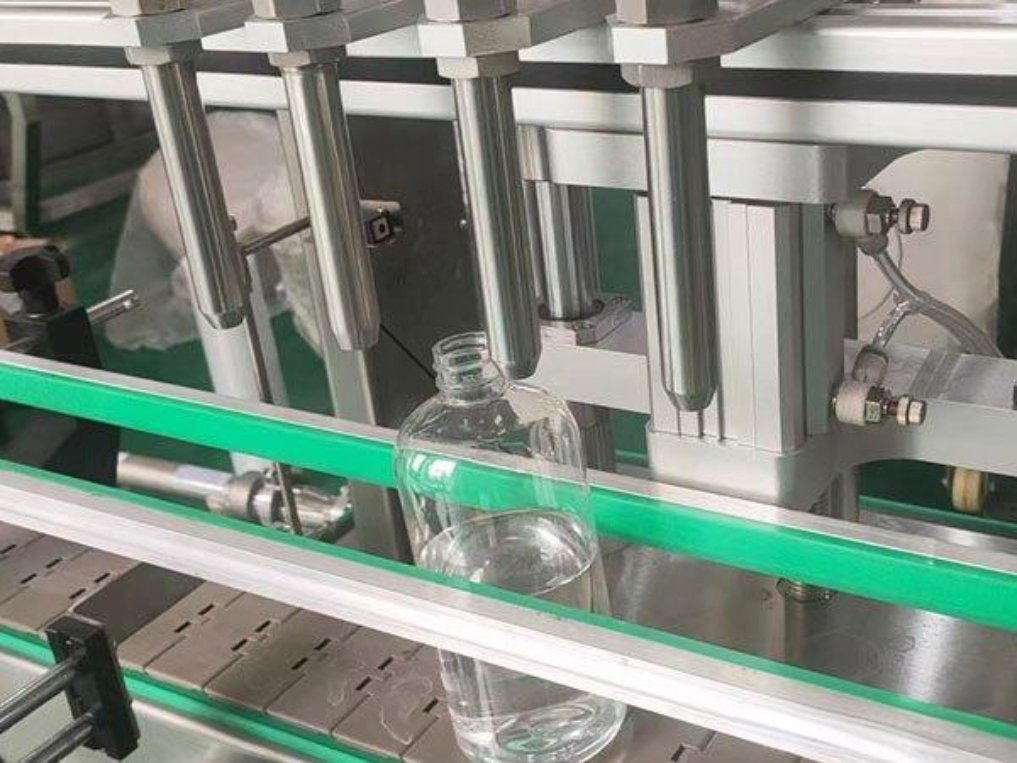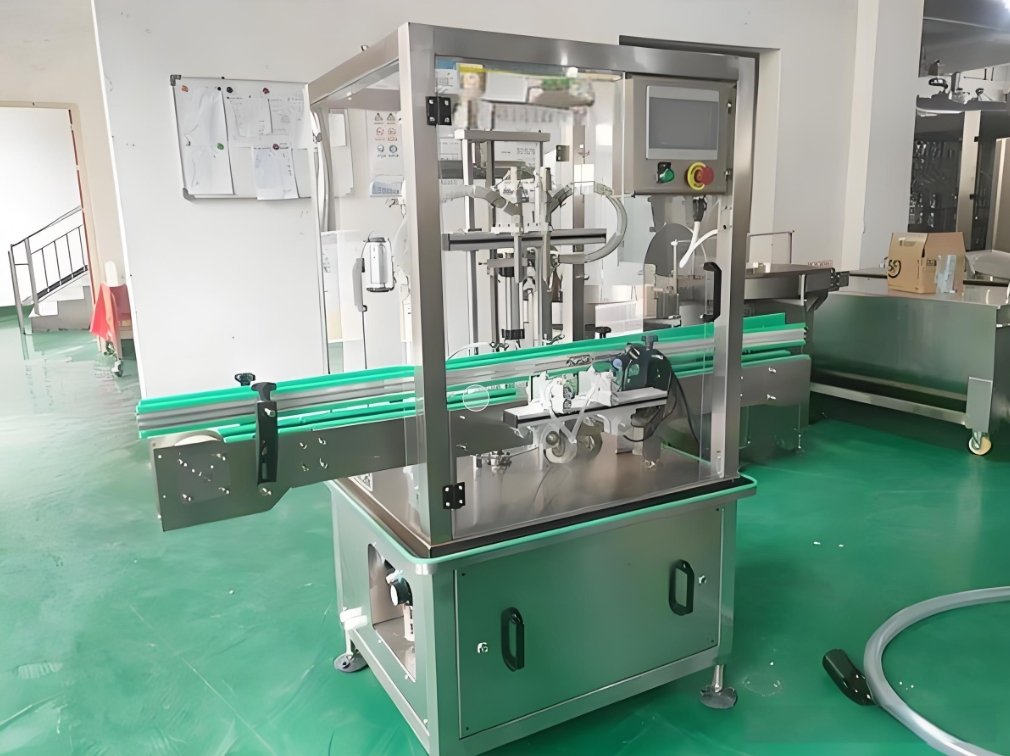
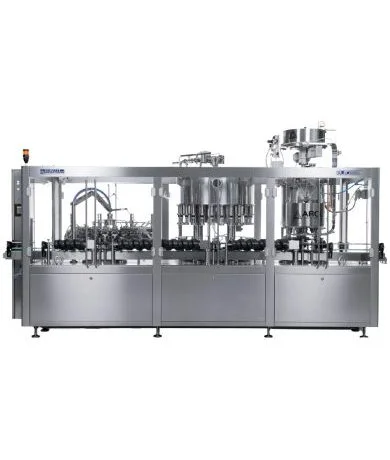
A wine bottle filling machine is a specialized liquid filling system designed to dispense measured volumes of wine into glass bottles with minimal oxygen exposure, consistent fill level, and no product loss through foaming or spillage. Unlike standard liquid fillers, wine filling machines are engineered around two properties unique to wine: its sensitivity to dissolved oxygen pickup during filling, and the foam behavior of sparkling and semi-sparkling varieties that standard gravity fillers cannot handle.
Choosing the wrong filling system costs a winery more than machine efficiency it costs product quality. A single filling cycle that exposes wine to excess oxygen accelerates oxidation, shortens shelf life, and undermines the work of every stage that came before bottling. For any winery serious about product consistency, a purpose-built wine bottle filling machine is not optional equipment. It is the last line of defence between production and the consumer.
This guide covers every wine filling machine type available in 2026, how each technology protects wine quality differently, what a wine bottling machine price looks like at each production scale, and exactly what to look for before you invest whether you are a small artisan winery bottling 5,000 cases a year or a commercial operation running multiple shifts.
For a broader technical overview of liquid filling technologies and how they apply across industries, see our complete guide to automatic filling machine types and working processes.
Why Wine Needs a Specialized Filling Machine
Wine is not simply a liquid. It is a chemically active product whose quality is directly affected by everything that happens during bottling including the filling process itself.
Oxygen is the primary enemy during bottling. Every millisecond of unnecessary wine-to-air contact during filling contributes to dissolved oxygen (DO) pickup. According to the International Organisation of Vine and Wine (OIV), even a dissolved oxygen increase of 0.1 mg/L during bottling can measurably reduce a wine’s shelf life and alter its aromatic profile. Premium wines, white wines, and natural wines are especially vulnerable. A wine filling machine designed specifically for wine minimizes DO pickup through counter-pressure filling, bottom-up filling with a diving nozzle, or vacuum-assist techniques none of which a standard liquid filler provides.
Sparkling wine and carbonated wine require pressure-rated equipment. A standard overflow or gravity filler will allow CO₂ to escape during filling, creating foam, product loss, inconsistent fill levels, and potential machine damage. A wine bottle filling machine for sparkling wine must use isobaric (counter-pressure) technology to maintain bottle pressure throughout the fill cycle.
Fill level consistency is a legal requirement in most markets. Underfilled bottles fail regulatory volume requirements and trigger retailer rejection. Overfilled bottles waste product at scale 2ml of excess fill on 100,000 bottles per year is 200 litres of wine lost. Precision fill level control is a commercial necessity, not a preference.
Types of Wine Filling Machines
1. Gravity wine filler
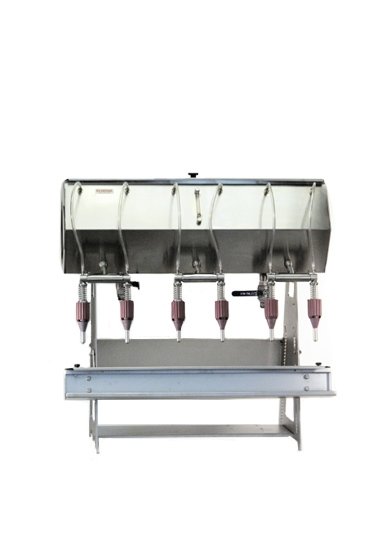
The simplest and most affordable wine filling technology. Wine flows from an elevated tank into the bottle under the force of gravity. The fill level is controlled by a vent tube that stops flow when wine reaches a set height in the bottle producing visually consistent fill levels across every bottle regardless of minor bottle volume variation.
Gravity fillers are well suited to still wines red, white, and rosé where the absence of carbonation means no foam management is required. They are not suitable for sparkling wine, pétillant naturel, or any carbonated wine style.
Output: 500 to 3,000 bottles per hour depending on fill heads and bottle size. Best for: Still wine, artisan wineries, small to medium production volumes. Fill accuracy: ±2–3mm fill level consistency.
2. Counter-pressure (isobaric) wine filler
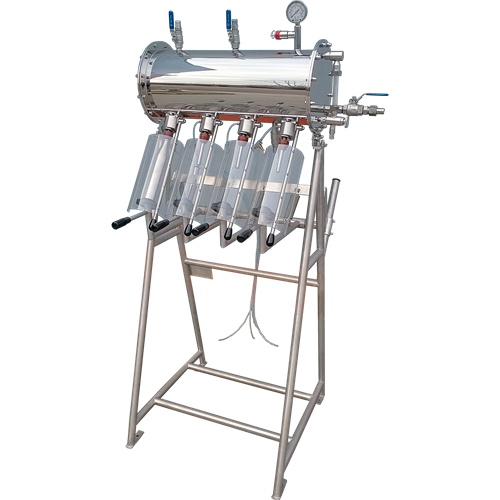
Counter-pressure filling also called isobaric filling is the standard technology for sparkling wine, Prosecco, Cava, Champagne, and carbonated wine styles. Before filling, the bottle is pressurized with CO₂ to match the pressure of the product tank. Wine is then introduced into the pressurized bottle, maintaining carbonation throughout the fill cycle and eliminating foam.
Counter-pressure fillers are significantly more complex and more expensive than gravity fillers but they are the only technology that can handle sparkling wine without product loss, inconsistent fill levels, or carbonation degradation.
Output: 1,000 to 8,000+ bottles per hour on fully automatic systems. Best for: Sparkling wine, Prosecco, Cava, Champagne, pét-nat, carbonated wine. Fill accuracy: ±1–2mm fill level with pressure regulation.
3. Vacuum wine filler
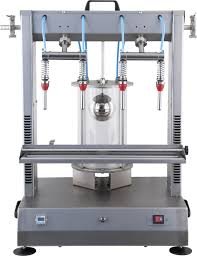
A vacuum filler evacuates air from the bottle before filling first drawing a vacuum to remove oxygen, then allowing wine to flow in under atmospheric pressure. This significantly reduces dissolved oxygen pickup compared to gravity filling and is favored by natural winemakers, biodynamic producers, and premium still wine operations where oxidation protection is a priority.
Vacuum fillers are slower than gravity fillers and more complex to clean and maintain but for producers who have invested significantly in low-intervention winemaking, the oxygen protection justifies the premium.
Output: 500 to 2,500 bottles per hour. Best for: Premium still wine, natural wine, orange wine, low-intervention producers. Fill accuracy: ±1–2mm fill level.
4. Monobloc wine bottling machine (fill + cork + label)
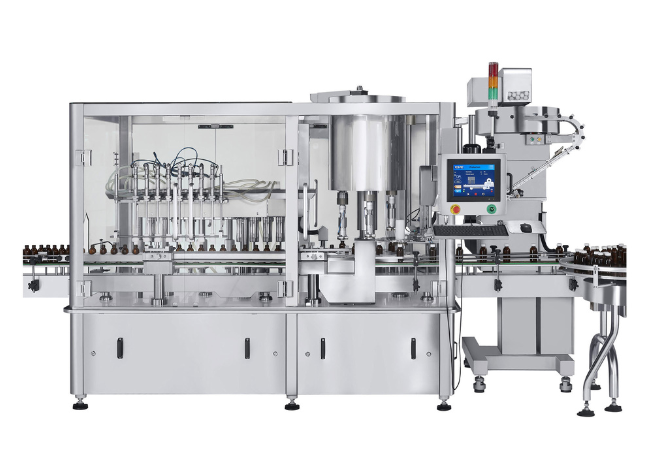
A wine bottling machine monobloc integrates the filler, corker or screw-cap capper, and sometimes the labeler into a single compact unit on one frame. All operations happen in sequence without conveyors between stations reducing the line footprint, eliminating transfer damage between machines, and simplifying commissioning to a single electrical and pneumatic connection.
Monobloc systems are particularly popular with small and medium wineries that need a complete bottling solution in a limited space. Our wine filling machine range includes monobloc configurations from 4-head small-winery systems to 12-head commercial production lines.
Output: 1,000 to 6,000 bottles per hour. Best for: Small to medium wineries wanting a complete integrated bottling solution.
5. Wine filler for small winery (semi-automatic)
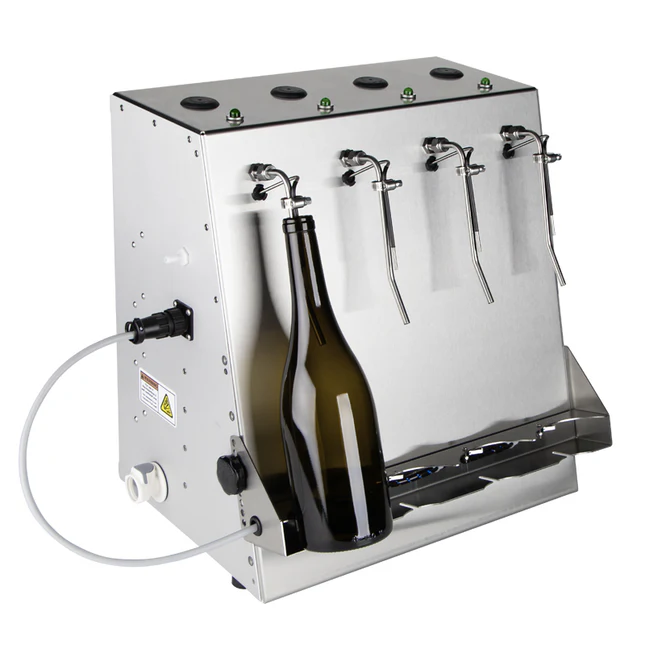
A wine filler for small winery applications is a semi-automatic 2 to 4 head unit where the operator places bottles manually and the machine handles the fill cycle. These machines are compact, affordable, easy to clean, and require no special infrastructure beyond a standard power outlet and compressed air supply.
For wineries bottling under 20,000 cases per year or producers bottling in small batches across multiple varietals a semi-automatic wine filler offers an excellent balance of automation and flexibility without the capital commitment of a fully automatic line.
Output: 200 to 800 bottles per hour. Best for: Artisan wineries, estate wineries, small-batch bottling, mobile bottling operations. Price range: $2,500 to $8,000.
Wine Bottling Machine Price Guide 2026
| Machine Type | Semi-Automatic | Fully Automatic | High-Speed |
| Gravity wine filler | $2,500 – $8,000 | $8,000 – $25,000 | $25,000 – $50,000+ |
| Counter-pressure (isobaric) filler | $8,000 – $18,000 | $18,000 – $45,000 | $45,000 – $90,000+ |
| Vacuum wine filler | $5,000 – $12,000 | $12,000 – $30,000 | $30,000 – $60,000+ |
| Monobloc (fill + cork + label) | $10,000 – $22,000 | $22,000 – $55,000 | $55,000 – $100,000+ |
| Wine filler for small winery | $2,500 – $8,000 | — | — |
All prices are ex-factory (FOB). Shipping, import duties, installation, and commissioning are additional costs.
What drives wine bottling machine price within each range:
Fill head count is the primary cost driver more heads, more output, more cost. A 4-head gravity filler costs considerably less than an 8-head equivalent from the same manufacturer.
Fill technology counter-pressure systems are inherently more complex than gravity systems and command a higher price at every automation level.
Material specification all wine contact parts should be 304 stainless steel as a minimum. 316L stainless steel is required for highly acidic wines or where regular aggressive CIP cleaning is part of the sanitation protocol.
Corker or capper integration a standalone filler costs less than an equivalent monobloc with integrated corking. However, the monobloc delivers lower total cost when you account for the separate corker you would otherwise need to purchase.
CIP (clean-in-place) system automatic in-place cleaning adds to upfront cost but significantly reduces labour time between varietals or bottling runs and improves sanitation consistency.
Gravity Filler vs Counter-Pressure vs Vacuum: Comparison Table
| Factor | Gravity Filler | Counter-Pressure | Vacuum Filler |
| Wine style | Still wine only | Sparkling, still | Still wine |
| DO pickup | Medium | Low | Very low |
| Fill accuracy | ±2–3mm | ±1–2mm | ±1–2mm |
| Speed | High | High | Medium |
| Price | Lowest | Highest | Medium |
| Maintenance | Simple | Complex | Medium |
| Best for | Standard still wine | All sparkling styles | Premium / natural wine |
| Cleaning | Standard CIP | Pressure-rated CIP | Standard CIP |
Industries and Winery Types That Use Wine Filling Machines
Commercial wineries and co-operatives running multiple shifts and high annual volumes use fully automatic counter-pressure or gravity fillers with 8 to 24 fill heads. Output requirements of 3,000 to 10,000 bottles per hour demand a machine engineered for continuous high-speed operation with fast CIP cycles between varietals.
Estate wineries and medium producers bottling 5,000 to 50,000 cases annually typically use a 4 to 8 head automatic gravity filler or monobloc unit. The monobloc configuration filler, corker, and labeler on one frame is particularly well suited to estate wineries where floor space is limited and the bottling team is small. For winery labeling options that integrate downstream of your filler, see our labeling machine range and our round bottle labeling machine the standard configuration for wine bottle labeling.
Artisan and small-batch wineries bottling under 5,000 cases per year are best served by a semi-automatic wine filler for small winery applications a 2 to 4 head unit that one operator can run, clean, and maintain without specialist technical knowledge. For producers at this scale who are also filling other beverages or products between vintages, a general-purpose liquid filling machine configured for wine can offer more flexibility than a wine-only dedicated unit. Our guide on filling machines for small business covers the entry-level options in detail.
Spirits and distillery producers often use the same counter-pressure or gravity filling technology as wineries the product properties of spirits (thin viscosity, no carbonation for most) align closely with still wine filling requirements.
How to Choose the Right Wine Bottle Filling Machine
Match fill technology to your wine style first everything else follows.
If you produce still wine only, a gravity or vacuum filler is the right starting point. If you produce sparkling wine, Prosecco, or any carbonated style, counter-pressure filling is non-negotiable. Trying to fill sparkling wine on a gravity filler results in foam, product loss, and inconsistent fill levels regardless of how well the machine performs on still wine.
Calculate your required output before specifying fill head count.
Your annual case production divided by your available bottling days and hours per day gives your required bottles per hour. Add a 25% buffer for cleaning, changeover, and stoppages. This is your minimum machine throughput specification. In our experience supplying wine filling machines to wineries across Europe, Southeast Asia, and the Middle East, wineries consistently underestimate bottling frequency and end up with a machine running at 95% of rated capacity accelerating wear and compromising fill quality. Size up by at least one fill head count from your calculated minimum.
Specify CIP as standard, not an option.
Wine is produced seasonally and in multiple varietals bottling runs change frequently. A machine with automatic CIP reduces cleaning time between runs, improves sanitation consistency, and protects wine quality across every varietal you bottle. The labour saving on a 10-bottling-run season pays back the CIP premium within the first year.
Verify all wine contact materials are 304 or 316L stainless steel.
Wine is mildly acidic and will corrode inferior materials over time, contaminating product and degrading machine performance. Request a material certificate for all product-contact parts from any wine filling machine supplier before purchase. Our wine filling machine range uses 304 stainless steel as standard with 316L available on request.
Plan the downstream bottling line at the same time as the filler.
A wine bottle filler without a matched corker or capper creates a production bottleneck immediately. The corker or capper must match the filler’s output speed and ideally come from the same manufacturer to guarantee integration. Read our comprehensive guide to capping machines to understand which closure type (natural cork, synthetic cork, screw cap, or crown cap) determines which capping machine you need. You can also contact our engineering team to discuss a complete winery bottling line specification.
Confirm CE certification and food-grade compliance.
CE marking is required for wine production equipment sold into European markets. Food-grade contact materials are required in all markets. According to the Wine Institute, global wine export volumes continue to grow year on year meaning machines destined for export markets must meet the importing country’s equipment compliance standards, not just the manufacturing country’s.
Wine Bottling Line: Full End-to-End Setup
A complete wine bottling line for a medium to large winery typically includes the following stages in sequence:
Bottle rinser → Wine bottle filling machine → Corker or capper → Capsule applicator → Labeling machine → Carton packing machine → Palletizer
For wineries sourcing a complete line, matching every machine to the same output speed and sourcing from one manufacturer eliminates speed-mismatch problems and reduces commissioning to a single site visit.
At Foshan Popper Machinery, we supply wine fillers, capping machines, labeling machines, and packaging machines all engineered to run together on a shared conveyor at matched speed. Our service page details our commissioning process, warranty terms, and after-sales support for complete winery bottling lines.
Frequently Asked Questions
What is a wine bottle filling machine?
A wine bottle filling machine is a specialized liquid filling system that dispenses measured volumes of wine into glass bottles with minimal oxygen exposure, consistent fill level, and no product loss. Unlike standard liquid fillers, wine filling machines use fill technologies gravity, counter-pressure, or vacuum specifically designed to protect wine quality during the filling process.
What is the difference between a gravity filler and a counter-pressure filler for wine?
A gravity filler uses the weight of the wine to flow into the bottle under atmospheric pressure suitable for still wines only. A counter-pressure (isobaric) filler first pressurizes the bottle with CO₂ to match the product tank pressure before filling essential for sparkling wine, Prosecco, and carbonated styles. Using a gravity filler for sparkling wine results in foam, carbonation loss, and inconsistent fill levels.
How much does a wine bottling machine cost?
Wine bottling machine prices in 2026 range from $2,500 for a semi-automatic gravity filler for small wineries to over $100,000 for a fully automatic monobloc counter-pressure system with integrated corker and labeler. The price is primarily driven by fill technology (gravity vs counter-pressure), fill head count, automation level, and whether corking and labeling are integrated. See the price table above for a full breakdown.
What is the best wine filler for a small winery?
For small wineries bottling under 5,000 cases per year, a semi-automatic 2 to 4 head gravity filler in the $2,500 to $8,000 range is the most practical choice. It requires no special infrastructure, can be operated by one person, and is easy to clean between varietals. For wineries that also produce sparkling wine, a semi-automatic counter-pressure unit is required expect to budget $8,000 to $18,000 for a quality semi-automatic isobaric filler.
How do I minimize dissolved oxygen pickup during wine bottling?
The three most effective methods are: using counter-pressure or vacuum filling technology instead of gravity filling; pre-purging bottles with inert gas (CO₂ or nitrogen) before filling; and ensuring the fill nozzle delivers wine from the bottom of the bottle upward (diving nozzle) rather than splashing from the top. Premium wine producers combine all three methods for maximum protection.
Can a wine filling machine handle both red and white wine?
Yes. A gravity or counter-pressure wine filler handles any still wine style red, white, rosé, orange, and dessert wines with equal performance. Changeover between wines requires a full CIP cleaning cycle to prevent cross-contamination and flavour carryover. Machines with automatic CIP reduce this cycle to 15 to 30 minutes.
What certifications should a wine filling machine have?
CE marking is required for machines used in European wine production. All product-contact parts must be food-grade 304 or 316L stainless steel, food-grade silicone seals, and PTFE or food-grade plastic fittings. Machines supplied to US wineries should use FDA-compliant contact materials. Always request and verify material certificates and CE documentation specific to the exact model being purchased.
How fast does an automatic wine bottle filling machine run?
Automatic wine bottle filling machines range from 1,000 to 3,000 bottles per hour for 4-head systems, 3,000 to 6,000 bottles per hour for 8-head systems, and 6,000 to 12,000+ bottles per hour for 16-head high-speed rotary systems. Speed depends on fill head count, bottle size, fill technology, and whether corking is integrated on the same machine.
What is the ullage space in wine bottling?
Ullage is the space between the wine surface and the bottom of the cork or closure in a sealed wine bottle. It is typically 10 to 15mm in a standard 750ml wine bottle. A wine bottle filling machine controls fill level precisely to produce consistent ullage too little increases pressure risk for sparkling wines, too much accelerates oxidation for still wines.
Get a Quote for Your Wine Filling Machine
Selecting the right wine bottle filling machine for your winery depends on your wine style, annual production volume, floor space, and downstream bottling equipment. The fastest way to get the right specification is to work with a manufacturer who understands wine production requirements not just liquid filling in general.
At Foshan Popper Machinery, we manufacture wine filling machines, automatic wine bottling machines, and complete winery bottling lines from compact semi-automatic units for artisan producers to high-speed fully automatic monobloc systems for commercial wineries. Every machine uses food-grade 304 stainless steel contact parts, CE-certified construction, and is supplied with full commissioning support and a 12-month warranty.
Request a free wine filling machine quote →
Explore our wine bottling line range:
- Wine Filling Machine
- Liquid Filling Machine
- Capping Machines
- Labeling Machine
- Packaging Machines
- Full Automatic Filling Machine Solutions
Have a question about which wine filler configuration suits your production volume and wine style? Contact our team we will assess your requirements and recommend the right solution with no obligation.