A palletizing machine is an industrial end-of-line system that automatically stacks filled, sealed, and labeled cases, bags, or cartons onto a pallet in a defined layer pattern ready for warehouse storage or dispatch. It is the final automated stage in any complete production line, converting individual cases into stable, transport-ready pallet loads without manual lifting or stacking.
For any factory producing more than 200 to 300 cases per shift, manual palletizing creates three serious problems: high labor cost, unacceptably high injury rates from repetitive heavy lifting, and inconsistent pallet stack stability that causes load collapses during transit.
A palletizing machine eliminates all three and typically delivers one of the fastest payback periods of any end-of-line investment.
This complete buying guide covers every palletizing machine type available in 2026, the industries that depend on them, how to calculate your specific ROI, what drives the price at each level, and the key questions to ask any palletizing machine manufacturer before you commit to a purchase.
For a broader look at how palletizing integrates with carton packing and wrapping at the end of your production line, read our carton packaging machine complete guide and explore our full packaging machine range.
How a Palletizing Machine Works
Every automatic palletizer regardless of type follows the same core operating sequence.
Step 1: Case in-feed. Sealed cases, bags, or cartons arrive on a conveyor from the upstream packaging station typically a carton sealer, shrink wrap machine, or case packer.
Step 2: Layer formation. The machine arranges individual cases into the target pallet pattern a grid, brick, or pinwheel arrangement chosen for maximum load stability. Pattern formation is done by a pusher, robotic arm, or gantry depending on machine type.
Step 3: Layer transfer. The formed layer is lowered or pushed onto the pallet. A layer sheet (slip sheet or cardboard interlayer) is placed between layers if required for load stability or product protection.
Step 4: Pallet discharge. When the pallet reaches the programmed number of layers, it is automatically conveyed out of the machine to a wrapping packaging machine for stretch wrapping, or to a dispatch conveyor for forklift collection.
The cycle time per layer ranges from 8 to 30 seconds depending on machine type and case weight.
Types of Palletizing Machines
1. Conventional layer palletizer
The conventional layer palletizer is the most widely used configuration in food, beverage, and chemical production. Cases arrive on a conveyor, are arranged into a layer by mechanical pushers or a sweep arm, and the completed layer is lowered onto the pallet by a layer transfer plate. Conventional palletizers are fast 10 to 35 layers per minute reliable, and well-suited to high-volume production of a single or small number of case formats. They are simpler mechanically than robotic systems and easier to maintain.
Best for: High-volume single-SKU production beverage, canned food, bottled water, chemical drums, and agricultural product bags where speed matters more than flexibility.
2. Robotic palletizer
A robotic palletizer uses a multi-axis robot arm fitted with a gripper head to pick cases, bags, or trays and place them onto the pallet in a programmed pattern. The robot can handle multiple case sizes, multiple pallet formats, and multiple product types simultaneously switching between programs in seconds via the PLC.
Robotic palletizers are slower than conventional layer palletizers at equivalent output speeds but dramatically more flexible. A single robotic cell can handle 5 to 15 different product formats without mechanical changeover just a program selection on the HMI touchscreen.
According to the Association for Advancing Automation (A3), robotic palletizer installations have grown by over 15% annually in manufacturing since 2022, driven by labor cost increases and the need for flexible end-of-line systems in multi-SKU production environments.
Best for: Multi-SKU operations, cosmetics and pharmaceutical factories with frequent product changes, food factories running seasonal or promotional pack formats, and any operation where flexibility outweighs raw speed.
3. Gantry palletizer (high-level palletizer)
A gantry palletizer uses a fixed overhead frame with a gripper or vacuum head that moves on X, Y, and Z axes to pick and place cases. It delivers the high-speed capability of a conventional palletizer with more flexibility than a traditional layer palletizer handling multiple case sizes with shorter changeover times. Gantry systems are common in large-format food, beverage, and chemical operations where case sizes vary but output volume is consistently high.
Best for: Large factories running 2 to 5 case formats at high speed beverage multinationals, chemical manufacturers, and FMCG distribution centres.
4. Low-level palletizer
A low-level palletizer builds the pallet from the bottom up the pallet sits on the floor and the machine stacks from ground level. This configuration requires less floor-to-ceiling height than a high-level system, making it suitable for factories with low ceiling clearance. Output is typically lower than high-level systems 5 to 15 layers per minute but installation is simpler and cost is significantly lower.
Best for: Small to medium factories, food producers, and pharmaceutical operations where ceiling height is a constraint and output requirements are moderate.
5. End of line palletizer (integrated system)
An end of line palletizer is a complete integrated system that combines the palletizing machine with an infeed conveyor, pallet dispenser, layer sheet dispenser, and pallet conveyor all managed by a single PLC. It connects directly to the upstream carton packaging machine or shrink wrap packaging machine output conveyor and discharges finished pallets to a stretch wrapper or forklift lane. This is the standard configuration for new complete production line installations and the version most factories should be specifying in 2026.
Best for: Any factory building a new production line or upgrading to full end-of-line automation.
Industries That Use Palletizing Machines
Palletizer for food industry: applications represent the largest demand segment by volume. Beverage bottles, canned goods, boxed cereals, bagged snacks, and frozen food cases all move through palletizing machines before entering the supply chain. Speed, hygiene-compatible construction, and integration with upstream filling and packaging equipment are the critical requirements. If your factory runs a liquid filling machine, capping machine, labeling machine, and carton packer in sequence, the palletizer is the natural final stage and sourcing it from the same supplier as the rest of your line eliminates speed-mismatch problems and commissioning complexity. For more on how filling and packaging equipment integrates on a shared line, read our guide on how filling machines improve production efficiency.
Chemical and industrial manufacturers: use palletizing machines for drums, pails, bags of granules, and bulk chemical containers. These applications often require explosion-proof electrical systems and chemical-resistant construction.
Pharmaceutical and healthcare: manufacturers use robotic palletizers for their flexibility frequent product launches and strict product handling requirements make robotic pick-and-place the right choice over conventional mechanical pushers.
FMCG and consumer goods: companies use palletizing machines across household products, personal care, and cleaning product lines typically multi-SKU operations where robotic flexibility and fast program changeover deliver the greatest operational benefit. Read our food packaging machine efficiency guide for more on how end-of-line automation delivers measurable ROI in consumer goods factories.
Palletizing Machine Price Guide 2026
| Machine Type | Entry Level | Mid Range | High Speed / Robotic |
| Low-level conventional palletizer | $15,000 – $30,000 | $30,000 – $55,000 | — |
| High-level conventional palletizer | $25,000 – $50,000 | $50,000 – $90,000 | $90,000 – $150,000+ |
| Robotic palletizer (single arm) | $35,000 – $65,000 | $65,000 – $120,000 | $120,000 – $200,000+ |
| Gantry palletizer | $40,000 – $70,000 | $70,000 – $130,000 | $130,000 – $180,000+ |
| End of line integrated system | $50,000 – $90,000 | $90,000 – $160,000 | $160,000 – $250,000+ |
All prices are ex-factory (FOB). Shipping, import duties, installation, and commissioning are additional costs.
Key factors that drive palletizing machine price:
Throughput in cases per hour is the primary cost driver. A machine rated at 500 cases per hour costs significantly less than one rated at 2,000 cases per hour even within the same machine category.
Robotic vs conventional robotic systems cost more upfront but deliver greater flexibility. Conventional layer palletizers cost less but are optimized for narrow product ranges.
Payload capacity the maximum weight of product the machine can handle per pick or per layer directly affects the structural requirement of the machine and its price.
PLC integration and Industry 4.0 connectivity machines with full network integration, remote diagnostics, and production data logging cost more but deliver measurable uptime improvements in multi-shift operations.
Pallet format flexibility machines configured for multiple pallet sizes (EUR, US, custom) with automatic changeover cost more than single-format machines.
Palletizing Machine ROI: How to Calculate Your Payback Period
Palletizing machine ROI is typically the most compelling financial case of any end-of-line investment. The calculation is straightforward.
Step 1: Calculate your current manual palletizing labor cost. Number of manual palletizing operators × annual salary + employer costs = total annual labor cost. Example: 3 operators × $18,000/year = $54,000/year in direct labor.
Step 2: Add injury and absenteeism cost. Manual palletizing is one of the highest-injury tasks in any factory. Factor in lost time, replacement worker costs, and insurance premiums. Conservative estimate: $8,000 to $15,000 per year for a 3-person manual palletizing operation.
Step 3: Add rework and load collapse cost. Inconsistent manual stacking causes transit damage and load collapses. Even 1% of pallet loads failing in transit on a 10,000-pallet-per-year operation represents significant rework and customer service cost.
Step 4: Calculate payback period. Machine investment ÷ annual savings (labor + injury + rework) = payback period in years. Example: $60,000 machine ÷ $65,000 annual savings = under 12 months payback.
In most food, beverage, and chemical applications with 2 or more manual palletizing operators, the palletizing machine ROI payback period falls between 12 and 24 months making it one of the fastest-returning capital investments available to a production manager.
Robotic Palletizer vs Conventional Palletizer: Full Comparison
| Factor | Robotic Palletizer | Conventional Palletizer |
| Output speed | 400–1,200 cases/hour | 600–3,000+ cases/hour |
| Product flexibility | High multiple SKUs, shapes | Low optimized for fixed formats |
| Changeover time | Seconds (program selection) | 20–60 minutes (mechanical) |
| Upfront cost | Higher | Lower |
| Maintenance complexity | Medium robot arm servicing | Low simpler mechanics |
| Footprint | Compact | Larger |
| Best for | Multi-SKU, frequent changes | High-volume single SKU |
| Payback period | 18–36 months | 12–24 months |
The robotic palletizer vs conventional palletizer decision comes down to one question: does your operation value speed or flexibility more? High-volume single-product factories consistently choose conventional. Multi-SKU operations with frequent product launches consistently choose robotic.
How to Choose the Right Palletizing Machine
Start with your required throughput in cases per hour.
This single figure narrows your machine type and configuration faster than any other specification. Calculate it precisely: daily case output ÷ available shift hours = cases per hour required. Add 20% buffer. This is your minimum machine throughput specification.
Define your case format range.
If you run one or two case sizes consistently, a conventional layer palletizer is the right tool and the lower cost. If you run five or more case sizes or launch new products regularly, a robotic palletizer will pay back its higher upfront cost through changeover time savings within the first 18 months.
Check your facility ceiling height and floor space.
High-level palletizers require 5 to 7 metres of clear ceiling height. Low-level machines require 3 to 4 metres. Robotic palletizer cells are typically more compact than equivalent conventional systems. Measure your available space before specifying a machine retrofitting a palletizer that does not fit is an expensive mistake.
Confirm the downstream stretch wrapper compatibility.
In our experience supplying end of line palletizers to food and beverage factories across Southeast Asia, the Middle East, and Europe, the most common integration problem is a pallet conveyor height mismatch between the palletizer output and the stretch wrapper infeed. Specify both machines from the same supplier to guarantee compatibility. You can explore all our integrated solutions on our packaging machine range page, or contact our team to discuss your specific layout.
Ask for references in your industry. A palletizing machine manufacturer
who has supplied machines to food factories has different engineering context than one who has not even if the catalog looks identical. Ask for documented references in your specific sector and request a machine trial video showing your case format running at rated speed.
For full details on our after-sales support, commissioning process, and warranty terms, visit our services page.
Palletizing Machine vs Wrapping Machine: Understanding End-of-Line Flow
A question we regularly receive from buyers is whether they need a palletizing machine, a wrapping machine, or both. The answer is always both they serve sequential functions.
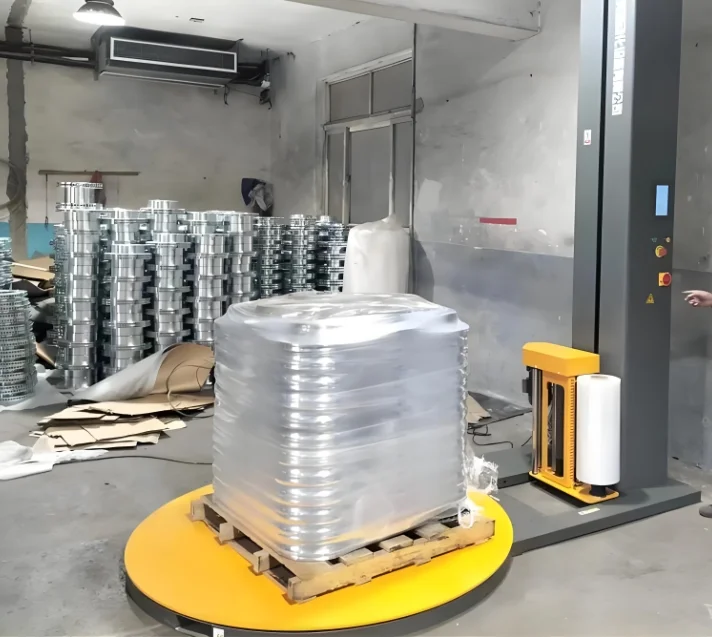
The palletizing machine stacks cases into a stable pallet load. The wrapping packaging machine then applies stretch film around the finished pallet to secure the load for transit and protect it from moisture and dust. Neither machine replaces the other they complete the end-of-line automation loop together.
For a detailed guide on stretch wrapping and how it integrates at the final stage of your line, read our vertical wrapping packaging machine guide. For the upstream stage case forming and sealing before palletizing see our carton packaging machine guide and our shrink wrap packaging machine range.
Frequently Asked Questions
What is a palletizing machine?
A palletizing machine is an industrial end-of-line system that automatically stacks sealed cases, bags, or cartons onto a pallet in a defined layer pattern, ready for warehouse storage or transport. It replaces manual pallet stacking to deliver consistent load stability, faster throughput, and significantly lower labor and injury costs. Explore our range at Foshan Popper Machinery.
What is the difference between a robotic palletizer and a conventional palletizer?
A robotic palletizer uses a multi-axis robot arm to pick and place individual cases offering high flexibility across multiple product formats with near-instant changeover. A conventional palletizer uses mechanical pushers or sweep arms to form and transfer complete layers at higher speed better suited to high-volume single-SKU production. The right choice depends on whether speed or flexibility is the priority in your operation.
How much does a palletizing machine cost?
Palletizing machine prices in 2026 range from $15,000 for an entry-level low-level conventional palletizer to over $250,000 for a fully integrated high-speed robotic end-of-line system. The price is primarily driven by throughput (cases per hour), machine type, payload capacity, and PLC integration level. See the price table above for a full breakdown.
What is the ROI of a palletizing machine?
Palletizing machine ROI payback periods typically fall between 12 and 24 months for operations replacing 2 or more manual palletizing operators. The savings come from direct labor cost reduction, lower injury and absenteeism costs, reduced transit damage from consistent pallet stacking, and increased throughput capacity. The calculation is straightforward annual labor and rework savings divided by machine investment cost gives the payback period in years.
What industries use palletizing machines?
Food and beverage is the largest sector for palletizing machine demand, followed by chemical and industrial, pharmaceutical, FMCG consumer goods, and agricultural product manufacturers. Any industry producing more than 200 to 300 cases per shift and using two or more manual palletizing operators is a strong candidate for palletizing automation.
What is an end of line palletizer?
An end of line palletizer is a complete integrated palletizing system that combines the palletizing machine with infeed conveyor, pallet dispenser, layer sheet dispenser, and pallet discharge conveyor all managed by a single PLC and connected directly to the upstream packaging equipment. It is the standard configuration for new complete line installations and the most reliable way to integrate palletizing into an existing production line.
How fast does an automatic palletizer run?
Automatic palletizer throughput ranges from 300 to 500 cases per hour for low-level conventional machines, 600 to 3,000+ cases per hour for high-level conventional machines, and 400 to 1,200 cases per hour for robotic palletizers. The appropriate speed depends on your upstream production rate the palletizer must match or exceed the output of your carton packer or shrink wrap machine.
How long does a palletizing machine last?
A well-maintained palletizing machine from a quality manufacturer operates productively for 10 to 15 years. Conventional palletizers have simpler mechanics and lower maintenance requirements than robotic systems. Key wear items conveyor belts, sensors, and gripper heads are straightforward to replace with a spare parts kit on hand.
Get a Quote for Your Palletizing Machine
Selecting the right palletizing machine for your production line requires matching machine type, throughput, pallet format, and integration requirements to your specific operation. The fastest and most reliable way to get the right specification is to work with a manufacturer who has designed and commissioned palletizing systems for your industry.
At Foshan Popper Machinery, we manufacture automatic palletizers and complete end-of-line packaging systems including carton packaging machines, shrink wrap machines, and wrapping machines all engineered to integrate on a shared production line with a single PLC. Our team supplies palletizing machines to factories in 50+ countries across food, beverage, chemical, pharmaceutical, and FMCG sectors.
Request a free palletizing machine quote →
Explore our complete end-of-line packaging range:
- Palletizing Packaging Machine
- Carton Packaging Machine
- Shrink Wrap Packaging Machine
- Wrapping Packaging Machine
- Paper Box Packaging Machine
- Full Packaging Machine Range
Have questions about which palletizer configuration is right for your case format and throughput? Contact our engineering team we will assess your line requirements and recommend the right end-of-line solution with no obligation.