Choosing the best capsule filling machine starts with one practical question: how many capsules must you produce consistently with your actual formulation, capsule size, workforce, available space, and quality requirements?
A manual filler may be suitable for research or very small batches. A semi-automatic system often provides growing supplement manufacturers with a practical balance between output and investment. Meanwhile, a fully automatic capsule filling machine is normally the right choice for continuous pharmaceutical or high-volume nutraceutical production.
There is no single machine that is best for every buyer. The correct decision depends on production volume, powder behavior, dosage accuracy, capsule compatibility, cleaning requirements, changeover time, automation level, technical support, and total operating cost.
This guide compares the main capsule filling machine types and explains how to select equipment that can support your current operation and future production growth.
Best Capsule Machine by Production Scale
| Production situation | Recommended machine | Why it fits |
|---|---|---|
| Formula testing, laboratories and very small batches | Manual capsule filling machine | Low investment, compact design and simple operation |
| Startups and growing supplement brands | Semi-automatic capsule filling machine | Better consistency and output without full automation |
| Pharmaceutical and high-volume facilities | Fully automatic capsule filling machine | Continuous production, reduced labor and line integration |
| Powders, pellets or combined materials | Formulation-specific capsule filler | Dosing technology must match the material |
| Coffee pods and beverage capsules | Dedicated coffee capsule filling machine | Coffee capsules require filling and sealing rather than capsule locking |
For most growing manufacturers, a semi-automatic model is a practical starting point. For stable, large-volume manufacturing, a fully automatic system normally offers better long-term efficiency.
The best capsule filling machine is the one that meets your validated output and accuracy requirements without creating unnecessary labor, cleaning, maintenance, or changeover problems.
What Is a Capsule Filling Machine?
A capsule filling machine separates empty two-piece capsule shells, doses material into the capsule bodies, rejoins the caps, locks the capsules, and discharges the completed units.
Depending on its tooling and dosing system, it may process:
Powders
Granules
Pellets
Mini-tablets
Certain liquid formulations
Semi-solid formulations
Most pharmaceutical and supplement applications use two-piece hard gelatin or HPMC capsules. Capsule sizes commonly range from 000 to 5, but not every machine supports every size with the same tooling.
Buyers should confirm the capsule material, required sizes, target dose range, and necessary change parts before selecting a machine.
A standard hard-capsule filler is not the same as a softgel encapsulation system. Softgels are formed, filled, and sealed through a separate manufacturing process.
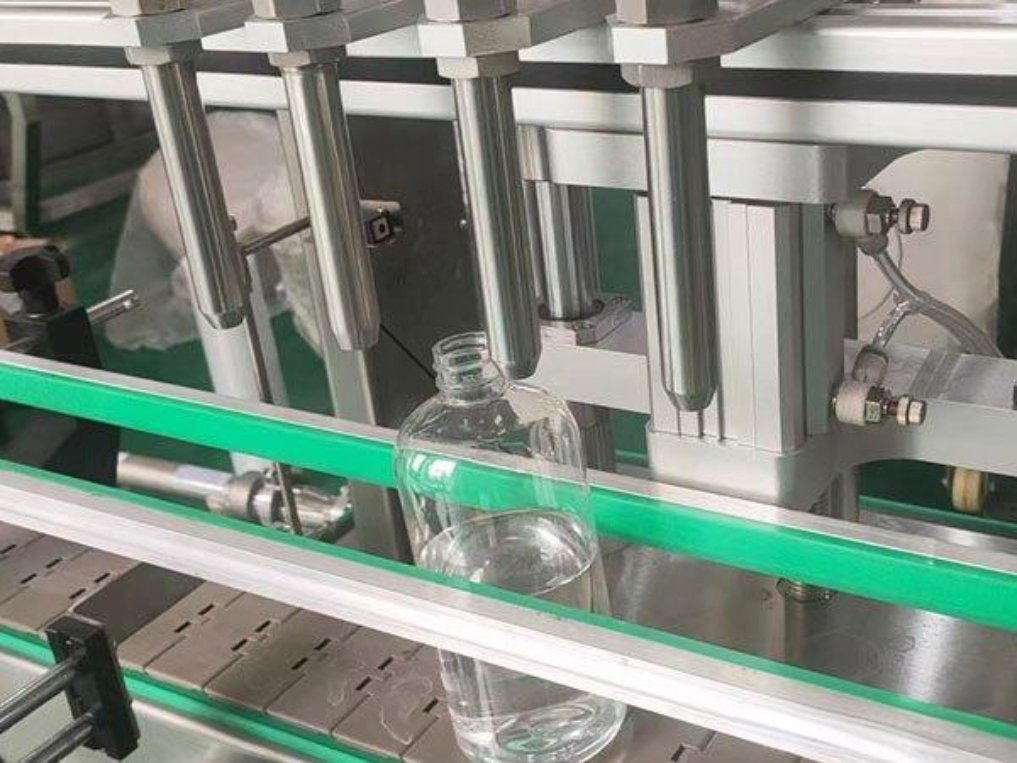
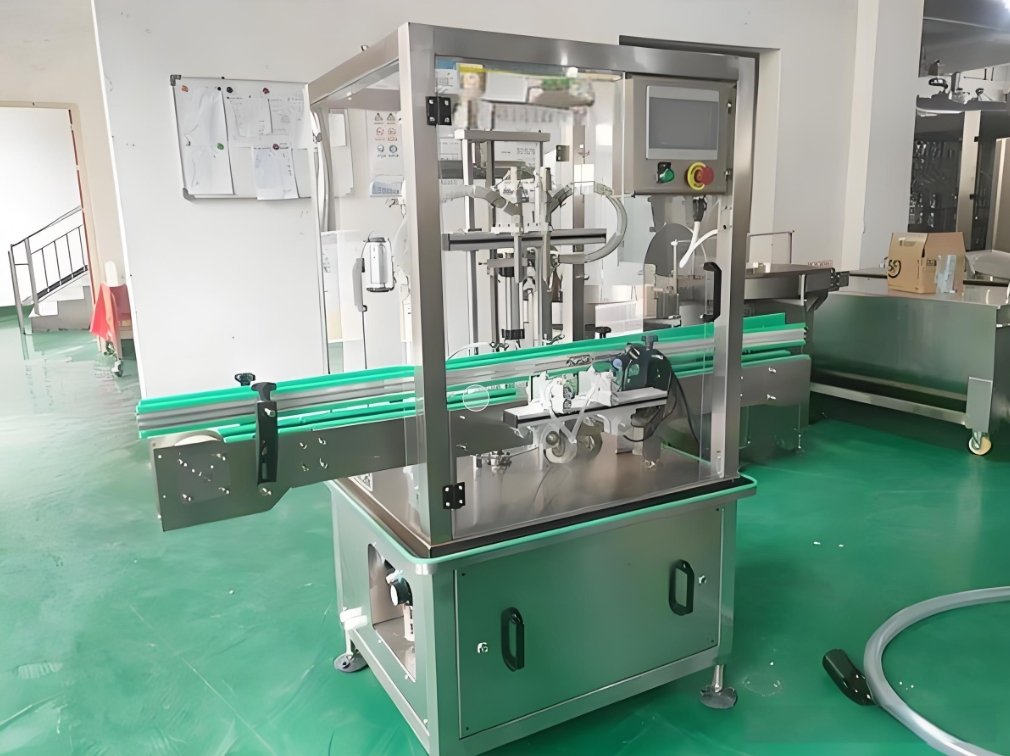
Similarly, a coffee capsule filling machine loads cups or pods, measures coffee, places lids, and seals each capsule. It is not designed for pharmaceutical two-piece capsules.
How Does a Capsule Filling Machine Work?
Although automation levels differ, capsule production generally follows these stages:
Empty capsules are loaded into a tray or capsule hopper.
Capsules are oriented in the correct direction.
The capsule caps are separated from the bodies.
The formulation is measured into the capsule bodies.
Capsule caps and bodies are rejoined.
Capsules are locked and discharged.
Finished capsules move to inspection or packaging.
Manual equipment requires an operator to complete most stages. Semi-automatic systems mechanize key operations but still require some manual handling. Fully automatic machines complete the process continuously with minimal operator involvement.
Main Types of Capsule Filling Machines
Manual Capsule Filling Machine
A manual capsule filler normally uses plates or trays that hold a specific number of capsule shells. The operator loads the capsules, separates the caps, spreads powder into the capsule bodies, tamps the formulation, closes the capsules, and removes the finished batch.
Manual capsule machines are suitable for:
Research and development
Formulation testing
Educational laboratories
Product samples
Compounding
Very small supplement batches
Businesses testing market demand
Their main advantages include:
Low initial cost
Compact size
Simple operation
Limited maintenance requirements
No complex electrical controls
However, output and fill consistency depend heavily on the operator, powder flow, tamping method, and capsule quality.
The best manual capsule filling machine should offer accurate hole alignment, rigid construction, easy powder spreading, smooth capsule release, and parts that can be cleaned properly.
It should also be designed for the exact capsule size being used. Many manual machines require separate plates or complete tooling for different capsule sizes.
For low-volume production, the best capsule filling machine should reduce capsule breakage and help the operator close each capsule correctly.
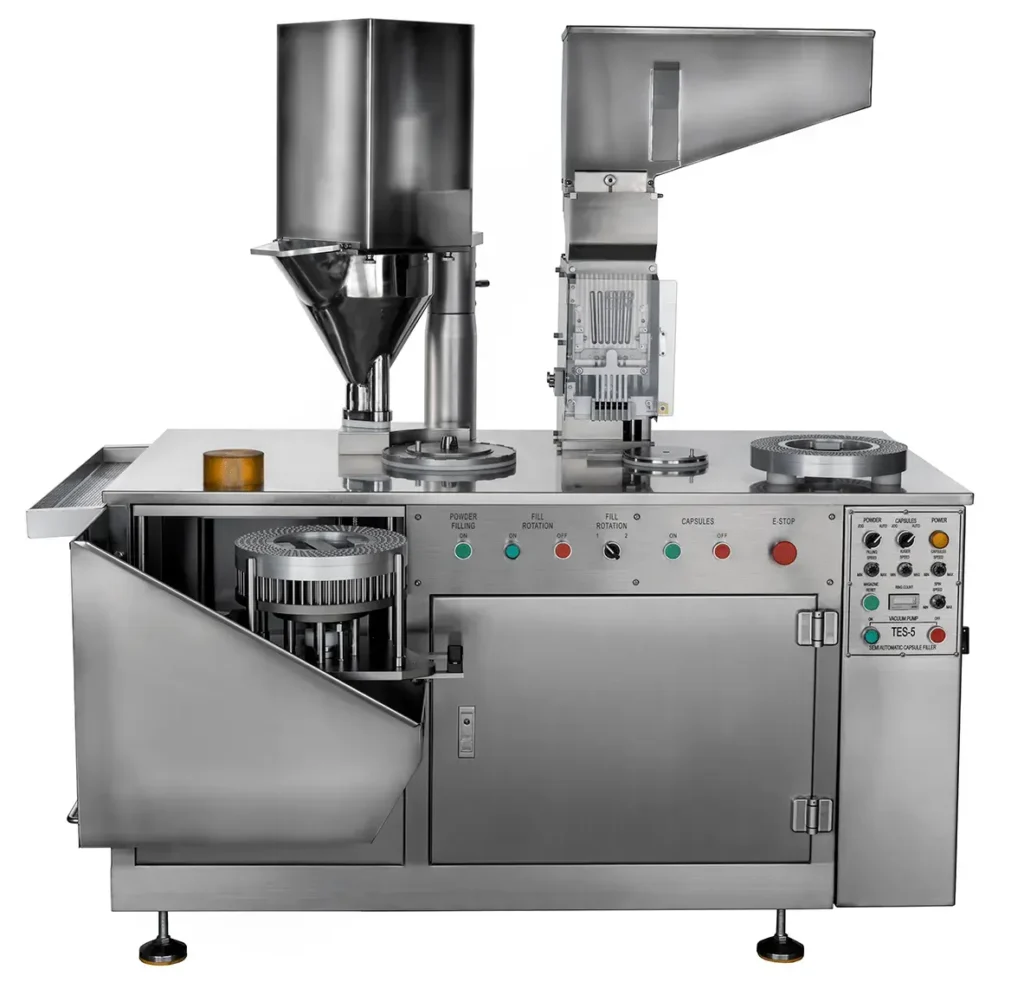
Semi-Automatic Capsule Filling Machine
Semi-automatic capsule fillers provide a middle stage between manual batch production and fully automatic manufacturing.
Depending on the machine design, it may automate:
Capsule orientation
Capsule separation
Powder dosing
Capsule closing
Capsule locking
Finished-capsule discharge
The operator may still need to transfer trays, rings, capsule holders, or finished batches between different stations.
Semi-automatic capsule fillers are normally suitable for:
Growing supplement brands
Small nutraceutical manufacturers
Medium-sized production facilities
Pharmacies with recurring production
Contract manufacturers handling smaller batches
Businesses upgrading from manual filling
These machines can improve output and consistency without requiring the investment, technical skills, and floor space associated with high-speed automatic equipment.
When comparing semi-automatic models, evaluate how much operator work remains, how quickly the machine can be cleaned, and whether the quoted output can be sustained throughout a normal shift.
For many growing businesses, the best capsule filling machine is a semi-automatic model with dependable powder feeding, accurate dosing, simple size changes, effective capsule locking, and reliable technical support.
Businesses operating at lower production volumes should also review the dedicated guide to choosing a capsule filling machine for small business.
Fully Automatic Capsule Filling Machine
A fully automatic capsule filling machine feeds, orients, separates, fills, closes, locks, rejects, and discharges capsules through a continuous indexed process.
It may also integrate with:
Capsule polishing machines
Metal detectors
Checkweighers
Capsule dedusters
Conveyors
Counting machines
Bottling systems
Blister packaging equipment
Automatic capsule filling machines are generally suitable for:
Pharmaceutical manufacturers
High-volume nutraceutical factories
Contract manufacturing facilities
Multi-shift production
Facilities requiring controlled production recipes
Integrated filling and packaging lines
The best automatic capsule filling machine should be selected after reviewing the formulation, target output, capsule sizes, fill-weight requirements, cleaning procedures, containment needs, utilities, operator experience, spare parts, and validation support.
Do not select equipment only by its maximum advertised speed. A machine may not reach its claimed output if the powder flows poorly, capsules vary in quality, changeovers take too long, or downstream packaging equipment cannot keep up.
For high-volume production, the best capsule filling machine must perform consistently across full shifts rather than only during a short factory demonstration.
Capsule Filling Machine Comparison
| Factor | Manual machine | Semi-automatic machine | Fully automatic machine |
|---|---|---|---|
| Initial investment | Lowest | Medium | Highest |
| Production output | Low | Medium | High |
| Operator involvement | High | Moderate | Low |
| Filling consistency | Operator-dependent | More controlled | Highly repeatable when configured correctly |
| Changeover complexity | Low | Moderate | Moderate to high |
| Space requirement | Small | Medium | Large |
| Maintenance skills | Basic | Intermediate | Advanced |
| Best application | Tests and small batches | Growing production | Continuous industrial production |
This table should be used only as an initial comparison. Two machines in the same category may produce very different results with cohesive powders, pellets, low-dose formulations, hygroscopic ingredients, or fragile capsule shells.
How to Choose the Best Capsule Filling Machine
1. Calculate Your Actual Production Requirements
Selecting the best capsule filling machine begins with calculating how many saleable capsules you need per hour, shift, day, and month.
Your calculation should include:
Current sales volume
Expected growth
Number of production shifts
Number of products
Average batch size
Cleaning downtime
Changeover time
Operator availability
Downstream packaging speed
Quoted machine speed is not always equal to sustainable production output.
Actual output may be reduced by:
Powder loading
Capsule loading
Machine cleaning
Tooling changes
Quality inspections
Product changeovers
Minor stops
Rejected capsules
Packaging-line limitations
Ask suppliers to demonstrate the required output using a product and capsule format reasonably similar to your intended application.
2. Test the Actual Formulation
Capsule powders can be:
Free-flowing
Cohesive
Fluffy
Abrasive
Hygroscopic
Electrostatic
Prone to separation
Difficult to compress
These characteristics influence powder feeding, dosing consistency, dust formation, tamping, product loss, and cleaning.
Provide the machine supplier with:
Product composition
Bulk density
Tapped density
Target fill weight
Particle size
Flow characteristics
Moisture sensitivity
Pellet or granule information
Cleaning requirements
A factory test using your real formulation is more valuable than a general machine video showing an easy, free-flowing powder.
3. Confirm Capsule Type and Size
Confirm whether the machine supports:
Gelatin capsules
HPMC capsules
Pullulan capsules
Other specialty capsule shells
You should also verify the capsule sizes and tooling required for each format.
A suitable machine should orient, separate, close, and discharge capsules without causing:
Broken shells
Dented capsules
Loose caps
Telescoping
Improper locking
Excessive rejects
Whenever possible, test the machine using capsules from your regular capsule supplier.
4. Evaluate Capsule Filling Accuracy
Capsule filling accuracy depends on more than the machine’s advertised tolerance.
It may be affected by:
Powder density
Powder flow
Dosing method
Operating speed
Hopper level
Tooling condition
Capsule quality
Temperature
Humidity
Operator setup
During testing, evaluate:
Average capsule fill weight
Variation between samples
Variation between dosing stations
Startup performance
End-of-batch performance
Reject percentage
Accuracy after cleaning
Accuracy at normal production speed
The machine must support your quality procedures, but it does not replace formulation development, calibration, in-process testing, and documented production controls.
5. Match the Dosing System to the Product
Capsule filling machines may use:
Tamping-pin dosing
Dosing-disc systems
Dosator systems
Auger dosing
Pellet-filling systems
Pump dosing
Specialized multi-product dosing
Ask the supplier:
Why the proposed dosing method suits your formulation
How the fill weight is adjusted
How low-dose products are handled
How high-dose products are handled
Whether powder and pellets can be combined
How dust is controlled
Which parts contact the product
Whether liquid filling requires separate tooling
The most expensive machine is not automatically the most suitable machine. The dosing technology must match the product.
6. Review Cleaning and Cross-Contamination Control
Capsule machines should provide safe access to all product-contact components and powder-collection areas.
Review:
Product-contact material
Surface finish
Component accessibility
Tool-free dismantling
Dust extraction
Dead spaces
Seal design
Cleaning time
Cleaning verification
Reassembly procedures
You should also review the detailed capsule filling machine cleaning instructions before comparing machine designs.
A lower-priced machine may become more expensive over time if every product change requires several hours of dismantling, cleaning, drying, and reassembly.
7. Evaluate Controls and Inspection Features
Depending on your production needs, useful control features may include:
Recipe storage
Password-controlled settings
Alarm history
Low-powder warnings
Low-capsule warnings
Empty-capsule detection
Capsule-separation monitoring
Vacuum monitoring
Batch counting
Production-data recording
Automatic rejection
Checkweigher integration
Metal detector integration
Only pay for features that support your actual production and quality requirements.
Automation is valuable when it reduces labor, risk, rejects, or downtime. It should not be selected only because the control panel appears advanced.
8. Check Changeover Time
A machine that supports several capsule sizes may still require significant tooling replacement and adjustment.
Ask the supplier to demonstrate a complete size change.
Review:
Number of change parts
Cost of each tooling set
Time required for changeover
Tools required
Alignment procedure
Recipe changes
Cleaning requirements
Operator training
Tooling-storage requirements
Manufacturers producing frequent small batches may benefit more from faster changeovers than from maximum production speed.
9. Confirm Installation and Utility Requirements
Before ordering, confirm that your facility can provide:
Correct voltage
Correct electrical phase
Correct frequency
Adequate compressed air
Required vacuum
Dust extraction
Temperature control
Humidity control
Suitable floor loading
Adequate machine clearance
Delivery access
Maintenance access
Network connections where required
United States buyers should specify their electrical, guarding, facility, documentation, and certification requirements before the machine is manufactured.
10. Compare Total Ownership Cost
Do not compare quotations only by purchase price.
Consider:
Tooling
Change parts
Installation
Commissioning
Shipping
Import costs
Training
Spare parts
Preventive maintenance
Cleaning labor
Product loss
Energy consumption
Compressed-air use
Downtime
Technical support
Future upgrades
The capsule filling machine price guide explains the main factors that affect the total cost of manual, semi-automatic, and fully automatic systems.
Ask each supplier to provide a written quotation showing exactly what is included and excluded.
11. Verify Manufacturer Support
Before placing an order, confirm who will provide:
Installation support
Operator training
Maintenance guidance
Warranty support
Remote troubleshooting
Replacement parts
Electrical drawings
Operating manuals
Recommended spare parts
Software support
On-site service where required
A technically suitable machine can still become a poor investment when replacement parts and technical support are not available.
Which Capsule Machine Is Best for Small Businesses?
A manual machine may be sufficient when a business is testing products, developing formulations, or producing very small batches.
Once recurring demand makes manual loading, filling, tamping, closing, and cleaning a bottleneck, a semi-automatic machine is usually the better upgrade.
The best capsule filling machine for a small but growing business should:
Be manageable for a small production team
Produce repeatable capsule weights
Support the required capsule sizes
Be easy to clean
Have affordable tooling
Fit the available floor space
Match existing utilities
Meet demand without operating continuously at maximum speed
Include practical training and technical support
Do not purchase a high-speed automatic machine until production volume, formulation, staffing, quality systems, and packaging requirements justify the investment.
Which Capsule Machine Is Best for Pharmaceutical Production?
Pharmaceutical production normally requires more than high output.
The machine must also support:
Controlled recipes
Restricted access
Documented machine settings
Suitable product-contact construction
Dust containment
Reject handling
In-process weight monitoring
Cleaning procedures
Calibration
Validation documentation
Inspection-system integration
Reliable spare-parts access
For technical specifications, available configurations, machine videos, and quotation information, review the industrial capsule filling machine product page.
Common Capsule Filling Machine Buying Mistakes
Avoid these common purchasing errors:
Selecting equipment only by advertised speed.
Testing the machine with an easy powder instead of the real formulation.
Assuming one tooling set supports every capsule size.
Ignoring cleaning and cross-contamination control.
Buying a manual machine for confirmed high-volume demand.
Buying full automation before production demand is stable.
Failing to verify utilities and electrical requirements.
Ignoring tooling, freight, installation, and spare-parts costs.
Failing to consider downstream packaging speed.
Choosing a supplier without dependable technical support.
Buyers should also review the guide covering common capsule filling machine problems before making a final decision. Understanding common faults helps evaluate machine design, maintenance access, spare-parts requirements, and operator training.
Capsule Filling Machine Buyer’s Checklist
Provide the following information when requesting a quotation:
Product type
Industry
Formulation
Powder bulk density
Powder flow characteristics
Target capsule weight
Acceptable weight variation
Capsule material
Required capsule sizes
Required hourly output
Number of products
Changeover frequency
Cleaning requirements
Containment requirements
Available utilities
Available floor space
Required inspection equipment
Downstream packaging equipment
Destination country
Documentation requirements
Installation expectations
Training requirements
Spare-parts requirements
This information allows manufacturers to recommend an application-specific machine rather than offering a generic model.
It also gives each supplier the same technical information needed to explain why its proposed system is the best capsule filling machine for your production requirements.
Frequently Asked Questions
What is the best capsule filling machine for beginners?
A manual filler is usually suitable for laboratory work, learning, and very small batches. A semi-automatic machine is more appropriate when the business already has recurring commercial demand.
The best capsule filling machine for a beginner should match the next realistic stage of production without introducing unnecessary cost and complexity.
What is the best manual capsule filling machine?
Choose a rigid and accurately aligned machine designed for your required capsule size. It should separate capsule shells cleanly, support even powder spreading and tamping, close capsules without damage, and allow easy cleaning.
What is the best automatic capsule filling machine?
The best automatic capsule filling machine is one proven with your actual formulation, capsule size, target dose, normal production speed, and quality requirements.
It should also include suitable controls, safety systems, tooling, documentation, spare parts, and after-sales support.
Can one capsule machine fill different capsule sizes?
Yes. Many semi-automatic and automatic machines support multiple sizes, but separate tooling or change parts are normally required.
Confirm the supported size range, tooling cost, and changeover process before ordering.
Can capsule filling machines process powders, granules and pellets?
Some machines can handle several material types, but the correct dosing system and tooling are essential.
A machine configured for free-flowing powder may not perform correctly with pellets, sticky powders, low-dose formulations, or liquid materials.
How accurate is a capsule filling machine?
Accuracy depends on machine design, dosing method, formulation behavior, capsule quality, tooling condition, environmental conditions, calibration, and production speed.
Request a documented test using your material instead of relying only on a brochure specification.
Is a coffee capsule machine the same as a pharmaceutical capsule filler?
No. Coffee capsule machines fill and seal cups or pods. Pharmaceutical and supplement capsule machines fill two-piece capsule shells and lock the cap to the body.
How should a capsule filling machine be maintained?
Follow the manufacturer’s cleaning, inspection, lubrication, calibration, and replacement schedule.
Product-contact components should be cleaned through an approved process after production and between products that could create contamination or compatibility risks.
Get a Capsule Filling Machine Recommendation
The best capsule filling machine is not automatically the fastest or least expensive option. It is the machine that can process your formulation, achieve the required fill accuracy, meet production demand, support proper cleaning, fit your facility, and remain serviceable throughout its operating life.
Foshan Popper Machinery provides capsule filling and integrated packaging solutions for laboratories, supplement manufacturers, pharmaceutical facilities, and industrial production lines.
To receive an appropriate machine recommendation, provide:
Formulation details
Capsule size
Capsule material
Target fill weight
Required output
Destination country
Facility utilities
Preferred automation level
Cleaning requirements
Inspection requirements
Contact the technical team to discuss product testing, machine configuration, installation support, operator training, spare parts, and a complete quotation.