Quick Answer: Filling Machine Price Ranges in 2026
A filling machine costs between $500 and $150,000+, depending on automation level, machine type, production speed, and material specifications. Here is a fast reference:
| Automation Level | Price Range | Typical Output |
| Desktop (manual) | $500 – $1,500 | 5–20 containers/min |
| Semi-automatic | $1,500 – $15,000 | 20–60 containers/min |
| Automatic | $8,000 – $80,000+ | 60–300+ containers/min |
| Complete filling line | $25,000 – $150,000+ | Full-line production |
The sections below explain what drives those numbers and how to identify which machine fits your operation without overpaying or under-specifying.
Filling Machine Prices by Type
Not all filling machines are priced equally. The product you are filling its viscosity, density, particle size, and regulatory requirements determines the technology you need, which in turn sets the price floor. For a full overview of machine categories and how each one works, see our guide to automatic filling machine types and working principles.
Liquid Filling Machines ($1,500 – $60,000+)
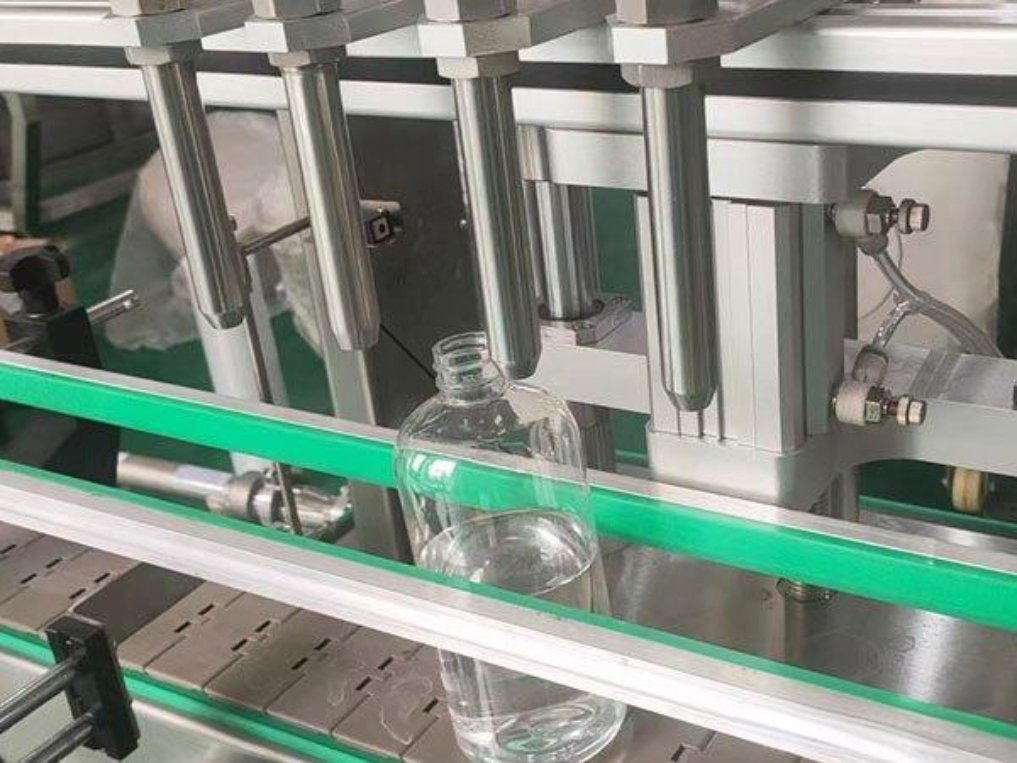
Liquid filling machines handle water, oils, beverages, sauces, cleaning chemicals, and pharmaceutical liquids. The technology used to move the liquid matters significantly for both accuracy and cost:
- Gravity fillers are the most affordable option, suited for thin, free-flowing liquids. Expect to pay $1,500 – $5,000 for a semi-automatic unit.
- Piston fillers provide volumetric precision and handle a wider viscosity range, including thicker products like honey or gel. Semi-automatic piston fillers start at around $3,000; automatic multi-head units reach $30,000 – $60,000+. See our comparison of viscous liquid filling machine best practices for product-specific guidance.
- Overflow fillers fill containers to a consistent visible level, making them popular for transparent bottles in the cosmetics and beverage industries. Pricing is similar to piston fillers.
- Pump fillers (peristaltic or gear pump) are used for corrosive chemicals, pharmaceutical liquids, or highly viscous products requiring sanitary handling. These are among the most expensive, typically $8,000 – $60,000+.
Fill accuracy across these technologies is generally ±0.5%, though pharma-grade machines achieve ±0.1%.
For a side-by-side breakdown of which technology suits your product, read our guide to comparing different types of liquid filling machines. If you are evaluating options for a growing operation, our roundup of the top 10 liquid filling machines for small and medium businesses covers the most practical models across price tiers.
Industry-specific liquid filling applications:
- Beverage production: Beverage can filling machines handle carbonated and non-carbonated drinks. For a deeper look at how filling technology is reshaping this sector, read the role of filling machines in the beverage industry.
- Sauce and condiment filling: Sauce filling machines are designed for high-viscosity, particulate-heavy products.
- Wine bottling: Wine filling machines handle inert gas purging and gentle product handling to preserve quality.
- Bottle production lines: Bottle filling machines are available in a wide range of configurations for glass, PET, and HDPE containers.
Powder Filling Machines ($2,000 – $70,000+)
Powder filling equipment uses auger or net-weight technology to fill bags, bottles, cans, and pouches with dry bulk materials such as spices, flour, protein powders, pharmaceutical APIs, and pesticides.
- Auger fillers measure product by volume via a rotating screw and are the most common configuration for fine, free-flowing powders. Entry-level semi-automatic models start at $2,000 – $6,000; automatic multi-lane systems reach $40,000 – $70,000.
- Net-weight fillers use load cells to fill by mass rather than volume essential for dense or variable-density powders where volumetric accuracy is insufficient. These command a price premium of 20–40% over equivalent auger systems.
Compared with similar liquid filling systems, these machines are often more expensive because they require precision weight control, dust containment, and anti-bridging mechanisms. For a comprehensive purchasing framework, see our ultimate guide to choosing the right powder filling machine.
Specialty powder applications include milk powder filling machines for dairy operations, which require nitrogen flushing and hermetic sealing to preserve shelf life, and pharmaceutical powder lines that must conform to FDA Current Good Manufacturing Practice (cGMP) regulations. For businesses scaling up from manual fills, our guide to the best powder filling machines for small businesses is a practical starting point.
Granule Filling Machines ($8,000 – $80,000+)
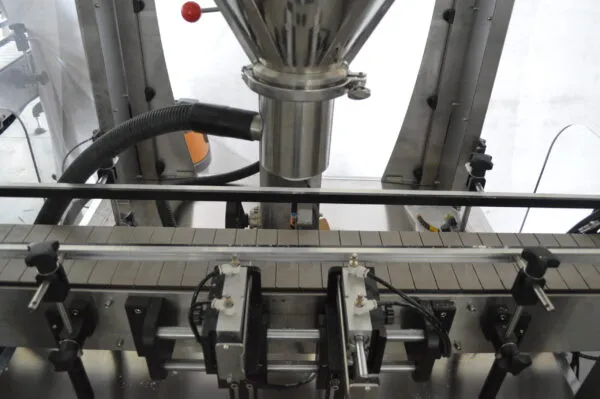
Granule filling machines handle solid particulates: nuts, seeds, coffee beans, freeze-dried fruit, pet food, hardware fasteners, and similar products. The dominant technology here is the multi head weigher (combination scale), which uses multiple vibrating hoppers and load cells to achieve extremely fast and accurate fills. For an in-depth look at this technology, see our article on granule filling machine precision and efficiency.
- Entry-level single-head or linear weighers start at $8,000 – $15,000.
- 10-head and 14-head combination weighers capable of 60–120 packs/min typically cost $25,000 – $60,000.
- High-speed 32-head systems for snack or fresh produce lines can reach $80,000+.
Fill accuracy for multihead weighers is typically ±0.5g or better difficult to match with volumetric methods at high throughput.
Coffee capsule production is a specialized subset of granule filling. Coffee capsule filling machines must combine accurate dose control with hermetic lid sealing and modified atmosphere packaging (MAP), placing them in a higher price bracket than standard granule fillers.
Desktop Filling Machines ($500 – $1,500)
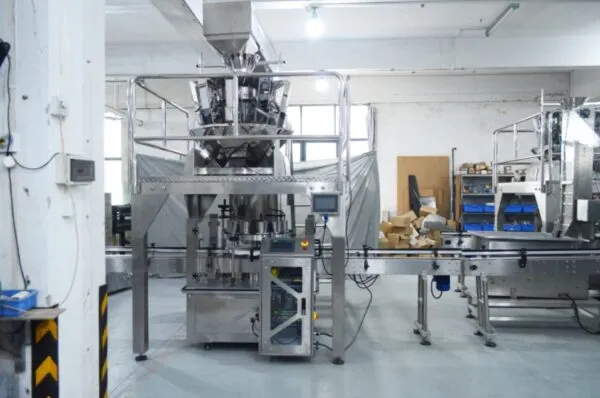
Desktop filling machines are compact, manually operated units designed for very low-volume production sampling, artisan production, or early-stage startups testing product-market fit. They are not suitable for scaling beyond 20 containers per minute and offer lower accuracy (±1–2%) than automated counterparts.
If your operation is growing beyond 500 units per day, a semi-automatic machine will deliver faster ROI than running multiple desktop units. Our guide to filling machines for small businesses walks through the upgrade decision in detail.
What Factors Drive Filling Machine Cost?
Understanding what you are paying for prevents costly misspecification either overspending on features you do not need or underspending on a machine that cannot meet your regulatory or production requirements. For a full discussion of how automation choices affect your production line, see our article on filling machine automation: benefits and challenges.
1. Automation Level
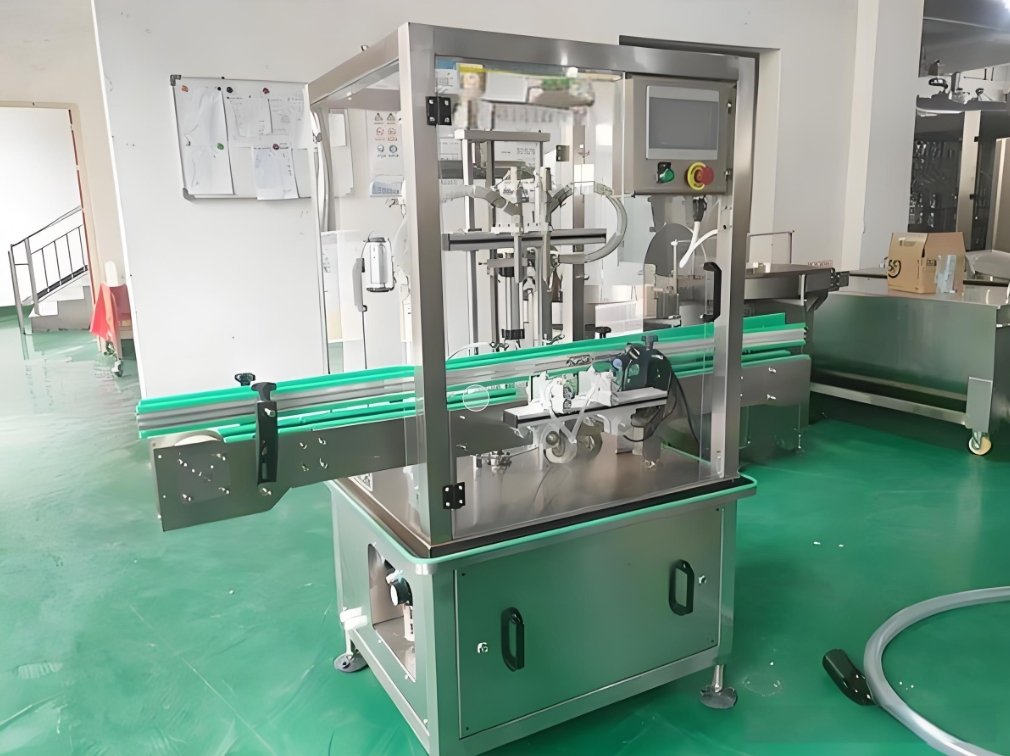
This is the largest single cost driver. Manual and semi-automatic machines rely on the operator to position containers, initiate fills, and move product. Automatic machines use conveyors, sensors, and PLC logic to handle all of that without human intervention. Each step up in automation increases capital cost but reduces per-unit labor cost. Browse the full range of automatic filling machine solutions to compare configurations.
2. Number of Filling Heads
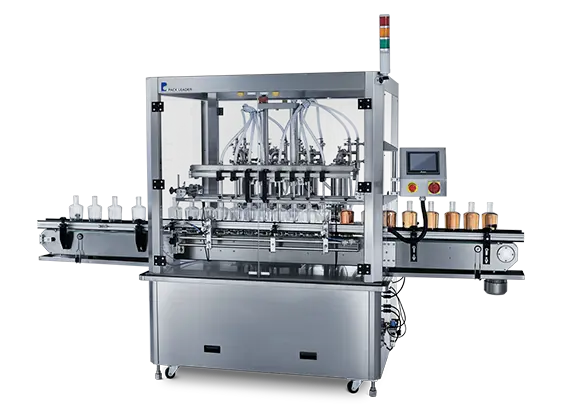
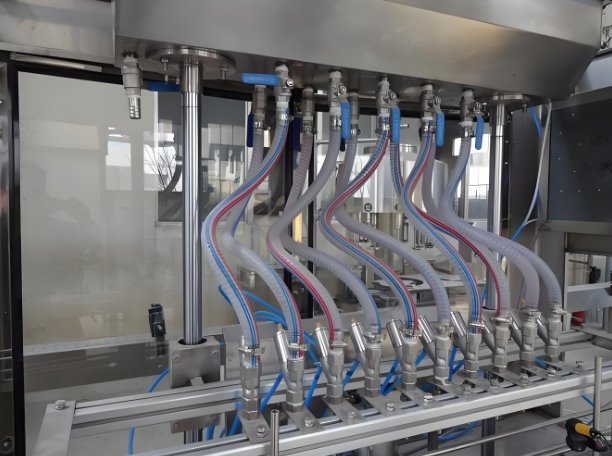
A single-head machine fills one container at a time. A 4-head machine fills four simultaneously. More heads mean higher throughput but also more valves, nozzles, sensors, and calibration complexity all of which add cost. Most automatic liquid fillers are sold in 2-, 4-, 6-, 8-, 12-, and 16-head configurations.
3. Material Specification
The two most common grades are:
- 304 stainless steel: Industry standard for food and beverage contact surfaces. Corrosion-resistant under normal conditions.
- 316L stainless steel: Required for pharmaceutical, chemical, and high-acid applications. Contains molybdenum for superior corrosion resistance. Adds approximately 10–20% to machine cost.
4. Control System and Sensors
Basic machines use mechanical timers or simple pneumatic controls. Mid-range and high-end machines use PLC (Programmable Logic Controller) systems with HMI touchscreens. PLC control allows recipe storage, fill parameter adjustments without tools, integration with upstream and downstream equipment, and production data logging all of which support GMP compliance. To understand how sensing technology affects fill precision, read how sensors enhance filling machine performance.
5. Certifications and Compliance
Machines sold into regulated industries must carry relevant certifications:
- CE marking (required for European markets)
- FDA 21 CFR Part 11 compliance (pharmaceutical data integrity) see our overview of FDA regulations for pharmaceutical filling machines
- GMP (Good Manufacturing Practice) design standards
- ATEX certification (for explosive dust or solvent environments)
- Food industry compliance see compliance standards for filling machines in the food industry
Certified machines cost more because they require engineering documentation, third-party testing, and design modifications. Attempting to retrofit compliance after purchase is far more expensive than buying the right machine initially. The PMMI (Packaging Machinery Manufacturers Institute) publishes useful benchmarks on regulatory requirements by market and industry.
6. Customization
Standard catalog machines fit most applications. Custom machines non-standard container shapes, unusual product viscosities, integrated checkweighers, vision systems for fill verification, or clean-in-place (CIP) systems add 15–40% to base machine cost. Request a quotation for custom builds rather than relying on list prices.
Understanding a Complete Filling Line
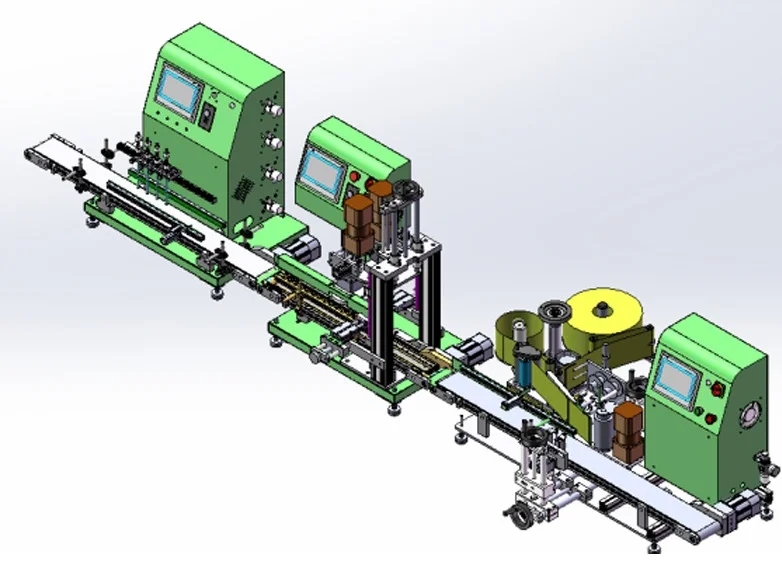
Most production facilities need more than a filling machine. A complete line integrates:
- Filling machine the core unit
- Capping machines sealing the container after fill. Options include roller capping machines, servo capping machines, high-speed capping machines, and can seaming machines for canned products. For a full introduction to sealing technology, see what is a capping machine: a comprehensive guide.
- Labeling machines applying product labels. Common configurations include single-side, two-side, top and bottom, and round bottle labeling machines. Learn more in our guide to how labeling machines work.
- Packaging machines secondary packaging equipment including shrink wrap machines, carton packaging machines, paper box packaging machines, and palletizing systems.
A complete line costs $25,000 to $150,000+, depending on product type, throughput, and integration complexity. For facilities mixing liquids before filling, liquid mixer and homogenizer machines are often purchased alongside filling equipment as part of a single procurement.
Hidden and Total Ownership Costs
The machine purchase price is only part of your total investment. Budget for:
| Cost Category | Typical Range |
| International shipping | $800 – $3,000 |
| Import duties / tariffs | Varies by country |
| Installation & commissioning | $1,500 – $5,000 |
| Operator training | $500 – $2,000 |
| Spare parts (first year) | $200 – $1,500 |
| Air compressor (if required) | $500 – $3,000 |
| Electrical upgrades | $0 – $2,000 |
In total, installation and logistics typically add 20–35% to the purchase price. Always request an ex-works (EXW) vs. delivered duty paid (DDP) comparison from your supplier to understand the full landed cost before committing. Long-term, running costs can be reduced significantly through planned maintenance see how to create an effective filling machine maintenance schedule and best practices for energy efficiency in filling machines.
Filling Machine Prices by Region
Global sourcing significantly affects price.
China manufactures the majority of the world’s filling machines, particularly in the Guangdong, Zhejiang, and Jiangsu provinces. Chinese machines are typically 30–60% less expensive than European or American equivalents. Quality ranges widely established manufacturers with CE certification and verifiable export histories offer strong value, while the cheapest options may use inferior components and lack documentation.
Europe (Germany, Italy) produces premium machines with strict compliance documentation, longer service lifespans, and strong after-sales support networks. Best for pharmaceutical, food, and cosmetic producers who require certified traceability.
United States domestic manufacturers offer shorter lead times, easier service access, and compliance with FDA and OSHA standards. Prices are comparable to European machines.
According to the PMMI’s State of the Industry Report, global packaging machinery demand continues to grow, with Asia-Pacific production particularly China holding the largest share of global output due to competitive manufacturing costs and expanding capacity. The Grand View Research Liquid Filling Machines Market Report similarly identifies cost efficiency as the primary driver of Chinese market dominance in this segment.
Return on Investment (ROI) Analysis
ROI on a filling machine depends on three variables: labor savings, throughput increase, and waste reduction. For a detailed breakdown of how filling equipment affects your overall production efficiency, see how filling machines improve production efficiency.
Example calculation semi-automatic upgrade:
A food manufacturer filling 800 units/day manually with two operators at $18/hour (8-hour shift) spends approximately $288/day in direct labor, or $74,880/year.
After purchasing a $6,500 semi-automatic filler, one operator manages the same output in 5 hours:
- Annual labor cost: $46,800 (reduction of ~$28,000)
- Machine cost recovered: approximately 5.6 months
- Additional gains: reduced product giveaway (overfilling), lower rejection rates, improved consistency
Typical ROI timelines by machine class:
| Machine Type | Typical ROI Period |
| Semi-automatic | 4–12 months |
| Automatic | 12–24 months |
| Complete filling line | 18–36 months |
ROI is faster when replacing significant manual labor. In highly automated facilities, the ROI case shifts to quality consistency and throughput capacity rather than headcount reduction. To see how smart technology is accelerating returns even further, read exploring the future of smart filling machines.
Real-World Case Study
Scenario: A mid-sized cosmetics manufacturer producing body lotions and serums was hand-filling 400 bottles/day with three staff members, experiencing high product giveaway (average 3.5ml overfill per bottle at $0.08/ml = $112/day in lost product).
Solution: Upgraded to a 4-head automatic piston filler with PLC control and overflow detection, purchased for $6,500 from a CE-certified manufacturer.
Results after 90 days:
- Production increased to 1,200 bottles/day (same staffing)
- Product giveaway reduced to 0.4ml per bottle average
- Monthly savings: ~$2,800 (labor reallocation) + ~$2,900 (product waste)
- Full machine ROI: achieved in under 6 months
The key decision factor was choosing an overflow-capable piston filler rather than a gravity filler the thicker serum formulation required consistent pressure-driven flow that a gravity unit could not reliably provide.
How to Choose the Right Filling Machine
Work through these questions before requesting a quote. If you want a broader framework, our article on what is a filling machine: types, working principles, and applications is an excellent foundation.
- What are you filling? Liquid (thin/viscous), powder (fine/coarse), or granules/solids?
- What is your daily or hourly output target? Calculate from your sales forecast, not your current manual capacity.
- What containers are you using? Material (glass, HDPE, PET, aluminum), shape, neck diameter, and fill volume range all affect machine specification.
- What fill accuracy do you need? Food and beverage typically require ±1%; pharmaceutical ±0.1–0.5%. See understanding powder filling machine accuracy levels for detail on how this is measured and validated.
- What regulatory environment applies? CE, FDA, GMP, ATEX?
- What is your floor space and power supply? Automatic lines require 3-phase power and compressed air in most configurations.
- What is your 3-year growth plan? Buying a machine at your current capacity may mean replacing it sooner than expected. Buying a machine with headroom additional head positions, wider speed range often costs 15–20% more upfront but avoids a full replacement in 24 months.
For sector-specific guidance, explore: pharmaceutical filling machines and regulatory standards, capsule filling machine uses in the pharmaceutical industry, and tube filling and sealing machines for cosmetics and topical pharmaceuticals.
Frequently Asked Questions
What is the average cost of a filling machine?
The average price ranges from $1,500 to $30,000, depending on automation level, product type, and number of filling heads. Desktop machines start at $500; high-speed automatic lines exceed $80,000.
How much does an automatic filling machine cost?
Automatic filling machines typically cost $8,000 to $80,000+. The main variables are filling speed (containers per minute), number of heads, material specification (304 vs 316L stainless), and whether a PLC/HMI control system is included.
Why are powder filling machines more expensive than liquid filling machines?
Powder machines require precision auger or load-cell weight systems, dust containment enclosures, anti-bridging mechanisms, and more complex calibration procedures. Variable product density which affects volumetric accuracy also means more expensive weight-based control systems are often necessary.
What does a complete filling line cost?
A complete filling line integrating filling, capping, labeling, and inspection systems typically costs $25,000 to $150,000+, depending on product type, throughput, and integration complexity.
How long does a filling machine last?
A well-maintained filling machine has an operational lifespan of 8–15 years. Machines with stainless steel frames, branded PLC components (Siemens, Allen-Bradley), and accessible spare parts availability tend to last longest and carry the lowest lifetime maintenance cost. To protect your investment, follow our filling machine maintenance schedule guide and learn how to address common filling machine problems before they cause downtime.
Is it cheaper to buy a filling machine from China?
Yes, by a significant margin typically 30–60% less than equivalent European or American machines. Savings are real, but due diligence matters: verify CE certification, request a factory audit or third-party inspection report, and confirm spare parts availability in your region before purchasing.
What factors affect filling machine price the most?
In order of impact: automation level, number of filling heads, material specification (304 vs 316L), control system complexity, required certifications, and degree of customization.
Do filling machine prices include shipping and installation?
Most manufacturers quote ex-works (EXW) pricing, meaning the price covers the machine at their factory. Shipping, import duties, installation, and training are additional. Always request a total landed cost estimate before comparing quotes from different suppliers.
What is the cheapest type of filling machine?
Desktop filling machines start at around $500 and are the most affordable entry point. They are appropriate for startups, artisan producers, or sampling operations but are not practical for consistent production above 20 containers per minute.
Get a Custom Filling Machine Quote
Every production line has unique requirements. Contact our engineering team with your product type, container specifications, and daily output target and we will provide a tailored machine recommendation with exact pricing within 24 hours. You can also explore our full filling machine catalog for an overview of available configurations.