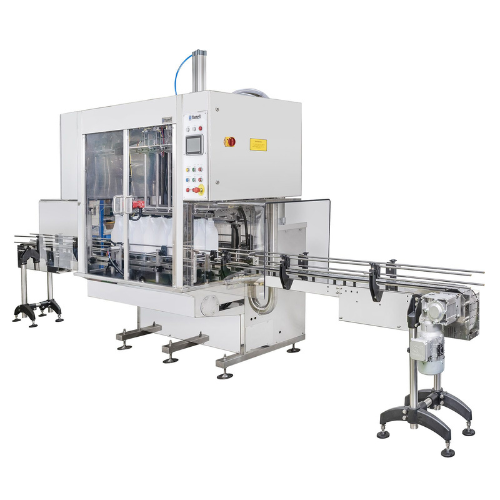
Choosing the right filling machine for your industry is one of the most consequential equipment decisions a production manager makes. Get it right and your output, compliance record, and cost-per-unit align with your growth plan. Get it wrong and you have a machine that battles your product every single shift, poor fill accuracy, excess waste, cleaning problems, and regulatory risk.
The core issue is that filling machines are not interchangeable across industries. A food processing filling machine configured for thin beverages will fail on a thick cosmetic cream. A pharmaceutical filling machine built for GMP compliance has engineering requirements that a standard industrial filler cannot meet. The product type, viscosity, regulatory environment, and required fill accuracy are different in every sector, and so is the machine.
This guide breaks down the top five industries that depend on filling machines, explains exactly what makes each industry’s requirements unique, identifies the right machine type for each application, and gives you the buying considerations that matter for each sector. Whether you are in food, pharma, cosmetics, chemicals, or nutraceuticals, the right answer for your industry is here.
For a full technical overview of how different filling machine types work, see our complete guide to automatic filling machine types and working processes.
Why Industrial Filling Machine Applications Differ by Sector
A filling machine that works perfectly in one industry can fail completely in another, not because of build quality, but because it was not designed for those specific product properties.
Every industry presents a different combination of challenges: product viscosity and density, particle size for dry products, sensitivity to contamination, required fill accuracy, regulatory compliance standards, and the cleaning procedures required between production runs. Industrial filling machine applications must be engineered to match all of these factors simultaneously, not just the container size and fill volume.
This is why industry-specific machine selection is the first and most important step in any filling line investment.
Industry 1: Food and Beverage
Why food processing filling machines are essential
Food and beverage is the largest sector for filling machine demand globally. According to Grand View Research, it accounts for more than 50% of total packaging machinery demand worldwide, and the food processing filling machine sits at the center of every production line in this sector.
The scale of food production makes manual filling economically impossible above a very modest volume. A beverage factory running three shifts cannot hand-fill 300,000 bottles a day. A sauce manufacturer cannot maintain consistent fill accuracy across 50,000 jars per shift without automation. Speed, hygiene compliance, and consistency at FMCG production line volumes require dedicated filling equipment.
Food-grade requirements add significant engineering complexity. Every surface that contacts the product must meet FDA or EU food safety standards. Machines must support clean-in-place (CIP) operation to prevent cross-contamination between production runs. Food-grade silicone seals, sanitary tri-clamp fittings, and 304 or 316L stainless steel contact parts are baseline requirements, not upgrades.
Best filling machines for food and beverage
The right food processing filling machine depends entirely on the product’s viscosity and physical state. Thin free-flowing liquids, water, juice, spirits, use gravity or overflow fillers running at high speed. Medium-viscosity products, syrups, dressings, cooking oil, use piston fillers achieving ±0.5% accuracy. Thick viscous products tomato paste, chili sauce, peanut butter, require a purpose-built sauce filling machine with a servo-driven piston and heated product contact parts to maintain viscosity and fill consistency.
Dry food products, coffee, nuts, seeds, pet food; use a granule filling machine with a multihead combination weigher delivering ±0.5g accuracy at 40 to 120 bags per minute.
For the full range of liquid filling machine configurations covering gravity, piston, peristaltic, and overflow technologies, our product range covers 4-head entry systems to 32-head high-speed rotary lines.
Use cases: Bottled water, carbonated beverages, fruit juice, cooking oil, sauces, jam, honey, coffee, confectionery, dry snacks, pet food.
Industry 2: Pharmaceutical and Healthcare
Why pharmaceutical filling machines have unique requirements
No industrial filling machine application demands greater precision than pharmaceutical production. An underfilled capsule is a dosing failure. An overfilled vial is a safety event. A contaminated batch is a regulatory catastrophe. The tolerance for error is measured in milligrams, and the consequences of exceeding it extend to patient safety and regulatory liability, not just production cost.
GMP filling machine pharmaceutical requirements go far beyond standard industrial specifications. Contact parts must be 316L stainless steel, not 304, which is insufficient for pharmaceutical-grade cleaning validation. Machines must support full IQ/OQ/PQ validation documentation. Clean-room compatibility, closed product pathways, and 100% in-process weight checking are standard requirements. Every fill must be traceable and auditable.
This is a fundamentally different engineering context from food or industrial filling, and it demands a machine built specifically for it.
Best filling machines for pharmaceutical
A GMP filling machine pharmaceutical-grade powder system uses a servo-driven auger with ±0.3% fill accuracy, 316L stainless steel wetted parts, and integrated weight rejection. Our powder filling machine range includes models validated for pharmaceutical powder applications including APIs, excipient blends, and dry inhaler formulations.
For encapsulated products, an automatic capsule filling machine handles capsule separation, powder dosing, tamping, and closure at 15,000 to 200,000 capsules per hour with integrated weight checking and auto-rejection.
For liquid pharmaceuticals, oral solutions, eye drops, injectable preparations, a peristaltic pump filler is the correct technology. The product never contacts the pump mechanism itself, eliminating contamination risk and enabling rapid, verifiable sanitation between batches.
Use cases: Capsule filling, tablet coating, powder sachets, liquid medications, eye drops, injectable vials, topical creams, oral rehydration solutions.
Industry 3: Cosmetics and Personal Care
Why cosmetic filling machines need viscosity versatility
The cosmetics industry presents a combination of challenges that is unique among filling machine for industry applications: an exceptionally wide viscosity range across a single product portfolio, high retail presentation standards, frequent new product launches requiring fast changeover, and strong regulatory requirements for labeling and hygiene.
A cosmetics brand may need to fill water-thin toner at 1–2 cP, medium-viscosity body wash at 500–2,000 cP, and thick face cream at 50,000+ cP, often on the same production line in different shifts. No single standard filler handles that viscosity range. The cosmetic filling machine must be specified to the specific product segment it will run, not to the brand’s full portfolio.
Retail presentation standards add another requirement. For products sold in transparent or translucent containers, the fill level must be visually consistent across every unit on the shelf, because an inconsistent fill level reads as a defect to the consumer even if the volume is technically correct.
Best filling machines for cosmetics
Overflow fillers maintain a consistent visible fill level regardless of minor container volume variation, the standard choice for thin to medium-viscosity cosmetic liquids in transparent packaging. Piston fillers with a temperature-controlled heated hopper handle thick creams, gels, and emulsions that would become too viscous to dispense accurately at room temperature.
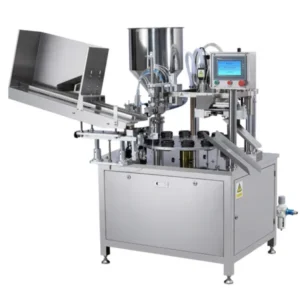
For products packaged in tubes, creams, ointments, gels, toothpaste; a tube sealing and filling machine fills and hermetically seals each tube in one automatic cycle at 20 to 120 tubes per minute.
Cosmetics production lines typically combine the filling machine with a downstream labeling machine to produce fully labeled, filled, and sealed products in a single integrated pass, reducing handling, reducing contamination risk, and increasing throughput.
Use cases: Toner, serum, shampoo, conditioner, body wash, face wash, moisturizer, foundation, sunscreen, lip gloss, hand cream, toothpaste, eye cream, hair gel.
Industry 4: Chemical and Industrial
Why chemical liquid filling machines have the strictest material requirements
Chemical filling machine for industry applications are arguably the most demanding environment any filling system operates in. Products are frequently corrosive, abrasive, flammable, or toxic, and contact with incorrect machine materials causes seal failure, contamination, equipment damage, or serious safety incidents.
A chemical liquid filling machine must use corrosion-resistant materials throughout: 316L stainless steel or PTFE-lined product contact parts, explosion-proof electrical enclosures for flammable products, and chemical-resistant seals rated for the specific product being filled. These are not options, they are the baseline specification for this sector.
Fill accuracy also directly protects margin in chemical applications. Chemical products are expensive per litre, and consistent fills across high-volume production runs translate into measurable cost savings. A consistent ±0.5% fill accuracy on a 5,000-litre production run saves more product than the equivalent figure suggests.
Best filling machines for chemical and industrial
A servo-driven piston filler with PTFE-lined cylinder and chemical-resistant seals handles medium to high-viscosity chemicals, adhesives, lubricants, paint, resin, with accurate, repeatable fills. For aggressive acids, solvents, and reactive liquids, a peristaltic pump filler is the safest configuration: only the replaceable tubing contacts the product, eliminating corrosion risk and making product changeover fast and verifiable.
For chemical powders, detergent powder, agricultural chemicals, cement additives, a robust powder filling machin with dust-rated enclosures and stainless steel contact parts handles aggressive products safely at production volumes.
Use cases: Lubricating oil, motor oil, industrial cleaner, detergent, paint, adhesive, agricultural chemicals, fertilizer, battery acid, solvent, resin, polymer granules.
Industry 5: Nutraceuticals and Supplements
Why nutraceutical filling machines sit between food and pharma requirements
The nutraceutical industry has grown rapidly and with it, demand for filling machines that meet a dual compliance standard: food-grade hygiene requirements for products consumed directly, combined with pharmaceutical-grade accuracy requirements for products making health claims. This hybrid regulatory environment makes nutraceutical production one of the most technically demanding filling machine for industry applications available.
Supplement products also present specific physical challenges that standard industrial fillers are not designed for. Protein powders are sticky and prone to bridging in hoppers. Pre-workout formulas contain hygroscopic ingredients that absorb moisture and change density between batches. Probiotic capsules are temperature-sensitive. These properties require machines with active agitation, temperature-controlled product zones, and closed product pathways.
Best filling machines for nutraceuticals
For supplement powders, protein, pre-workout, collagen, greens powder, creatine, a servo-driven auger powder filling machine with an agitator hopper delivers ±0.5% fill accuracy across the variable density and cohesiveness that characterizes this product category. Agitation prevents bridging; servo drive maintains fill weight consistency across shifts.
For encapsulated supplements, vitamins, minerals, probiotics, herbal extracts; an automatic capsule filling machine with integrated weight checking handles both powder and pellet fills with full audit trail capability for GMP certification compliance.
For liquid supplements and wellness shots, a piston or peristaltic liquid filling machine with food-grade contact surfaces and easy-clean nozzle design handles viscous and sensitive formulations without cross-contamination risk between batches.
Use cases: Protein powder, pre-workout supplements, multivitamins, fish oil capsules, probiotics, collagen powder, herbal supplements, wellness shots, greens powder.
Industry vs Machine Type: Quick Reference Table
| Industry | Primary Machine | Key Requirement | Compliance Standard |
|---|---|---|---|
| Food & Beverage | Food processing filling machine (gravity / piston / overflow) | CIP, food-grade contact, high speed | FDA / EU food safety |
| Pharmaceutical | GMP filling machine (powder / capsule / peristaltic) | 316L SS, validation documentation | GMP / IQ OQ PQ |
| Cosmetics | Overflow filler, paste filler, tube filler | Consistent fill level, viscosity range | EU Cosmetics Regulation |
| Chemical & Industrial | Chemical liquid filling machine (piston / peristaltic) | Corrosion resistance, explosion-proof | ATEX / OSHA |
| Nutraceuticals | Auger powder filler, capsule filler | Agitation, hygroscopic product handling | GMP / food-pharma hybrid |
Buying Considerations by Industry
Define your regulatory compliance requirement before contacting any supplier. The single most expensive mistake in industrial filling machine applications is purchasing a standard machine for a regulated application. A food processing filling machine that lacks CIP capability cannot meet EU food safety audits. A pharmaceutical filling machine without IQ/OQ/PQ documentation cannot be validated for GMP certification. State your compliance requirements in the first conversation with every supplier.
Match the machine’s contact material to your product’s chemical properties. Food applications need 304 stainless steel minimum. Pharmaceutical and chemical applications require 316L stainless steel or PTFE lining. Cosmetic applications need food-grade silicone seals and corrosion resistance for acidic formulations. Contact material is not an aesthetic choice, it is a product safety and machine longevity decision.
Calculate required output from real shift data, not wish-list targets. Divide your required daily unit output by available production minutes per shift. Add 20% buffer. That is your minimum machine speed specification. In our experience supplying filling machines to nutraceutical and food factories across Southeast Asia, Europe, and the Middle East, the most common and costly specification mistake is over-specifying speed and under-specifying fill accuracy, especially in pharmaceutical and supplement applications where accuracy matters more than throughput.
Changeover time is a hidden cost in multi-SKU production. A PLC-controlled machine with stored product recipes changes between container sizes in 5 to 15 minutes. A manually adjusted machine takes 30 to 60 minutes and introduces operator error. For cosmetics brands with 10+ SKUs or supplement businesses launching new products regularly, the changeover time difference justifies the PLC premium within the first production quarter.
Source from a direct manufacturer with industry-specific references. Ask any supplier for references in your specific industry, not general client lists. A manufacturer who has supplied GMP filling machines to pharmaceutical factories has different engineering capability than one who has not, even if the machines look identical in a catalog. Request a video trial of your product running on the machine before committing to any order.
For a full breakdown of investment costs across all five industries, see our complete filling machine cost and pricing guide.
2026 Trends Shaping Industrial Filling Machine Applications
Servo-driven systems are now the standard, not the premium. Servo motors deliver better fill accuracy, faster changeover, lower energy consumption, and quieter operation than pneumatic drives. Machines that were servo-only at high price points two years ago are now available across mid-range configurations in food, cosmetics, and nutraceutical applications.
Integrated production lines are replacing single-machine purchasing. The fastest-growing segment across all five industries is the complete integrated line, filling, capping, labeling, and packaging from one manufacturer on one shared conveyor. Integrated systems eliminate speed mismatches, simplify commissioning, and reduce after-sales support to a single contact.
GMP-grade filling machines are expanding beyond pharma. Nutraceutical and premium food brands are increasingly specifying GMP certification and validation capability even where it is not legally required, because retail buyers and contract manufacturers increasingly demand it as a quality signal. This trend is accelerating in the supplement and functional food sectors.
Frequently Asked Questions
What industries use filling machines most?
Food and beverage is the largest sector, accounting for over 50% of global filling machine demand. Pharmaceutical, cosmetics, chemical, and nutraceutical industries also rely heavily on industry-specific filling machines. Each sector requires different machine configurations based on product viscosity, regulatory standards, and required fill accuracy.
Which filling machine is used in the food industry
The food processing filling machine type depends on the specific product. Thin liquids use gravity or overflow fillers. Medium-viscosity products use piston fillers. Thick products like sauces and pastes use servo-driven piston fillers with heated hoppers. Dry food products use granule filling machines with multihead weighers. All food-industry machines must use food-grade contact surfaces and support CIP cleaning.
What are the pharmaceutical filling machine requirements?
A GMP filling machine for pharmaceutical applications requires 316L stainless steel contact parts, IQ/OQ/PQ validation documentation, clean-room compatibility, and integrated in-process weight checking with automatic rejection. CE marking is required for European markets. FDA-compliant materials are required for US applications. Standard industrial fillers cannot be validated for pharmaceutical production regardless of price.
What is a cosmetic cream filling machine?
A cosmetic cream filling machine is a piston or gear-pump filler configured specifically for high-viscosity emulsions, face creams, body butters, hair masks, and thick gels. It uses a temperature-controlled heated hopper to maintain product viscosity during filling, a slow-speed dispensing head to prevent air entrainment, and a diving nozzle to fill from the bottom up and avoid foaming or splashing.
How are filling machines used in manufacturing?
Filling machines automate the process of measuring and dispensing a product — liquid, powder, paste, or granule — into a container at consistent volume or weight. In manufacturing, they replace manual filling to achieve higher speed, better accuracy, lower labor cost, and compliance with food or pharmaceutical hygiene standards. They integrate with upstream and downstream equipment, mixers, cappers, labelers, on a shared production line.
Can one filling machine work across multiple industries?
Rarely. Each industry has different product properties, compliance requirements, and contact material standards that require purpose-built machine configurations. A food processing filling machine can sometimes handle cosmetic liquids of similar viscosity, but a pharmaceutical filling machine requires validation capability and material grades that standard food machines do not have. Multi-industry capability requires a supplier who engineers to specification, not a catalog machine.
What is the difference between a food-grade and pharmaceutical-grade filling machine?
A food-grade filling machine uses 304 stainless steel contact parts, food-grade silicone seals, and CIP capability, meeting FDA and EU food safety standards. A pharmaceutical-grade filling machine uses 316L stainless steel, supports IQ/OQ/PQ validation, includes in-process weight checking, and is built to GMP certification standards. The pharmaceutical machine is more expensive, more tightly toleranced, and more heavily documented than the food-grade equivalent.
What filling machine does the nutraceutical industry use?
The nutraceutical industry uses three main machine types depending on the product format. Supplement powders use servo-driven auger fillers with agitator hoppers. Capsule supplements use automatic capsule filling machines with integrated weight checking. Liquid supplements use piston or peristaltic fillers with food-grade contact surfaces. All nutraceutical filling machines should meet food-grade hygiene standards at minimum, with GMP capability increasingly specified for premium supplement brands.
Get a Quote for Your Industry’s Filling Machine
The right filling machine for your industry is defined by your product, your compliance requirements, and your production target, not by a catalog page. The fastest route to the correct specification is to speak directly with a manufacturer who has supplied machines to your specific industry.
At Foshan Popper Machinery, we manufacture filling machines for food and beverage, pharmaceutical, cosmetics, chemical, and nutraceutical industries, alongside complete integrated production lines with capping, labeling, and packaging. Every machine is built to the compliance standard of the industry it serves, not to a generic industrial specification.
Request a free quote for your industry
Explore our filling machine range by industry application:
Liquid Filling Machine: food, beverage, cosmetics, chemical 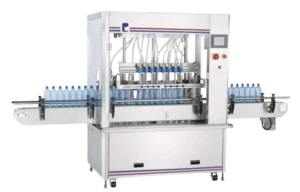
Powder Filling Machine: pharma, supplements, food, chemical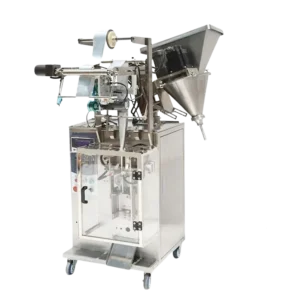
Granule Filling Machine: food, agricultural, industrial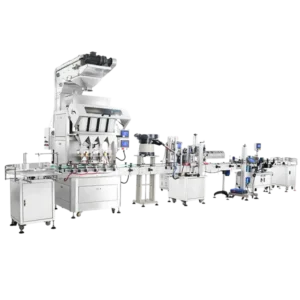
Capsule Filling Machine: pharmaceutical, nutraceuticals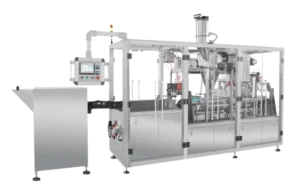
Sauce Filling Machine: food, condiments, cosmetics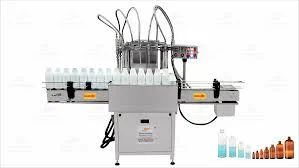
Tube Sealing and Filling Machine: cosmetics, pharma, food