Why calibration matters on a filling line
What you need before you start
| Tool | What It Is For |
|---|---|
| Calibrated scale | Weighing each test fill. Choose one whose readings are much finer than your tolerance |
| Clean, empty containers | One per test fill. Weigh each empty container first (the tare weight) |
| Product at normal running temperature | Viscosity and density change with temperature, and so does fill volume |
| Product density value | Converts weight to volume for liquids sold by volume |
| Calibration log sheet | Records the as-found and as-left results (template below) |
| Machine manual | Shows the adjustment points, such as piston stroke, auger turns or pump time |
How to calibrate a filling machine, step by step
- Warm up the machine. Run product through for a few minutes to stabilize temperature, pressure, and the product level in the hopper or tank.
- Set the target. Note the declared quantity on the label, your tolerance, and the product density if you fill by volume.
- Run the as-found test. Run 10 fills per head without adjusting anything. Weigh each one and subtract the container tare.
- Calculate. Work out the average, the lowest and highest fill, and the spread for each head.
- Adjust one head at a time. Change only one setting, such as stroke length, pump time, or auger turns, in small steps.
- Run the as-left test. Repeat 10 fills per head and confirm the average is on or just above target, and no fill falls below your lower limit.
- Record and sign off. Write down the as-found and as-left results, the changes made, the date, and who did it.
Worked example: 500 ml liquid on a piston filler
| Result | As Found | As Left |
|---|---|---|
| Average fill (10 fills) | 496.8 ml | 500.1 ml |
| Lowest fill | 494.9 ml | 498.4 ml |
| Highest fill | 498.6 ml | 502.1 ml |
| Standard deviation (how much fills vary) | Not recorded | 1.2 ml |
| Action | Piston stroke increased in small steps | None. Within limits |
How often should you calibrate?
| Check | When |
|---|---|
| Quick fill check (a few fills per head) | Start of each shift, and after any long stop |
| Full calibration (the steps above) | After every product or container changeover |
| Full calibration plus sensor check | On a fixed schedule, for example monthly. One published procedure suggests checking dosing every 2 to 4 weeks (Unitecd) |
| Scale calibration | As your scale supplier or certification body requires |
Liquid vs powder filling machines: what changes
| Filler Type | What You Adjust | What Usually Causes Drift |
|---|---|---|
| Piston filler | Piston stroke length | Worn piston seals, air in the product, temperature change |
| Peristaltic filler | Pump rotations or run time | Tube wear and stretching |
| Flow meter filler | Pulse count or fill time | Meter fouling, viscosity change |
| Auger powder filler | Number of auger turns | Powder density changes as the hopper level drops, humidity, bridging |
Calibrating powder filling machines
- Keep the hopper level steady. Use a level sensor and an automatic feeder so the hopper stays within the same band.
- Test at several hopper levels. Run the as-found test with the hopper full, and again when it’s low.
- Use a checkweigher. A checkweigher is an in-line scale that weighs every pack and can send a signal back to correct the auger. It’s the best option for powders that settle.
- Watch humidity. Damp powder flows differently, so calibrate in the same conditions as production.
Calibrating pressure and level sensors on food filling equipment
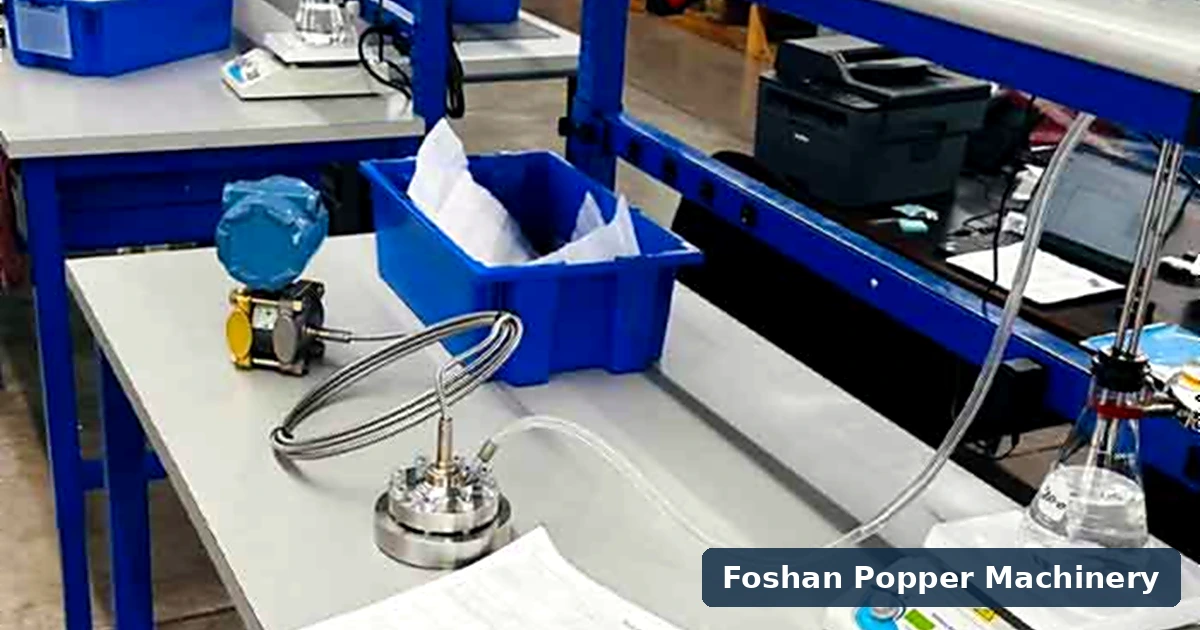
| Applied Pressure | Expected Signal |
|---|---|
| 0 bar | 4 mA |
| 5 bar | 12 mA |
| 10 bar | 20 mA |
For food lines, use sensors with a flush, hygienic diaphragm so product can’t collect in gaps, and choose materials that suit your cleaning chemicals.
To learn more about the sensors used across a filling line, see how sensors improve filling machine performance.
Where calibration fits in filler machinery maintenance?
Calibration and maintenance depend on each other. A worn seal or a dirty valve will pull a filler out of calibration, however carefully you set it.
So replace worn parts first, then calibrate. If a head keeps drifting soon after calibration, inspect it for wear instead of adjusting it again.
For a full daily, weekly, and monthly routine, see our filling machine maintenance schedule.
Checking the labeler on the same line
A calibrated filler is wasted if the next machine puts labels in the wrong place. After a changeover, check the round bottle labeler too:
- Label position. If labels sit too high, too low, or at an angle, adjust the label head height and the guide rails before changing any speed.
- Star wheel timing. The star wheel feeds bottles into and out of the labeling station. If bottles jam or arrive late, adjust it so each bottle sits centered in its pocket at the label head.
- Label sensor. If labels are skipped or doubled, re-teach the label gap sensor on the new label roll.
- Speed match. Set the conveyor, star wheel, and label dispensing speed to match. If they don’t, labels wrinkle or overlap.
For more faults and fixes, see our labeling machine troubleshooting guide and the round bottle labeling machine.
Filling equipment calibration and fill-weight rules in the UK and US
Calibration is how you prove your packs meet the legal minimum. The two markets check packs in similar ways.
UK: the average system
Packs sold in the UK under the average system must follow three “packers’ rules” (Pembroke shire Trading Standards; Weights and Measures (Packaged Goods) Regulations 2006):
- The average contents must not be less than the quantity on the label.
- Generally, no more than 2.5% of packs may be short by more than the tolerable negative error (TNE).
- No pack may be short by more than twice the TNE.
| Nominal Quantity (g or ml) | Tolerable Negative Error |
|---|---|
| 50 to 100 | 4.5 g or ml |
| 100 to 200 | 4.5% of the quantity |
| 200 to 300 | 9 g or ml |
| 300 to 500 | 3% of the quantity |
| 500 to 1,000 | 15 g or ml |
| 1,000 to 10,000 | 1.5% of the quantity |
US: NIST Handbook 133
Calibration log template
| Field | Example |
|---|---|
| Date and time | 9 Nov 2026, 07:30 |
| Machine and head number | Piston filler 2, head 3 |
| Product, batch and declared quantity | Juice, batch 1108, 500 ml |
| Scale ID and last calibration date | Scale S-04, 1 Oct 2026 |
| As-found average, lowest and highest | 496.8 / 494.9 / 498.6 ml |
| Adjustment made | Stroke +2 marks |
| As-left average, lowest and highest | 500.1 / 498.4 / 502.1 ml |
| Pass or fail against your limits | Pass |
| Done by and checked by | Initials |