Key takeaways
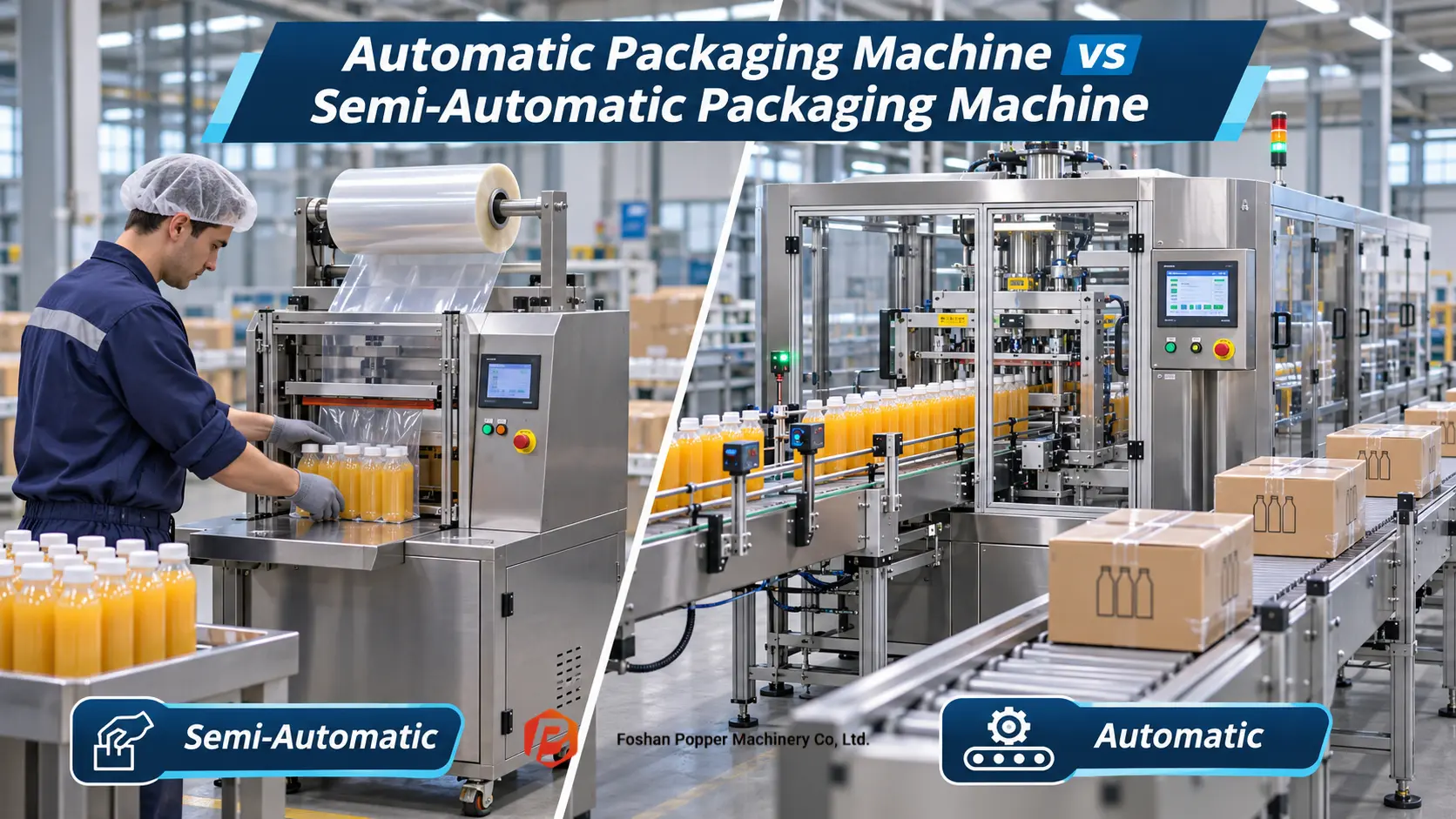
- An automatic packaging machine feeds, packs, and moves product on its own, while a semi-automatic machine requires a person to load each item and often start each cycle.
- Semi-automatic machines usually cost USD 2,000 to 20,000, and a single automatic packaging machine usually costs USD 20,000 to 80,000. The exact price depends on machine type, speed, and options.
- Automatic machines are usually faster and need fewer people, but only if the steps before and after them can keep up.
- Automation pays off when it actually cuts wages or overtime, or lets you sell more. Moving a worker to another job does not lower your payroll.
- Most growing businesses don’t switch everything at once. They automate the slowest step first, then the next one.
Introduction
Here is the short answer. The detailed differences, costs and a payback example follow below.
| Feature | Semi-Automatic Packaging | Fully Automatic Packaging |
|---|---|---|
| Operator role | Feeds, loads or moves product by hand | Supervises the line, checks data and clears stoppages |
| Production volume | Low to medium runs (for example, up to about 15,000 bags a day on a bagging line) | High-volume, continuous output (for example, 30,000+ bags a day) |
| Product variety | Very flexible; easy to adjust for different shapes, sizes and short batches | Best for standard, repeatable products in long runs |
| Upfront cost (USD) | Lower entry cost: about 2,000 to 25,000, depending on the machine | Higher investment: about 20,000 for a single machine, up to 250,000+ for a full line |
| Labor cost | Higher ongoing cost: 1 to 2 operators per machine | Lower ongoing cost: 1 operator can watch several linked machines |
Ranges vary by machine type and supplier. Use them for early planning, then compare real quotes.
What is an automatic packaging machine?
An automatic packaging machine is a machine that feeds, packs, seals and discharges product without a person handling each item. Product arrives on a conveyor, sensors detect it, and a PLC (the machine’s controller) runs every step in sequence. One operator watches the line, refills materials and deals with stoppages.
You’ll also see it called a fully automatic packaging machine. The two terms mean the same thing in practice: no manual step inside the packing cycle.
What is a semi-automatic packaging machine?
A semi-automatic packaging machine does the hard part of the job, such as sealing, folding or shrinking, but a person loads the product and often starts each cycle with a button or foot pedal. Speed depends on how fast the operator works.
A simple example is a shrink wrap setup. On a semi-automatic L-bar sealer, the operator places each pack in the film and pulls the sealing bar down. On an automatic sleeve wrapper, packs arrive on a conveyor and the machine wraps them continuously.
Bag filling lines work the same way. On a semi-automatic bag line, the operator places each empty bag on the spout. The machine then clamps it, weighs the product, moves the full bag along a conveyor and seals or stitches it.
Is there anything in between?
Yes. Many factories run a mixed line, with an automatic filler feeding a semi-automatic carton machine, for example. This is common and sensible. It lets you automate the slowest step first without replacing every machine at once.
Automatic vs semi-automatic packaging machine: key differences
The biggest difference is who sets the pace. On a semi-automatic machine, the operator does. On an automatic machine, the machine does and the operator watches. The table below adds the practical details. The numbers are typical examples, so check the real figures for any model you shortlist.
| Factor | Semi-Automatic | Automatic |
|---|---|---|
| Illustrative speed | 10 to 30 packs/min | 30 to 120+ packs/min |
| Illustrative floor space | 2 to 6 m² | 6 to 20 m², plus conveyors |
| Power | Model-dependent; single- or three-phase | Model-dependent; check voltage and air needs |
| Changeover | Quick, mostly by hand | Slower on older models; fast on servo models with saved recipes |
| Consistency | Affected by operator and setup | Generally more repeatable with correct setup |
| Operator skills | A few hours of training | Training on settings, sensors and basic fault-finding |
| Best for | Short runs, many products, growing volumes | Long runs, steady demand, high wages |
How much does an automatic packaging machine cost compared to semi-automatic?
What does hand packing really cost?
Worked example: payback on an automatic shrink wrap machine
| Input | Semi-Automatic Today | Automatic Upgrade |
|---|---|---|
| People on the packing step | 3 | 1 |
| Output | About 15 packs/min | About 30 packs/min |
| Machine cost, installed | Already owned | USD 30,000 |
| Annual base-wage savings (only if 2 roles are eliminated) | None | USD 72,560 (2 × USD 36,280) |
| Added monthly running cost (illustrative) | None | About USD 400 (power, air, maintenance and spares) |
Which packaging machines come in semi-automatic and automatic versions?
| Machine | Semi-Automatic Version | Automatic Version | Usually Worth Automating When |
|---|---|---|---|
| Shrink wrap machine | L-bar sealer, operator places each pack | Sleeve wrapper fed by conveyor | You bundle bottles or cans all day |
| Carton packaging machine | Operator loads product, machine folds and closes | Machine erects, loads and closes cartons | When required sustained output exceeds manual loading capacity |
| Wrapping machine | Manual infeed of each item | Servo-driven flow wrapper with auto infeed | You wrap single items in large volumes |
| Paper box packaging machine | Operator feeds blanks and product | Automatic box forming and packing | Box style stays the same for long runs |
| Palletizing machine | Manual stacking, sometimes with a lift aid | Layer or robotic palletizer | Workers lift heavy cases for full shifts |
If you sell boxed products, an automatic box packaging machine is often the second step to automate, after filling. Box packing is repetitive, and it is easy to make it consistent.
Palletizing is a special case. Even at modest volumes, it is often automated early because lifting heavy cases all day is tiring and a common cause of strain injuries.
How to verify real output before ordering
Ask the supplier to run the machine with your own product, pack size and film or cartons, and to time it. Write down the model, the real packs per minute, rejects, how much the operator does, and how long a changeover takes. A dated test sheet and a video of that run tell you far more than a brochure’s top speed.
What about automatic food packaging machines?
The rules depend on whether the machine touches food or only handles sealed packs. Parts that touch food need food-safe materials and must be easy to clean. 304 stainless steel is the usual choice. A carton or shrink wrap machine that only handles sealed packs has lighter hygiene needs.
For commercial food packaging machines, check these three points before buying:
- Cleaning time: measure how long it takes to clean between products. An automatic line that needs an hour of cleaning can lose its speed advantage.
- Product damage: soft or crumbly foods may need gentler infeed than standard conveyors give.
- Upstream filling: if your sauce or powder is still filled by hand, automate that first with an automatic liquid filling machine or a powder filling machine.
Six factors that decide which packaging machine you need
Work through these six factors in order. If most of your answers point the same way, that’s your machine.
- Daily output. Compare how many packs you need per shift with what each machine really produces with your product, after changeovers, stops and rejects. The two types overlap, so don’t rely on a single cut-off number.
- Number of products and sizes. Many short runs favor semi-automatic. A few products in long runs favor automatic.
- Labor cost and availability. If you struggle to hire or keep packers, or packing ties up two or more people, automation saves the most.
- Space and power. Check each model’s floor space, voltage, power use and whether it needs compressed air. Automatic machines often need three-phase power, but not always.
- The rest of your line. An automatic machine only helps if the steps before and after it can keep pace.
- Budget and payback target. Decide how quickly the machine must pay for itself. Many owners aim for under 12 to 18 months.
When is a semi-automatic packaging machine the better choice?
A semi-automatic machine is often the smarter buy, not just the cheaper one. Choose it when:
- Your volumes are moderate and an automatic machine would sit idle part of the shift.
- You change product shapes or sizes often, or run many short batches.
- Your budget is limited and you need payback from a smaller investment.
- Your product still needs a person’s judgment, for example fragile, irregular or hand-arranged items.
When should you switch from semi-automatic to automatic?
Switch when one of these is true:
- Packing ties up two or more full-time workers on every shift.
- Packing is the step that limits how much you ship each day.
- You turn down orders, or run overtime, because packing can’t keep up.
- Pack quality varies from one operator to another and customers notice.
You don’t have to replace everything at once. A common path is:
| Stage | What You Run | What You Add Next |
|---|---|---|
| 1 | Semi-automatic machines at each step | Automate the slowest step |
| 2 | One automatic machine, the rest semi-automatic | Link machines with conveyors |
| 3 | Several automatic machines | Automate end-of-line palletizing |
| 4 | A fully automated packaging line | Add checks such as weighing or vision inspection |
- Buying speed you can’t feed. Check the real output of the steps around the machine first.
- Ignoring changeover time. Ask for the time to switch sizes, in minutes, and whether it needs tools.
- Skipping operator training. Automatic machines need someone who understands the settings, sensors, and basic fault-finding.
- Forgetting safety guarding. Moving parts can cause serious injuries. Check that guards and interlocks are fitted, and read OSHA’s machine guarding guidance if you operate in the US.
- Not testing with your product. Ask for a video of the machine running your actual product and packaging material before you pay.
Conclusion: choose for the output you need next year
What is the difference between a semi-automatic and a fully automatic packaging machine?
A semi-automatic packaging machine needs an operator to load product and often to start each cycle. A fully automatic packaging machine feeds, packs and discharges product by itself, using conveyors, sensors and a PLC. The operator only supervises, refills materials and clears stoppages.
How much does an automatic packaging machine cost?
An automatic packaging machine usually costs USD 20,000 to 80,000, depending on the type, speed and options. Robotic palletizers and complete lines cost more. Ask for a quote that lists freight, installation, change parts and setup separately.
How fast is an automatic packaging machine compared to semi-automatic?
An automatic machine is usually faster. Semi-automatic machines often run at 10 to 30 packs a minute, and automatic machines at 30 to 120 or more. The ranges overlap, so compare the real output with your own product, after changeovers and stops.
Can one person run an automatic packaging machine?
Yes. One trained operator can usually run one automatic machine, and sometimes several linked machines. The operator’s job changes from loading product to watching the line, refilling film or cartons, adjusting settings and fixing minor jams.
Can a semi-automatic packaging machine be upgraded to automatic?
Sometimes. Some semi-automatic machines can take an automatic infeed or a conveyor later, which raises speed without replacing the whole machine. Others cannot be upgraded. Ask the supplier about upgrade options before you buy, so the machine can grow with your line.
Are automatic packaging machines harder to maintain?
A little. They have more sensors, motors and conveyors, so they need regular maintenance and someone trained to find faults. How long they last depends on build quality, how hard they run, maintenance and spare parts support.
Is an automatic food packaging machine worth it for a small company?
Yes, once orders are steady and packing ties up two or more people. If you change products often or volumes are still small, a semi-automatic machine usually pays back faster.