
Home » Edible Oil Filling Machine: Types, Working Process and Buying Guide

Edible Oil Filling Machine: Types, Working Process and Buying Guide

An edible oil filling machine doses cooking oil into bottles, jars, tins, jerry cans or pouches at a controlled quantity, then passes the filled container to capping and labeling. Oil looks like an easy product to fill, and in flow terms it mostly is. The complications are commercial: oil is high value per litre, its density moves with temperature, it wets and clings to every surface it touches, and the quantity you are legally required to deliver may be a volume in one market and a weight in another. Those four facts decide which metering technology you buy, not the bottle shape.

This guide covers the oils, the metering methods, edible oil filling machine classes and realistic capacity, container formats, accuracy, contact materials, line integration and what to settle before asking for a quotation.

Which Oils an Edible Oil Filling Machine Handles

Most edible oil bottling operations run one or more of these:

  • Thin, free-flowing oils such as sunflower, soybean, canola, rapeseed, corn and refined blended vegetable oil. These are the mainstream high-volume products.
  • Mid-weight oils such as olive, peanut, sesame, rice bran and avocado. Flow is still easy, but value per litre is higher and fill giveaway costs more.
  • Oils that solidify or thicken below ambient such as coconut, palm and palm olein. These need a controlled product temperature before the filler, and sometimes jacketed pipework, or the fill rate collapses in winter.
  • Infused and specialty oils with herbs, chilli or particulates. Suspended solids change the metering choice, because a flowmeter and a narrow nozzle behave differently with particles in the stream.

Edible oil is not a single product category to an edible oil filling machine. Viscosity varies between grades, and it varies with temperature within a single grade. A line quoted on warm refined sunflower will not hold the same rate on cold peanut oil in an unheated building.

How an Edible Oil Filling Machine Works

The cycle is similar across edible oil filling machine classes:

  1. Product supply. Oil is held in a buffer tank or supplied directly from a storage tank, often with level control and a temperature hold.
  2. Container infeed. Bottles arrive on a conveyor, are separated by a screw or stop-gate and indexed under the filling heads. Dedicated oil lines often include rinsing before filling.
  3. Container detection. Sensors confirm a container is present before the valve opens, so no-bottle-no-fill is enforced.
  4. Dosing. The metering device delivers a measured quantity by volume, weight or flow count. This is the step that distinguishes machine types.
  5. Nozzle behavior. Diving nozzles descend into the neck and rise as the container fills, limiting splashing and surface aeration on fast fills.
  6. Cut-off and drip control. The valve closes, and a positive shut-off or suck-back action stops the thread and the bottle shoulder from being wetted.
  7. Discharge. The filled container moves to capping, then labeling, coding, case packing and palletizing.

Step 6 deserves more attention than it usually gets. Oil left on the bottle neck interferes with the cap seal and leaves a slippery container that collects dust and complicates labeling. Nozzle choice drives most of this behavior, and it is covered in depth in the guide to filling machine nozzle types.

Volume or Weight: The First Decision

Suppliers argue about this, and both positions appear in search results. The honest answer is that it depends on how the pack is declared in your destination market.

In the United States, FDA food labeling rules require the net quantity of contents on a packaged food to be expressed in fluid measure when the food is liquid, so retail cooking oil is declared in fluid ounces, quarts or litres. 21 CFR Part 101 sets that out. In several other markets, including large parts of South Asia and the Middle East, edible oil is commonly declared and traded by weight, which is why so many oil machines are sold as net-weight fillers.

The consequence is practical. Oil density falls as temperature rises, so a fixed volume is not a fixed weight and a fixed weight is not a fixed volume:

  • Declaring by volume: volumetric or flowmeter filling matches the declaration directly. Weight will drift slightly across a hot and cold day, and that is acceptable.
  • Declaring by weight: net-weight filling on load cells matches the declaration directly. The volume in the bottle will vary slightly with temperature, which customers may notice as a different fill line on the shelf.
  • Mixed export programs: if you ship both ways, decide which declaration governs each SKU before specifying the edible oil filling machine, and control product temperature either way.

Underfilling is a regulatory exposure, and overfilling is a direct margin loss on a high-value liquid. In the US, net content inspection procedures and the maximum allowable variations applied by weights and measures officials are published in NIST Handbook 133. Build your target fill around those limits rather than around a round number.

Metering Technologies Used in an Edible Oil Filling Machine

Gravity and level filling

Product flows from a header tank under its own head into the container, and the valve closes on time or on level. It is the cheapest option and works acceptably for thin oils at modest speeds. The limitation is that it fills to a level, not a quantity, so bottle volume variation passes straight through to the delivered amount.

Volumetric flowmeter filling

An inline flowmeter counts the volume passing each nozzle and closes the valve at the target. This suits thin and mid-weight oils, handles a wide container range through recipe changes, and is the common choice for mid to high-speed PET bottle lines. Flowmeter performance is affected by viscosity and temperature, so check how the edible oil filling machine compensates and whether it was calibrated on your oil rather than on water.

Piston (volumetric displacement) filling

A piston draws a fixed volume into a cylinder and pushes it into the container. It is highly repeatable, tolerant of thicker and cooler oils, easy to adjust by stroke length, and well suited to semi-automatic and mid-speed lines and to larger fills. It brings more product-contact parts to clean. The mechanics are covered in the article on piston filling machines.

Net-weight filling

Each container sits on a load cell and the valve closes when the target weight is reached. The weight in the pack is measured rather than inferred, which removes density and container-volume variation from the result. A net-weight edible oil filling machine is the usual choice for weight-declared markets and for larger formats such as 5 L jerry cans and 15 kg to 18 kg tins, where a small percentage error is a large absolute loss.

Servo pump filling

A servo-driven gear or lobe pump meters by controlled rotation. It gives smooth flow and recipe-driven volume changes, and handles a broad viscosity range including cooler and heavier oils.

Metering MethodMeasuresBest Suited ToContainer RangeMain Limitation
Gravity / levelLevel or timeThin oils, entry-level linesSmall to medium bottlesBottle volume variation affects the delivered quantity
FlowmeterVolumeThin to mid oils, volume-declared marketsWide, recipe drivenViscosity and temperature affect the reading
PistonDisplaced volumeMid to heavy oils, varied formatsSmall bottles to large tinsMore contact parts to clean
Net weightWeightWeight-declared markets, large formatsMedium to bulkHigher cost; fill level varies with density
Servo pumpRotationMixed viscosity portfoliosWidePump wear affects long-run accuracy

Edible Oil Filling Machine Classes and Realistic Capacity

  • Semi-automatic bench and floor fillers. One to four heads, operator places and removes containers. Suited to startups, specialty olive oil producers and small-batch runs. Output depends almost entirely on the operator, so quote it as containers per hour achieved, not per-head cycle time.
  • Automatic inline fillers. The most common automatic edible oil filling machine layout, with containers indexed under a row of heads on a straight conveyor. The common choice for small to mid-size bottlers and for large formats. Head count and fill volume set the output.
  • Rotary fillers. Containers travel on a carousel and fill continuously. This is the format used for high-speed PET lines and for tin can lines.
  • Monoblock and complete lines. Rinsing, filling and capping are combined in one frame, often extended into labeling and coding. This reduces floor space and container handling between operations.

Treat any published edible oil filling machine capacity figure as a benchmark, not a promise. Supplier capacity claims are usually stated against a specific fill volume and a specific oil, and the useful number is sustained acceptable containers per hour on your product, your container and your fill size, including changeovers, refills and quality checks. Ask for the test conditions behind every number you are quoted.

Container Formats and What They Change

  • PET bottles, 250 ml to 2 L. The retail mainstream. PET is light and flexible, so neck handling, bottle guides and fill speed all need care, and empty bottles can be unstable on fast conveyors.
  • Glass bottles for olive and specialty oils. Heavier and less forgiving of impact, often filled slower, and frequently finished with a pourer insert that affects the capping station.
  • 5 L and larger jerry cans. Usually handled by net-weight or piston filling. Large fills amplify any percentage error, and these packs often need a handle applicator.
  • Metal tins and cans, 1 L to 18 L. Common in food service and export, and typically seamed rather than capped.
  • Pouches and sachets. Filled on form-fill-seal equipment rather than bottle fillers, so this is a separate machine decision.

Container choice also sets nozzle diameter and dive depth, plus neck handling, cap type and whether handle application or seaming is part of the line.

Contact Materials, Hygiene and Oil Residue

On an edible oil filling machine, oil is a food product and also the residue that will eventually cause your downtime.

  • Contact parts should be food-grade stainless steel, commonly 304, with 316 or 316L specified where chlorides, salt or washdown chemistry are present. Gaskets and seals must be food grade and resistant to the oil itself.
  • Cleaning strategy. Decide early whether the line will be CIP-capable or stripped and cleaned manually. On single-oil operations, manual cleaning at intervals may be enough. On lines that switch between, for example, sesame and refined sunflower, carry-over of flavor and aroma is a real quality problem, and a flush and clean procedure between SKUs must be defined.
  • Allergen control. Peanut and sesame oils carry allergen implications. If they share a line with other oils, the changeover procedure is part of your food safety plan, not just a housekeeping task.
  • Drip management. Drip trays, suck-back nozzles and positive shut-off exist because oil that escapes the container ends up on the conveyor, in the bearings and on the floor. Housekeeping and floor safety are a genuine specification item on an oil line.

Thicker products and heavy oils behave differently again, and the broader principles are covered in the viscous liquid filling machine guide.

Edible Oil Filling Machine Accuracy and Where It Goes Wrong

Published edible oil filling machine accuracy figures such as plus or minus 0.5% or plus or minus 1% are measured by the supplier under set conditions. The variables that move the result on a live line are:

  • Product temperature, which changes both density and viscosity and therefore both weight and flow rate
  • Supply conditions, including tank level, head pressure and air entrained during refill
  • Container variation, particularly bottle volume on level-filled lines
  • Fill speed, since accuracy usually degrades at the top of a machine’s rated range
  • Nozzle and cut-off behavior, including stringing and post-fill dripping
  • Calibration drift on flowmeters, load cells and pumps
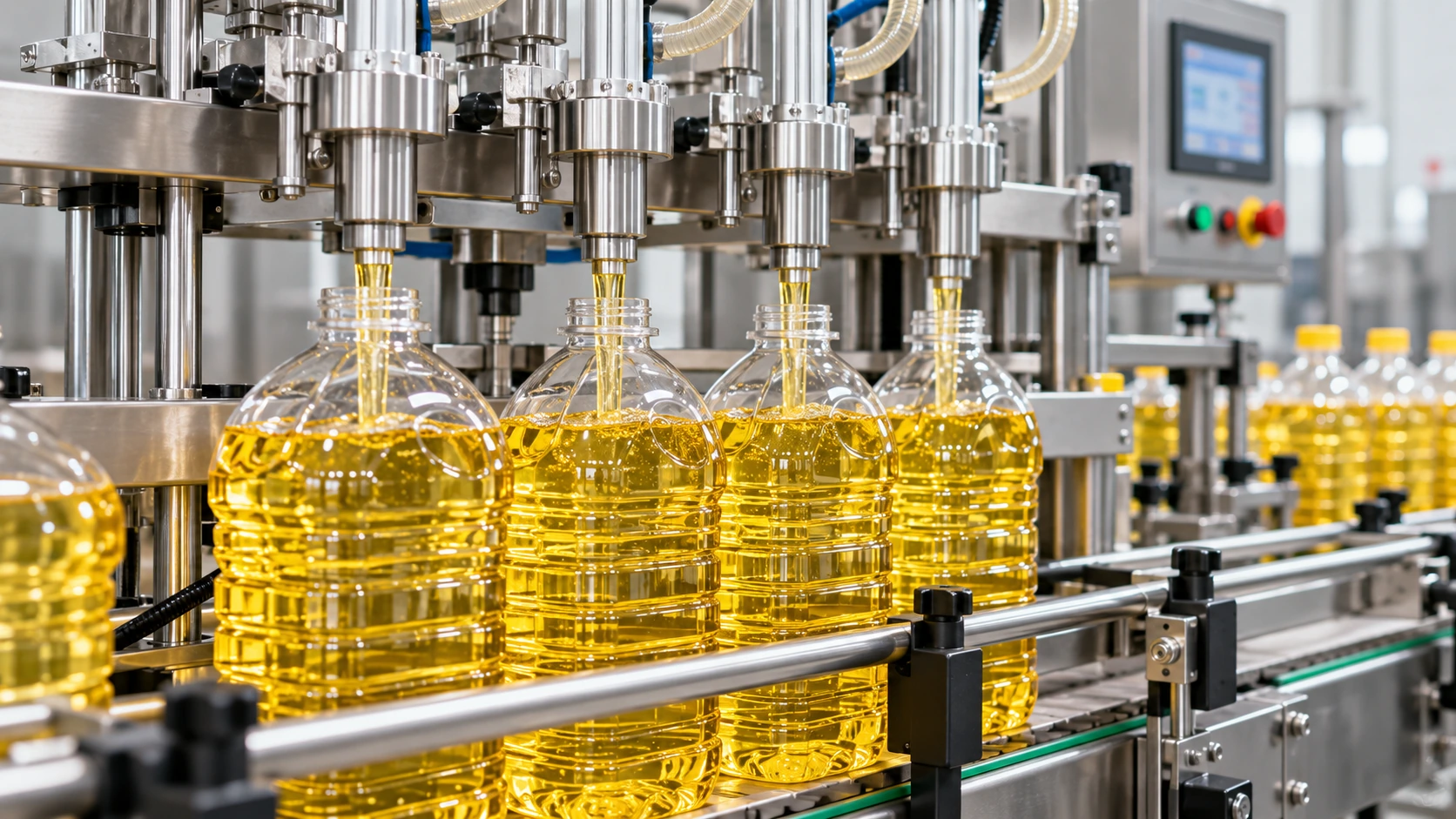
Edible Oil Filling Machine accurately filling large PET bottles with cooking oil on an automated production line

Control is straightforward in principle: hold the product temperature, keep supply conditions stable, verify fill quantity by sampling during the run, and recalibrate on a defined schedule rather than when someone notices a problem. For symptoms that appear mid-run, the filling machine troubleshooting guide covers diagnosis across liquid lines.

Line Integration

An edible oil filling machine rarely stands alone. A typical bottle line runs: bottle unscrambler or infeed, rinser, filler, capper, induction sealer where used, handle applicator for larger PET packs, labeler, date coder, case packer and palletizer.

Three integration points cause most trouble when an edible oil filling machine joins an existing line:

  1. Filler to capper. Oil on the neck or thread reduces seal integrity and causes leakers in transit. Cut-off quality at the filler determines capping results.
  2. Speed balance. The slowest machine sets the line rate. A filler specified above the capper’s capacity delivers no extra output and adds accumulation problems.
  3. Labeling on an oily container. Residue on the bottle body prevents label adhesion. Fix it at the filler, not with a stronger adhesive.

If you are planning a full line rather than a single machine, the automatic filling machine solutions overview sets out how the stations fit together.
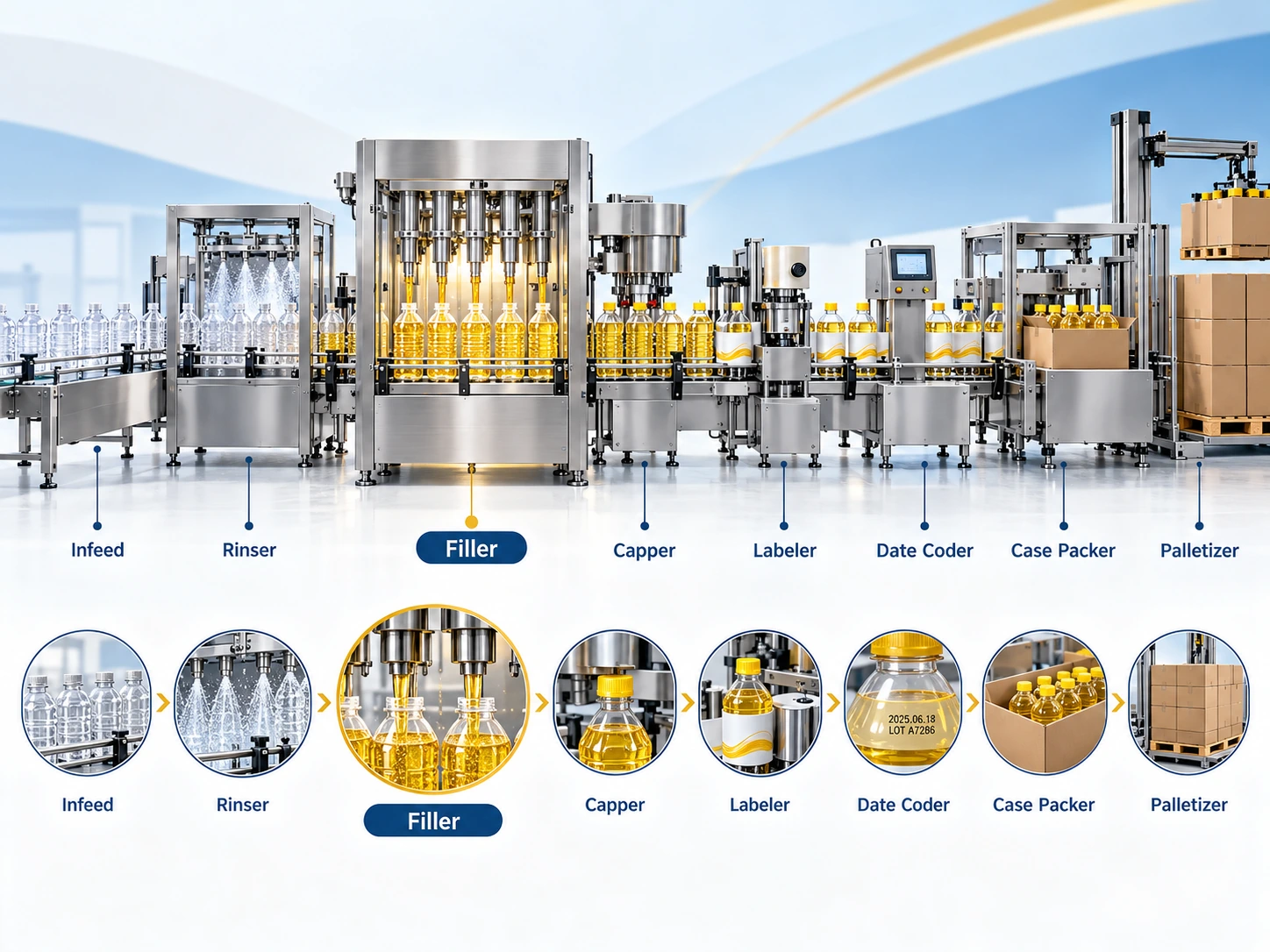
Edible Oil Filling Machine line integration with rinser, filler, capper, labeler, date coder, case packer and palletizer

How to Choosible Oil Filling Machine

SpecificationWhy It MattersBuyer Should ProvideSupplier Should Confirm
Oil grades and temperatureSets metering method and fill rateEach oil, viscosity if known, filling temperature rangeTest results on your oil at your temperature
Declaration basisDecides volume versus weight fillingMarket, label declaration, pack sizesMetering method matched to the declaration
Fill sizesDrives head count and valve sizingFull SKU list with volumes or weightsChangeover method between sizes
ContainersDetermines handling and nozzlesDrawings or samples, neck size, cap typeNozzle, guides and change parts per format
Target outputSets machine class and head countContainers per hour, shifts per daySustained output on your product and container
Accuracy and giveawayProtects margin and complianceTolerance and overfill targetAccuracy measured on your oil, with test conditions
Contact materialsFood safety and corrosion resistanceWashdown chemistry, allergen requirementsStainless grade and seal materials
Cleaning and changeoverPrevents carry-over between oilsNumber of oils, switching frequencyCIP scope or strip-down procedure and timing
Line integrationDetermines real throughputExisting or planned capper, labeler, coderInterfaces, conveyor heights and speed balance
UtilitiesMust match the facilityVoltage, frequency, compressed air, floor spaceElectrical rating, air demand, machine footprint
Support and sparesControls downtimePlanned running hours, locationWear parts, lead times, commissioning and training

Cost expectations across filling machine categories are set out in the filling machine price and cost guide, so this guide does not repeat them.

What to Send Before Requesting an Edible Oil Filling Machine Quotation

  • Every oil you intend to run, with filling temperature and viscosity if measured
  • Whether packs are declared by volume or by weight, and for which markets
  • Full SKU list with fill sizes and container materials
  • Container drawings or physical samples, including caps and closures
  • Target containers per hour and number of shifts
  • Required fill accuracy and acceptable giveaway
  • How often you switch between oils, and your cleaning expectations
  • Existing line equipment the filler must integrate with
  • Voltage, frequency, available compressed air and floor space
  • Destination country and any documentation needed for import

Frequently Asked Questions

Should an edible oil filling machine fill by volume or by weight?

It depends on how the pack is declared. US food labeling requires liquids to be declared in fluid measure, so volumetric or flowmeter filling matches the label, while weight-declared markets are better served by net-weight filling on load cells. Because oil density changes with temperature, a fixed volume is not a fixed weight, so match the metering method to the declaration and control product temperature.

Which filling method is best for thicker oils such as coconut or palm oil?

On an edible oil filling machine, piston, servo pump and net-weight metering handle thicker and cooler oils more reliably than gravity filling. The practical fix is usually temperature as much as technology, since these oils thicken or solidify below ambient and need controlled product temperature before the filler. Specify the filling temperature with the supplier rather than only naming the grade.

How fast can an edible oil filling machine run?

Output depends on fill size, container, metering method and head count, so a rate quoted for 500 ml PET will not hold for a 5 L jerry can. Semi-automatic machines are measured in containers per hour with operator handling, while rotary lines run continuously. Ask for sustained acceptable output on your container and fill size, including refills and changeovers.

Can one machine fill several oils and several bottle sizes?

Usually yes. One edible oil filling machine can cover several oils and sizes with change parts and recipe changes, but how smoothly it does so is a specification decision rather than an assumption. Confirm which nozzles, guides and change parts each format needs, and how long a format change takes. For multiple oils, the carry-over and cleaning procedure between SKUs matters more than the mechanical changeover.

What causes oil on the bottle neck and leaking caps on an edible oil filling machine?

Poor cut-off at the end of the fill is the usual cause, from stringing, dripping or the nozzle withdrawing while product is still flowing. Oil on the thread prevents a reliable cap seal and causes leakers in transit, and it also stops labels adhering. Diving nozzles with positive shut-off or suck-back fix most of it at the filler.

What stainless steel grade should contact parts be?

Food-grade stainless steel is the baseline, commonly 304 for product contact on an edible oil filling machine, with 316 or 316L specified where chlorides, salt or aggressive washdown chemistry are present. Seals and gaskets must also be food grade and compatible with the oil. Ask the supplier to state the grade for every contact component, not just the frame.

Discuss Your Edible Oil Filling Requirements

Foshan Popper Machinery builds filling machines with piston and pump metering for water-thin to medium-viscosity liquids, including oils, specified around the product, container and target speed. To check what an edible oil filling machine project would need for your oils and pack sizes, contact our team with your oil grades and filling temperature, whether packs are declared by volume or weight, your fill sizes and containers, and your target output per hour.

Leave a Comment

Your email address will not be published. Required fields are marked *

Scroll to Top