Every spray deodorant, can of spray paint, and air freshener starts on the same kind of equipment. An aerosol can filling machine doses the product into a metal can, fits a valve, and charges the can with pressurized propellant, so the contents stay sealed until someone presses the actuator. Because pressure and flammable gas are involved, this equipment works very differently from a standard liquid filling machine.
For manufacturers, the right setup affects output, product quality, and plant safety. As a filling machine manufacturer, we help buyers compare benchtop units, semi-automatic machines, and full production lines, and the best choice almost always comes down to the product, the propellant, and the target volume.
In this guide, you will learn how the machine works, which types exist, which specifications matter most, and how to plan a complete line from filling through labeling and end-of-line packing.
What Is an Aerosol Can Filling Machine?
An aerosol can filling machine is packaging equipment that fills an aerosol container with product concentrate, places and crimps a valve onto the can opening, and charges the can with a liquefied or compressed gas propellant. The result is a sealed, pressurized can that releases its contents as a spray, mist, foam, or stream.
Unlike a beverage can, which receives a seamed lid, an aerosol can is closed by crimping a valve cup into the 1-inch (25.4 mm) opening at the top. Most machines handle tinplate and aluminum cans. In addition, some pharmaceutical and perfume formats use smaller 20 mm valves, which need matching crimping tools.
Key Components of an Aerosol Filling Machine
Each station handles one stage of the job. Therefore, knowing the components makes it easier to compare quotations and spot where a cheaper machine cuts corners.
Product Filling Head
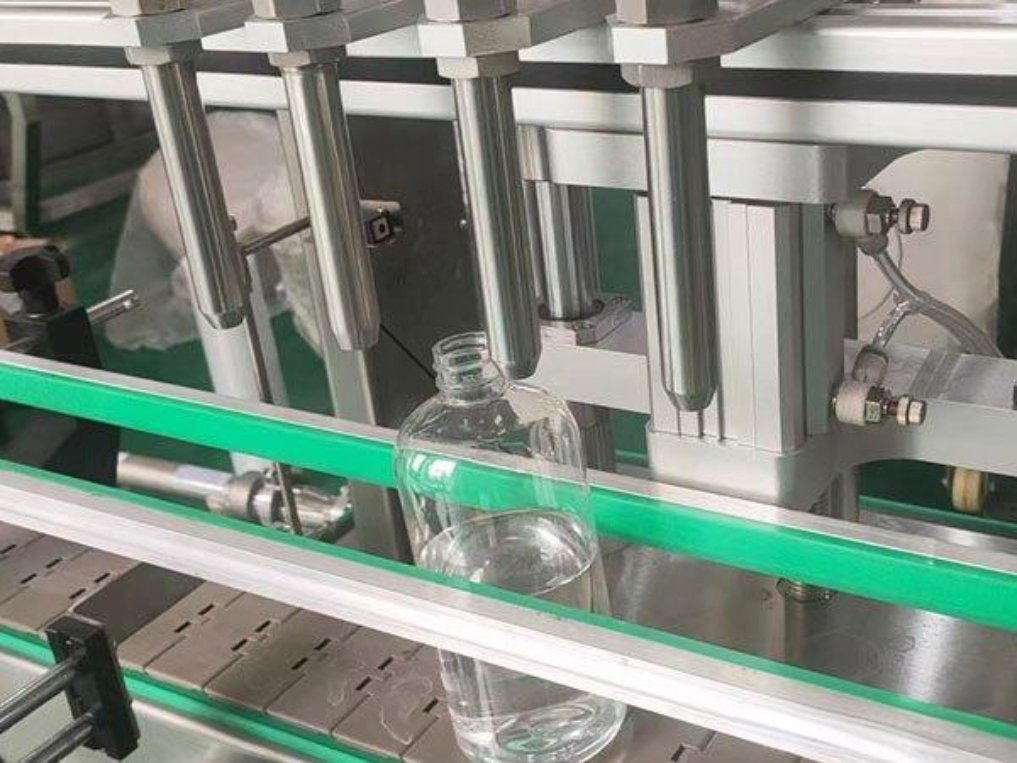
The filling head doses the concentrate, such as paint, lotion, oil, or cleaning solution, into the open can. Most machines use a pneumatic or servo-driven piston, since piston filling holds consistent volumes across thin and thick liquids. Contact parts are usually 304 stainless steel, while 316L is the better choice for corrosive formulas.
Valve Insertion and Crimping Head
Next, the valve placer drops a valve into the can opening. The crimping head then expands a set of jaws inside the valve cup and locks it onto the can bead. Crimp diameter and crimp depth must match the valve supplier’s specification; if either setting drifts, the can may leak or lose pressure on the shelf. Many machines also draw a vacuum just before crimping to remove air from the headspace.
Propellant Filling Head and Gas Booster Pump
The gassing head injects propellant under high pressure. Because the propellant has to pass through a narrow valve, a gas booster pump raises the supply pressure well above storage pressure. Operators set the gas volume separately from the product volume, so they can adjust the product-to-propellant ratio for each formula.
PLC Control and Pneumatic System
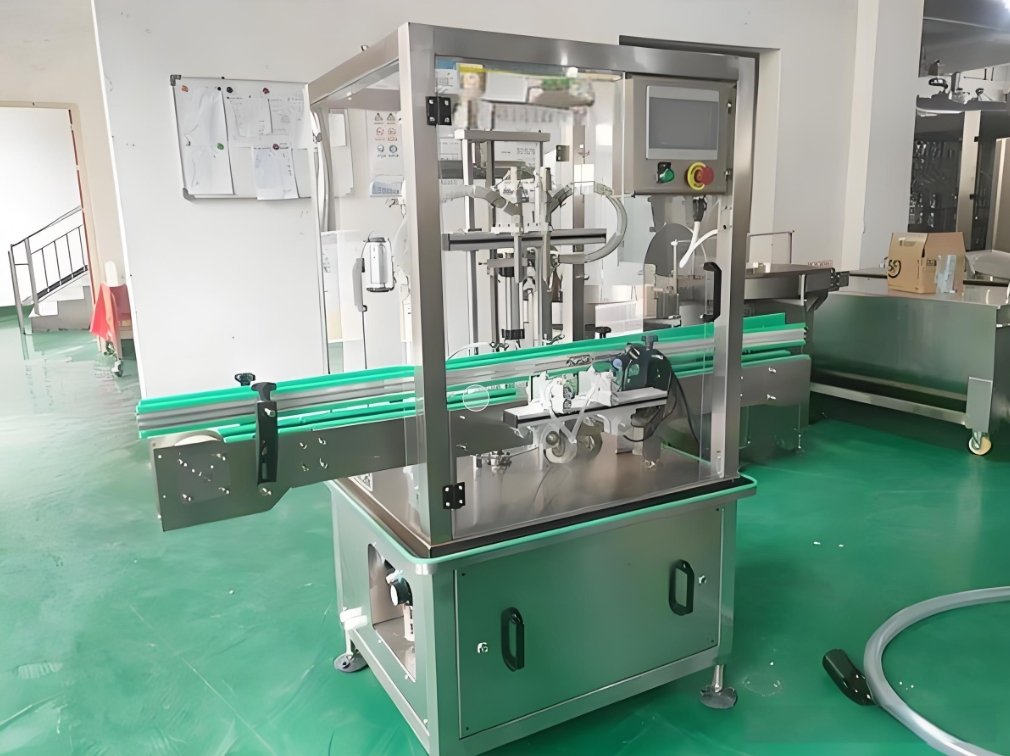
Automatic machines use a PLC and touchscreen to coordinate the stations, count cans, and stop the line when a can or valve is missing. Meanwhile, compressed air drives the cylinders, which keeps electrical parts away from flammable gas. Where electrical components do sit near the filling zone, they need an explosion-proof rating.
How Does an Aerosol Can Filling Machine Work?
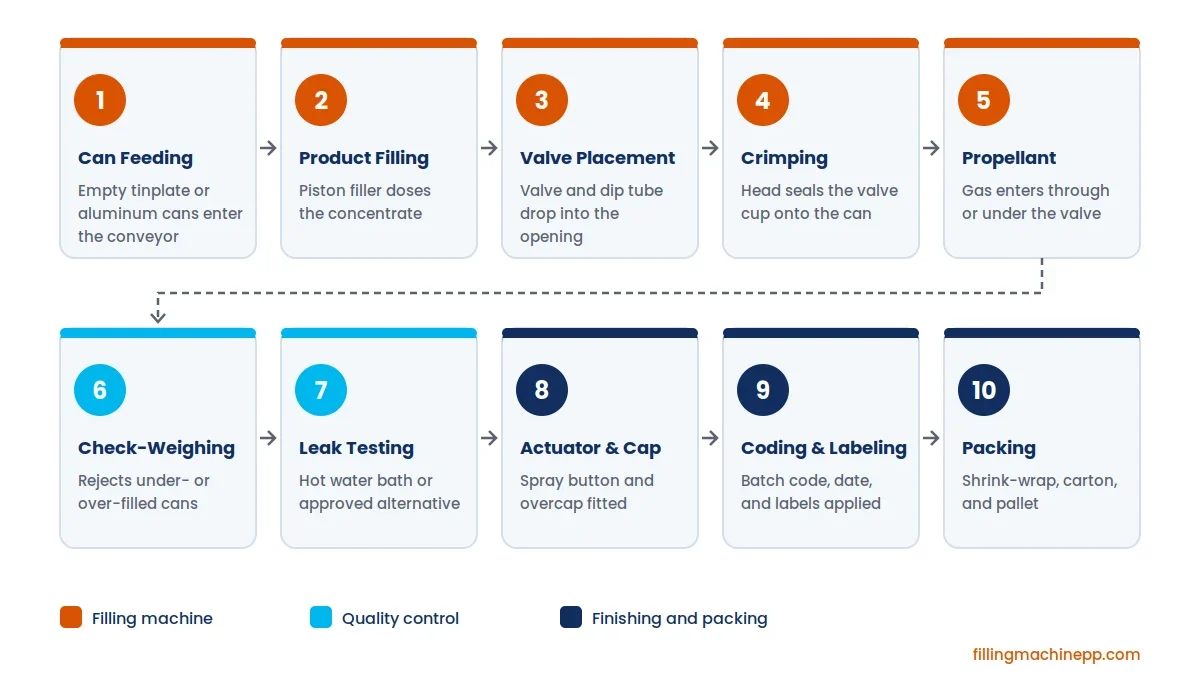
On a complete production line, each can moves through the following steps:
- Can feeding: Operators or a can unscrambler load empty tinplate or aluminum cans onto the conveyor. If the product requires it, an air rinser cleans each can first.
- Product filling: The piston filler doses a set volume of concentrate into each can. A no-can, no-fill sensor stops dosing whenever a gap appears on the conveyor.
- Valve placement: A valve inserter places the valve, usually with its dip tube attached, into the can opening.
- Crimping: The crimping head, often with vacuum, seals the valve cup onto the can.
- Propellant charging: The gassing head fills propellant through the valve, or under the valve cup on under-cup machines.
- Check-weighing: A check weigher confirms the correct amount of product and propellant and rejects under-filled or over-filled cans.
- Leak and pressure testing: Cans pass through a hot water bath or an approved alternative test. As a result, leakage problems get caught before they reach a customer.
- Actuator and overcap placement: An actuator presser fits the spray button, and an overcap placer adds the protective cap.
- Coding and labeling: A coder prints the batch number and date for traceability. If the cans are not pre-printed, a labeler applies self-adhesive or shrink sleeve labels.
- End-of-line packing: Finally, the line shrink-wraps the cans or packs them into cartons for palletizing and shipping.
Planning a new aerosol line? Send us your product, can size, and target output, and our engineers will recommend a suitable configuration.
Types of Aerosol Can Filling Machines
Aerosol filling equipment ranges from benchtop units for R&D to high-speed rotary lines. Here are the main categories and where each one fits.
Manual and Benchtop Aerosol Fillers
Small benchtop fillers suit paint shops, labs, and sample production. For example, custom-color spray paint fillers pump around 100 ml of paint into a pre-pressurized can and typically produce up to about 150 cans per hour.
Semi-Automatic Aerosol Filling Machine
A semi-automatic aerosol filling machine relies on an operator to move each can between steps. 3-in-1 and 4-in-1 models combine liquid filling, crimping, and gas filling on one frame, and some add vacuum crimping. Typical output runs from about 800 to 1,500 cans per hour. Consequently, these machines are a practical fit for startups, contract fillers, and pilot batches.
Fully Automatic Aerosol Filling Line
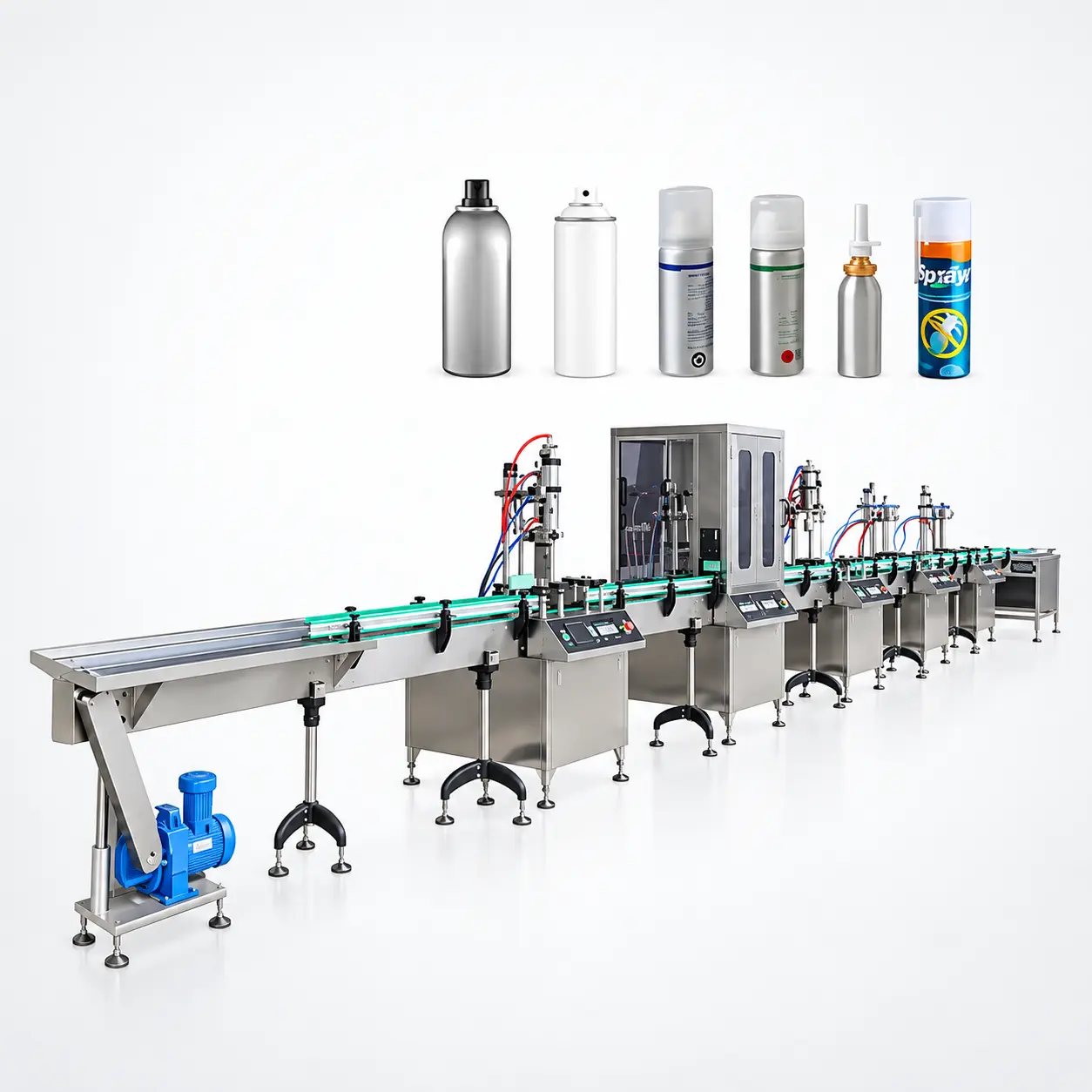
An automatic line links every station with a conveyor and PLC control, so cans travel from feeding to packing without manual handling. Compact inline lines commonly reach 1,200 to 2,400 cans per hour, and larger lines run at 60 cans per minute or more. As a result, labor per can falls and fill consistency improves.
High-Speed Rotary Aerosol Filling Machine
Rotary monoblock machines fill, crimp, and gas cans on a rotating turret instead of in a straight line. They mainly serve large brand owners and contract fillers, and the fastest systems on the market reach several hundred cans per minute.
Bag-on-Valve (BOV) Filling Machine
Bag-on-valve technology holds the product inside a laminated pouch welded to the valve. First, the machine charges compressed air or nitrogen around the bag while it crimps the valve. Then, it fills the product through the valve into the bag. Because the product never touches the propellant, BOV suits saline nasal sprays, sunscreens, food oils, and other sensitive formulas, and the can sprays at any angle. However, BOV needs dedicated filling heads, so a standard machine cannot run BOV cans without modification.
Aerosol filling machine types at a glance
| Machine Type | Typical Output | Best For |
| Manual / benchtop filler | Up to about 150 cans/hr | Custom spray paint, labs, samples |
| Semi-automatic (3-in-1, 4-in-1) | About 800 to 1,500 cans/hr | Startups, pilot batches, small contract runs |
| Fully automatic inline line | About 1,200 to 2,400+ cans/hr | Growing brands and mid-volume production |
| High-speed rotary | Several hundred cans/min | Large brand owners and contract fillers |
| Bag-on-valve (BOV) | Varies by configuration | Pharmaceutical, sunscreen, food, sensitive formulas |
Output figures are typical industry ranges, not ratings for a specific model.
Propellant Filling Methods: Through-the-Valve vs Under-the-Cup
How the propellant enters the can is one of the biggest design differences between machines.
Through-the-Valve (Pressure) Filling
With this method, the machine crimps the valve first and then forces propellant through the valve stem. It is simple, flexible, and common on semi-automatic and mid-speed equipment. On the other hand, pushing gas through a narrow valve takes more time and higher pressure.
Under-the-Cup Filling
Here, the gassing head lifts the valve cup slightly, injects propellant underneath it, and crimps the valve in the same stroke. Since the gas enters through a wide gap rather than the valve stem, cycle times are shorter. For this reason, high-speed lines often use under-cup filling, and it also works well with low-flow valves that would slow down pressure filling.
Common Aerosol Propellants
Liquefied gases: Hydrocarbons such as propane, butane, and isobutane (often blended as LPG), along with DME, keep a fairly steady pressure as the can empties. However, they are flammable.
Compressed gases: Nitrogen, carbon dioxide, compressed air, and nitrous oxide for foods such as whipped cream are non-flammable. In contrast, their pressure drops as the can empties, which is one reason BOV packaging pairs well with them.
Aerosol Can Filling Machine Technical Specifications
When you request quotations, compare every machine on the same parameters. The table below lists typical industry ranges next to the fields you should confirm for any model you evaluate.
Typical aerosol can filling machine specifications
Parameter | Typical Industry Range |
Can diameter | 35 to 65 mm |
Can height | 80 to 330 mm |
Valve size | 1-inch (25.4 mm) standard; 20 mm for some pharma and perfume formats |
Product fill volume | About 20 to 1,000 ml, depending on model |
Fill accuracy | Within ±1% |
Output | 800 to 1,500 cans/hr (semi-automatic); 1,200 to 2,400+ cans/hr (automatic) |
Working air pressure | 0.5 to 1.0 MPa |
Contact materials | 304 stainless steel; 316L for corrosive products |
Hazardous area design | Explosion-proof components for propellant zones |
Actual output depends on can size, product viscosity, and propellant type.
Aerosol Filling Machine Applications by Industry
Aerosol packaging covers far more than spray paint. These are the industries where the equipment runs every day:
- Personal care and cosmetics: Deodorants, body sprays, hair sprays, dry shampoo, shaving foam, and sunscreen sprays.
- Household products: Air fresheners, furniture polish, insecticides, and surface cleaners.
- Automotive and paint: Spray paint, rust removers, lubricants, tire shine, and brake cleaners.
- Food: Cooking oil sprays, whipped cream, and cake decorating sprays, usually on BOV or compressed gas systems.
- Pharmaceutical and healthcare: Nasal sprays, saline wound wash, topical sprays, and metered dose inhalers, where equipment must meet strict pharmaceutical regulatory standards.
- Industrial and technical: PU foam, mold release agents, contact cleaners, and marking paints.
Safety and Compliance in Aerosol Filling
Propellants such as LPG and DME are highly flammable, so safety has to be built into both the machine and the room around it. At the same time, general filling machine safety standards still apply to guarding and operator training.
Explosion-Proof Design and Gas House
Plants usually fill flammable propellants inside a separate, ventilated gas house fitted with gas detectors and explosion-proof electrics. In Europe, equipment for these areas must follow ATEX rules for explosive atmospheres. Pneumatic drives also help by keeping ignition sources out of the hazardous zone.
Hot Water Bath and Leak Testing
Every filled aerosol has to prove it is leak-tight and pressure-stable. Under the EU Aerosol Dispensers Directive 75/324/EEC, each can goes into a water bath until its contents reach 50°C, or it passes an approved equivalent test. In the United States, 49 CFR 173.306 requires the bath to bring internal pressure to the level reached at 55°C (131°F), or 50°C (122°F) when the liquid phase does not exceed 95% of the container capacity at 50°C. Immersion typically lasts two to three minutes, and the line rejects any can that distorts or leaks.
How to Choose the Right Aerosol Can Filling Machine
Start with your product and production plan, not the machine catalog. Then work through these factors in order:
- Product viscosity and type: Thin liquids, creams, foams, and pastes each need a suitable filling head. For thicker concentrates, follow these viscous liquid filling best practices when you specify pumps and nozzles.
- Propellant type: Flammable hydrocarbon or DME propellants call for explosion-proof components and a gas house. By comparison, compressed air or nitrogen systems are simpler to install.
- Can and valve format: Check can material, the diameter and height range, and valve type, including standard valves, BOV, or 20 mm metering valves. Changeover parts for several can sizes also add flexibility.
- Target output: Plan for realistic cans per hour over the next two to three years, not just today’s orders. A semi-automatic machine suits lower volumes, whereas an automatic line makes more sense as demand grows.
- Line integration: Decide whether the machine will stand alone or feed downstream equipment such as check weighers, labelers, and packers. Our guide to building a filling and packaging production line explains how the stations connect.
- Supplier support: Ask about factory acceptance testing, spare parts, operator training, and remote troubleshooting. If you are importing equipment, work through our checklist for buying a filling machine from China before you place an order.
What Affects Aerosol Can Filling Machine Price?
Aerosol equipment spans everything from benchtop units to turnkey lines, so a single price figure is rarely useful. Instead, compare quotations on these cost drivers:
- Automation level, from manual to semi-automatic, automatic, or rotary.
- Number of filling heads and rated output.
- Explosion-proof components and gas house requirements.
- BOV or under-cup filling capability.
- Contact material grade, such as 304 or 316L stainless steel.
- Number of can sizes and the changeover parts included.
- Downstream equipment, such as water baths, check weighers, labelers, and packers.
For wider cost benchmarks across machine categories, see our filling machine cost guide for 2026.
Maintenance Tips for Aerosol Filling Equipment
Regular care protects fill accuracy and, just as importantly, crimp quality. Build these checks into your routine:
- Inspect the crimping jaws and measure crimp diameter and depth at the start of each shift, because worn jaws often cause slow leaks.
- Replace seals and O-rings on the filling and gassing heads on a fixed schedule, since propellants wear elastomers over time.
- Flush product lines at every changeover and clean the nozzles so dried product does not affect fill volumes.
- Drain and filter the compressed air supply, as moisture and oil damage pneumatic cylinders.
- Calibrate fill volumes and check weigher settings regularly.
- Test gas detectors and gas house ventilation on the schedule your safety plan sets.
To turn these tasks into a routine, use our guide to creating a filling machine maintenance schedule.
Build a Complete Aerosol Line with Foshan Popper
A filling machine is only one part of a productive aerosol line. At Foshan Popper, we [confirm: aerosol filling models and configurations offered] and plan the full line around your product. That includes liquid mixers and homogenizers for concentrate preparation, along with labeling and shrink wrap packaging machines for end-of-line packing.
Before shipment, every machine goes through [confirm: factory acceptance testing process]. After delivery, our team supports installation, operator training, and spare parts [confirm: after-sales terms and service regions].
Ready to plan your line? Contact our team with your product type, can size, propellant, and target output for a tailored quotation.
Frequently Asked Questions
What is the difference between an aerosol can filling machine and a regular can filling machine?
A regular can filling machine fills beverages or foods at low pressure and closes the can with a seamed lid. An aerosol can filling machine, by contrast, crimps a valve onto the can and charges it with pressurized propellant, so it needs gassing equipment and stricter safety controls.
Can one machine fill both the product and the propellant?
Yes. Semi-automatic 3-in-1 and 4-in-1 machines, as well as automatic lines, handle product filling, valve crimping, and propellant filling on one frame or line. Manual benchtop fillers, however, often cover only one step.
What is a bag-on-valve aerosol filling machine?
It fills cans that hold the product in a pouch attached to the valve. The machine charges compressed air or nitrogen around the bag while crimping, then fills the product through the valve, which keeps the product separate from the propellant.
How many cans per hour can a semi-automatic aerosol filling machine produce?
Most semi-automatic models fill roughly 800 to 1,500 cans per hour, depending on can size, product viscosity, and operator speed. Automatic lines typically start around 1,200 cans per hour and scale much higher.
Why do aerosol cans go through a hot water bath test?
The test confirms that each filled can is leak-tight and can withstand the pressure it would reach during hot storage or transport. EU rules use 50°C, while US rules use 55°C (131°F), or 50°C when the liquid phase stays within the 95% capacity limit.
Which propellants can an aerosol can filling machine use?
Depending on the gassing system, a machine can fill liquefied gases such as LPG blends and DME, or compressed gases such as nitrogen, carbon dioxide, compressed air, and nitrous oxide. Flammable propellants, however, require explosion-proof equipment and a gas house.
Final Thoughts
The right aerosol can filling machine depends on four things: your product, your propellant, your can format, and your production volume. Semi-automatic machines give smaller operations a low-risk start, while automatic and rotary lines deliver the speed and consistency larger brands need. Whatever the scale, build safety and leak testing into the plan from day one. Explore our full range of filling machines, or talk to our engineers about an aerosol line designed around your product.