
Powder Filling Machine
We manufacture powder filling machines and powder filling equipment at our factory in Foshan, China, for products such as flour, spices, protein powder, milk powder, pharmaceutical powders, and cosmetic powders. Send us your powder details, target fill weight, container type, and required output, and our engineers will recommend the most suitable machine configuration.
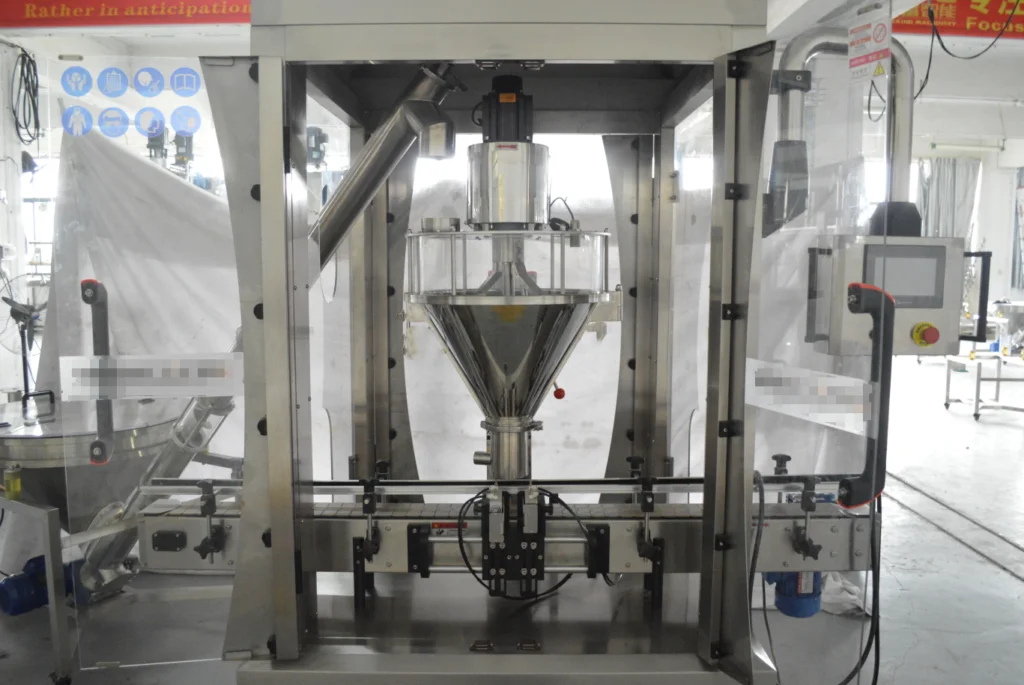
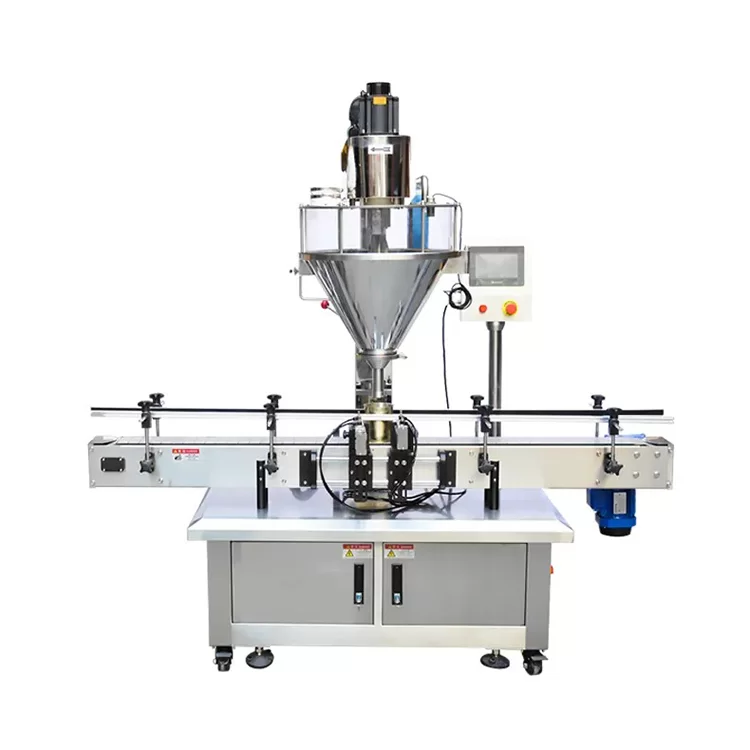
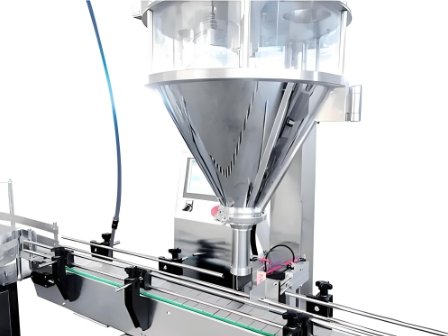
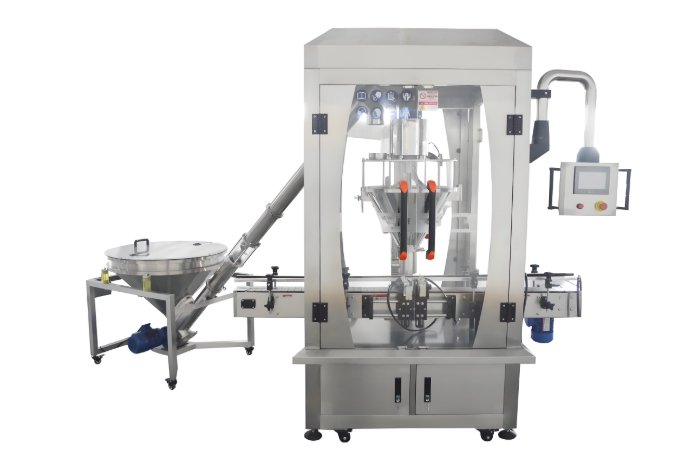
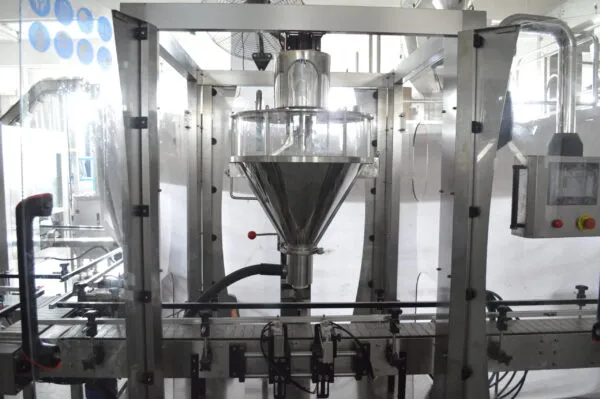
How the Powder Filling Machine Works
Powder behaves differently from liquids or granules. It can compact, aerate, bridge inside the hopper, and change in bulk density due to moisture, storage time, and handling conditions. These changes can affect dosing consistency, especially when powder is measured only by volume.
That is why we use auger dosing. A servo-driven screw rotates according to programmed dosing parameters to move a controlled amount of powder from the hopper into the container. An agitator keeps the powder moving and helps prevent bridging above the auger, while the control system regulates each dosing cycle for repeatable filling. When tighter weight tolerances are required, checkweighing can be added to monitor the filled weight and automatically correct the dose.
Powder Filling Machine
What You Get on a Popper Powder Filler
- Servo Auger Dosing: The dose is controlled by programmed auger rotation count, helping maintain repeatable filling when bulk density varies between batches.
- Agitator Sized to Your Powder: The agitator keeps product moving above the auger to help prevent bridging. Fine and cohesive powders require a different setup from free-flowing powders.
- Auger and Tube Matched to Each Product: Tooling is selected according to the characteristics and fill range of each powder. We specify and quote the required tooling for every SKU before commissioning.
- Dust Containment: The nozzle and container interface are configured for your powder to help reduce product escape and dust at the filling point.
- Recipe Storage: Save operating settings for each powder and container format, allowing operators to switch batches by selecting the correct recipe instead of starting from a full recalibration.
- Bench Testing Before Quotation: We test your actual powder and record achieved fill weights before confirming the expected filling tolerance in our quotation.
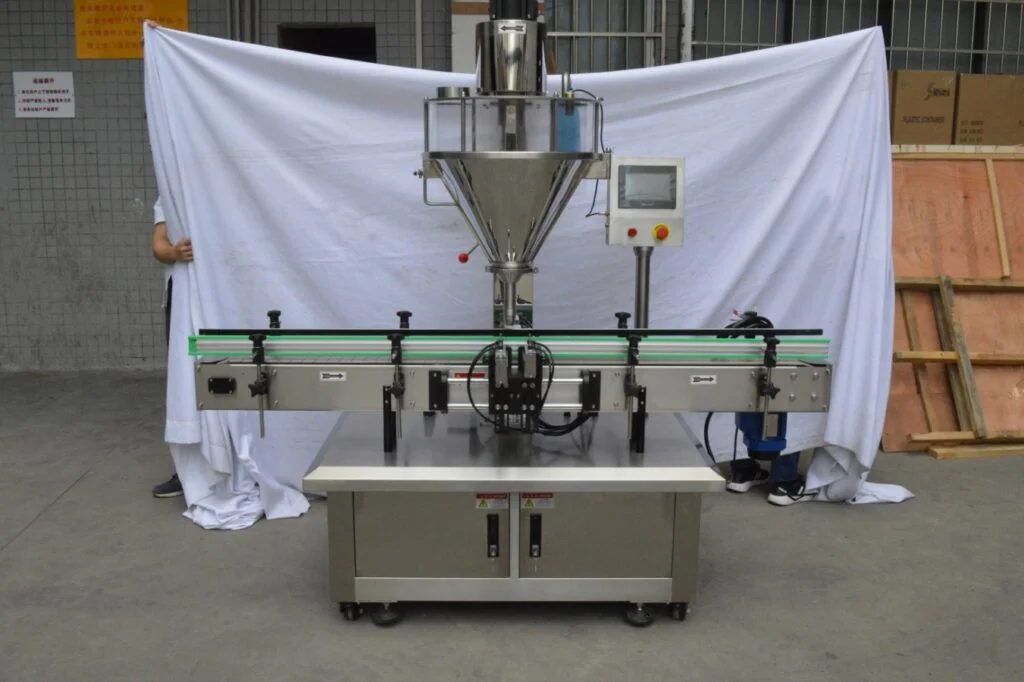
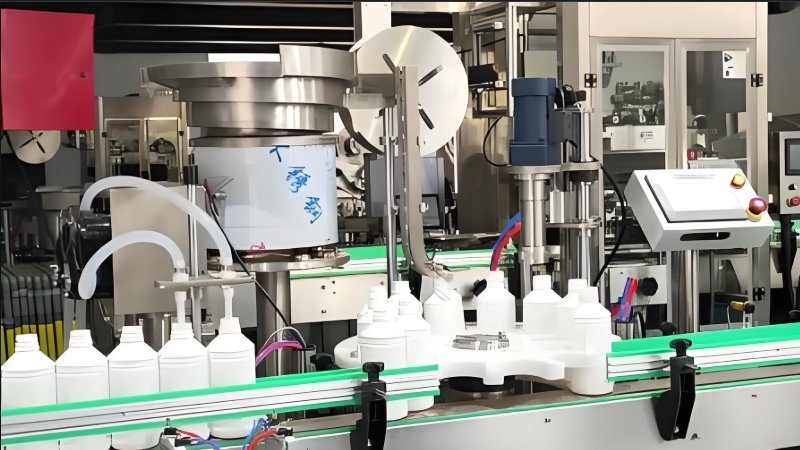

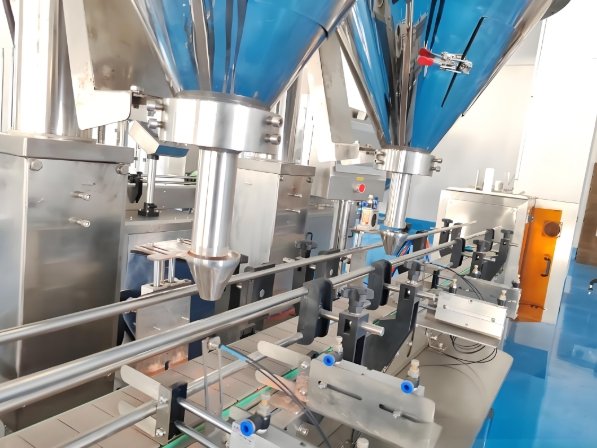
Which Dosing Method Fits Your Powder?
We build three dosing configurations across both semi-automatic and fully automatic powder filling machines. The right setup depends on how your powder flows, how much its bulk density varies, the filling tolerance you need, and the value of the product being filled.
| Auger Filler | Auger with Checkweigher | Volumetric Cup Filler | |
|---|---|---|---|
How it doses |
Servo-controlled auger rotation |
Auger dosing followed by weighing and automatic correction |
Fixed-volume cups filled by gravity |
Best suited for |
Most powders, including fine, cohesive, and non-free-flowing products |
High-value products or applications requiring tighter weight control |
Free-flowing powders with stable bulk density |
Handles density variation |
Moderate |
High, because weight feedback can correct the dose |
Low, because the system relies on a fixed volume |
Typical accuracy |
Approx. ±0.5% to ±1% with suitable servo control and setup |
Tighter tolerances, depending on the checkweighing configuration and product |
Approx. ±1% to ±3% |
Changeover |
Product-specific auger and tube may be required |
Product-specific auger and tube may be required |
Typically faster, with no auger tooling change |
Relative cost |
Mid-range |
Premium |
Entry-level |
If your product is free-flowing and made up of discrete particles rather than fine powder, a granule filling machine is usually the more suitable and cost-effective option. As a practical rule, products with particle sizes around 0.5 mm or larger are often better handled as granules, but flow behavior matters just as much. If the product bridges, compacts, or does not move consistently through the hopper, an auger-based powder filling system may still be the better choice.
Powder Filling Machine Specifications
These specifications cover our configurable powder filling machine range, including auger, checkweighing, and volumetric dosing systems. Final specifications are selected according to your powder type, fill weight, container size, accuracy requirement, and production speed.
| Parameter | Specification |
|---|---|
Model |
Custom-configured semi-automatic or automatic powder filling machine |
Dosing type |
Servo auger, servo auger with checkweigher, or volumetric cup |
Fill weight range |
1–5,000 g per fill, depending on auger/tooling and powder characteristics |
Filling accuracy |
Servo auger: typically ±0.5–1%; auger + checkweigher: approx. ±0.1–0.5%; volumetric cup: approx. ±1–3%, product dependent |
Output rate |
10–60 containers/min typical, depending on fill weight, powder flow, container and head configuration |
Number of filling heads |
1 or 2 heads; higher-output configurations engineered to application |
Hopper capacity |
25–50 L standard range; larger hopper configurations available according to application |
Container diameter range |
Approx. Ø20–200 mm, depending on conveyor guides, filling nozzle and container handling system |
Container height range |
Approx. 40–350 mm, configuration dependent |
Powder types supported |
Free-flowing, fine, cohesive and non-free-flowing powders; hygroscopic powders subject to product testing and moisture-control requirements |
Air consumption |
Approx. 0.6 MPa / 0.3 m³/min where pneumatic bottle handling, cut-off or dust-control functions are fitted |
Power supply |
220 V or 380 V, 50/60 Hz; approx. 1.5–3 kW, depending on configuration |
Machine dimensions |
Approx. 800–2,200 × 600–1,100 × 1,700–2,300 mm across semi-automatic, single-head and dual-head configurations |
Machine weight |
Approx. 120–550 kg, depending on automation level, hopper and head configuration |
Contact material |
SUS304 stainless steel standard; SUS316L available for pharmaceutical, corrosive or higher-hygiene applications |
Control system |
PLC + color touchscreen HMI, servo auger control and recipe storage; PLC/HMI brand confirmed for the quoted build |
Certification |
CE / ISO where applicable; certificate details supplied with the quoted machine documentation |
Industries and Powders We Fill
Learn how powder filling machines improve dosing accuracy, reduce product waste, and streamline packaging for food, pharmaceutical, chemical, and cosmetic powders.
Powder filling machines are configured differently depending on the product, hygiene requirements, powder behavior, and contact-material needs.
| Sector | Typical Powders | Key Considerations |
|---|---|---|
Food |
Flour, spices, coffee, protein powder, drink mixes, seasonings |
Food-grade contact parts are important, while dust containment is especially useful for fine flour and spice powders. |
Nutraceutical |
Supplement powders, collagen, meal replacements |
High-value products can justify checkweighing to reduce overfill and product giveaway. |
Pharmaceutical |
API powders, excipients, reconstitution powders |
316L stainless steel contact parts and appropriate production documentation may be required. |
Cosmetic |
Loose face powder, talc, pigments, bath salts |
Very fine and lightweight powders require careful agitator, hopper, and nozzle design. |
Chemical |
Detergent powder, pigments, agricultural chemicals |
Abrasive or corrosive powders may require different product-contact materials and machine components. |
We configure container handling for jars, bottles, cans, pouches, and sachets. The main changes are usually the infeed system, filling nozzle, container positioning, and dust control at the filling point rather than the powder dosing principle itself.
For products packed into formed pouches or sachets, see our sachet packaging machine guide. For dairy and nutritional powders filled into jars or cans, review our milk powder filling machine. If powder is dosed directly into capsules, a capsule filling machine is the more suitable system.
Three factors have a major effect on whether a powder dose repeats consistently, and each should be matched to the actual product before the machine is built.
- Auger and tube sizing: Tooling should match particle size, flow behavior, and target fill weight. An auger suitable for fine flour may not maintain the same tolerance with a coarse protein blend.
- Agitator type and speed: The agitator keeps powder moving above the screw. If it runs too slowly, the powder can bridge. If it runs too fast, the product may aerate and change the delivered dose.
- Hopper level: Product pressure can change as the hopper empties. Level sensing and an automatic top-up feeder help maintain more consistent feeding conditions.
For more detail, see our guides to powder filling machine accuracy levels and choosing the right filling speed.
Send Us Your Powder Before You Send Us a Specification
Two powders with the same product name can behave very differently. Protein isolate from one supplier may flow consistently, while another may cake or bridge. Spice blends can change with humidity, and milk powder can aerate during transfer, temporarily changing its bulk density.
That is why we prefer to bench test your actual powder before finalizing the machine specification. Testing helps us determine how the product flows, how stable its bulk density is, whether it bridges or rat-holes in the hopper, how much it aerates during transfer, and whether the product is abrasive, hygroscopic, dusty, or requires additional containment.
What We Need From You
- Product sample or bulk density: Send a sample where possible. If shipping is not practical, provide the bulk density in grams per litre.
- Target fill weight and tolerance: Tell us the required dose and the acceptable variation.
- Required production output: Provide the target containers per minute and operating hours per shift.
- Container specifications: Include container type, diameter, height, opening size, and closure.
- Number of SKUs: Tell us how many powders and package formats will run on the machine and how frequently you expect changeovers.
- Regulatory requirements: Specify any food-contact, pharmaceutical, dust-control, or explosion-protection requirements relevant to your application.
For further technical guidance, see our guide to choosing the right powder filling machine, our fine powder filling machine guide, and our guide to powder filling machines for food supplements.
Complete Powder Packaging Lines
A powder filling machine rarely operates on its own. Containers typically move through filling, closing, labeling, and secondary packaging as part of one connected production line.
We can supply and configure the equipment around the filler so conveyor height, container handling, production speed, and control signals are matched from the start. Depending on your application, this can include capping machines for bottles and jars, labeling machines for round or flat containers, and packaging machines for cartoning, wrapping, and case packing. You can also explore our wider filling machine range.
If you are adding a powder filler to an existing production line, send us the make and model of the upstream and downstream machines. We can then match conveyor height, container pitch, line speed, and control interfaces to your current setup.
For more information about our manufacturing capabilities, visit About Us. For installation, technical support, and after-sales information, see our service page.
Frequently Asked Questions
Powder filling equipment is suitable for flour, spices, milk powder, protein powder, coffee powder, pharmaceutical powders, cosmetic powders, detergent powder, and similar dry products. Depending on the machine configuration, these products can be filled into bottles, jars, cans, pouches, and sachets.
For free-flowing products made up of larger, discrete particles, a granule filling machine is usually the more suitable option.
An auger filler is usually the best choice for fine powders. These products can bridge inside the hopper and may produce inconsistent results when dosed only by volume. A servo-driven auger, combined with an agitator matched to the powder, helps maintain consistent product flow and repeatable dosing.
For more detail on very fine and difficult-to-handle powders, see our fine powder filling machine guide.
Yes. Change parts and guide settings can be configured for each container format you plan to run, with operating settings saved in the control panel for faster changeovers. Provide all bottle, jar, can, pouch, or other container formats at the enquiry stage so the required change parts can be specified and quoted upfront rather than added after commissioning.
Two factors help reduce product waste. First, auger dosing controls the dose by screw rotation, which can reduce the need for excessive overfill used to protect minimum package weight. Second, dust containment at the filling point helps prevent fine powder from escaping during filling.
For a broader look at waste reduction, see our guide on reducing product waste in filling machines.
Yes. With the correct product-contact materials and supporting documentation, powder filling machines can be configured for food and pharmaceutical applications. 304 stainless steel is commonly used for food-contact parts, while 316L stainless steel is typically specified for pharmaceutical or higher-hygiene applications.
Accuracy depends on the powder characteristics and dosing method. As a general range, servo auger fillers typically achieve about ±0.5% to ±1%, while volumetric cup fillers are usually around ±1% to ±3%. Auger systems combined with checkweighing can achieve tighter control.
We confirm the expected tolerance during bench testing with your actual product and state the verified figure in the quotation rather than promising an accuracy level before testing.
Usually, yes. The auger and filling tube are selected according to the powder’s particle size, flow behavior, and target fill range, so a multi-SKU line may require separate tooling for different products.
We specify and quote the required tooling upfront. If several powders have similar characteristics, one auger and tube set may be suitable for multiple SKUs, which we confirm through bench testing.
Get a Powder Filling Machine Built for Your Product
Send us a powder sample along with your target fill weight and required production output. We will bench test the product, recommend the most suitable dosing method, and provide a machine specification with pricing.
Contact us to get started, or email info@fillingmachinepp.com