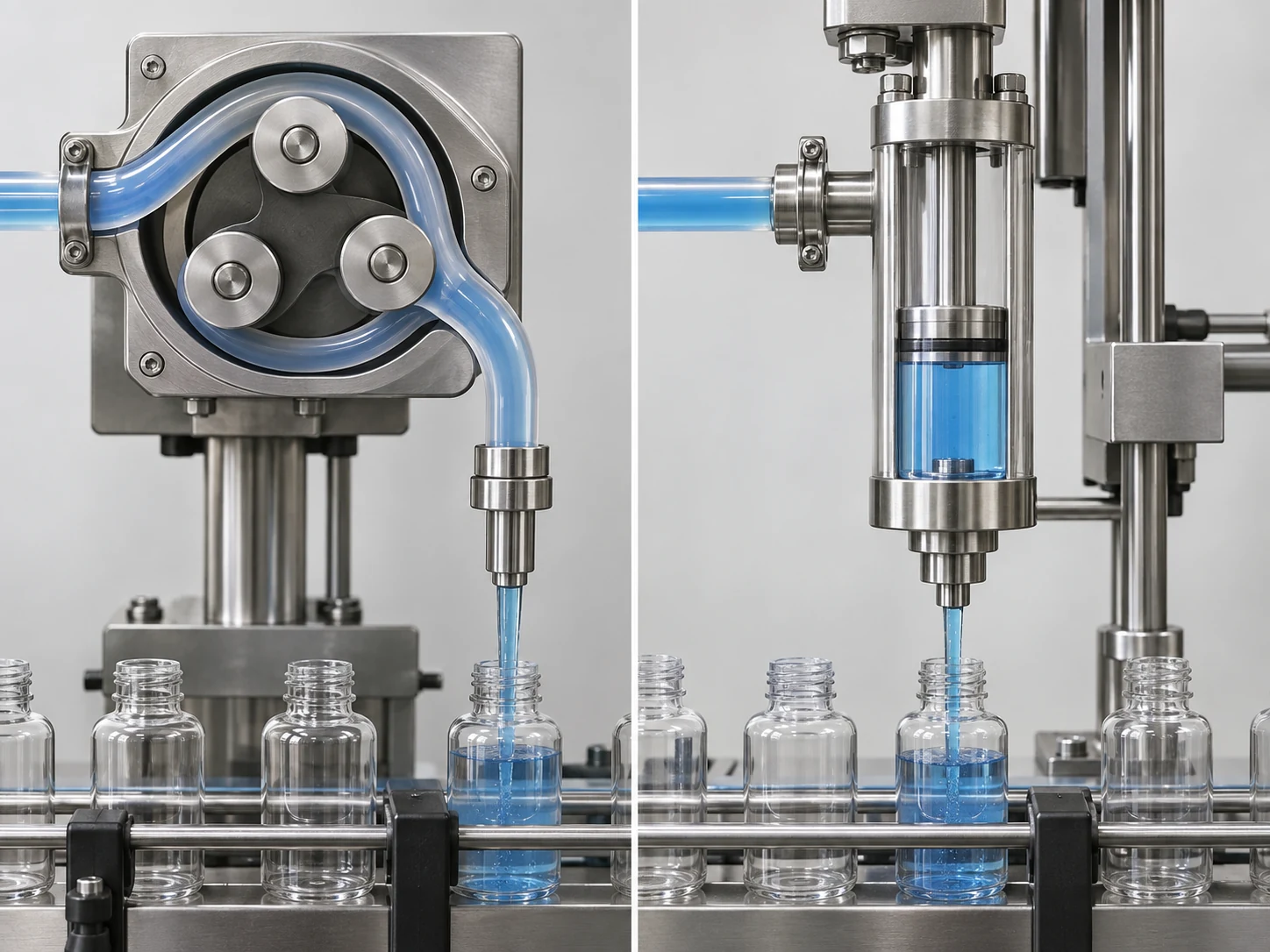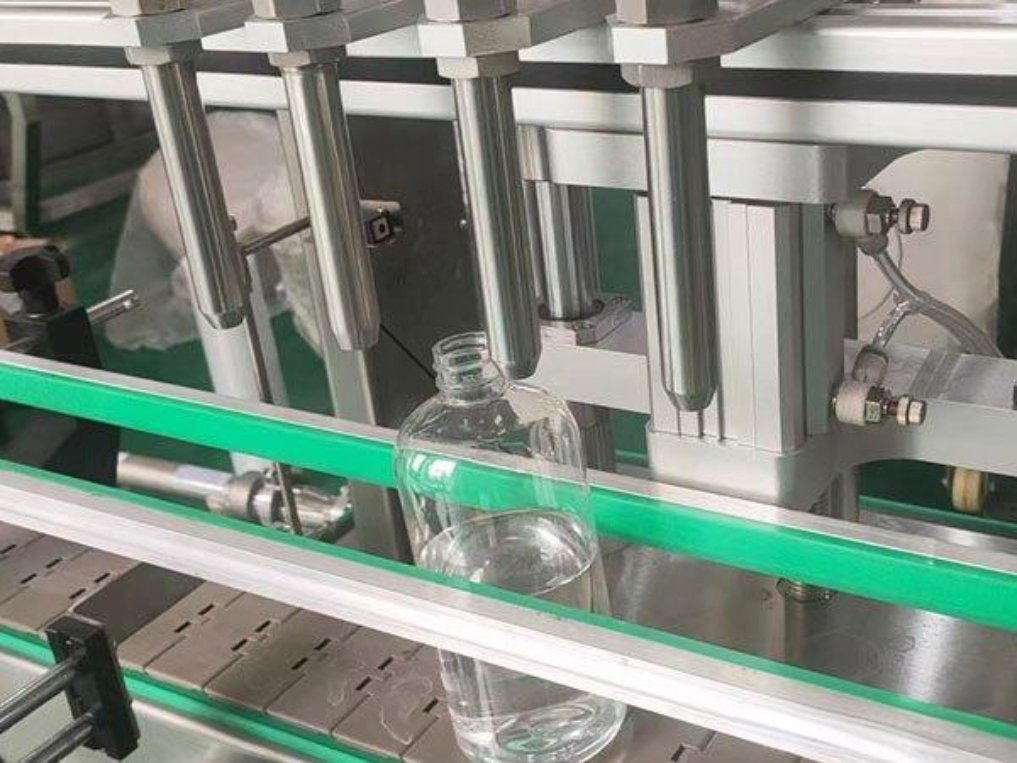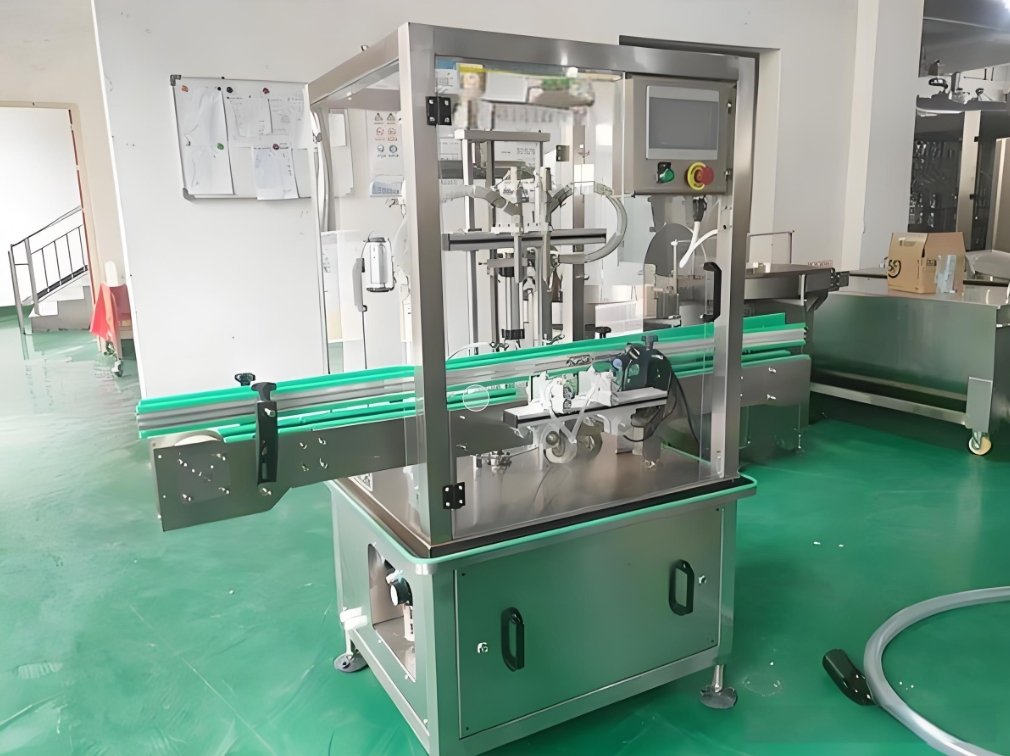
A peristaltic filling machine doses liquid into containers by squeezing a flexible tube with rotating rollers, so the product travels inside the tubing and does not pass through valves, seals or pistons in the pump. The tubing is the heart of the system: its bore, wall and elasticity set how much liquid moves per rotation and how consistently that volume repeats. Whether the technology suits your line depends on your product, fill volume, target speed and required accuracy. Below: the principle, where it fits, when another method is better, and what to specify before a quote.
What Is a Peristaltic Filling Machine?
A peristaltic filling machine is a liquid filler that uses one or more peristaltic pump heads to meter each dose, combined with the nozzles, controls and container handling needed to fill bottles or vials repeatably. The pump provides the metering. The machine turns that metering into a production process.
That distinction matters when comparing suppliers. A standalone peristaltic pump moves liquid at a controlled rate. A complete peristaltic pump filling machine adds dose programming, anti-drip control, nozzle positioning, container detection and, on automatic models, a conveyor and indexing system. Some systems are benchtop units where an operator places each container. Others are inline machines with several heads that feed directly into capping and labeling.
How a Peristaltic Filling Machine Works
The pumping principle behind every peristaltic filling machine is simple. Tubing sits in a curved track inside the pump head. As the rotor turns, rollers or shoes press the tube closed against the track and push the trapped liquid forward. Behind each roller, the tube springs back to its round shape, creating suction that draws more liquid in from the supply. Because each roller pocket holds a defined volume, a given amount of rotation delivers a repeatable quantity of liquid.
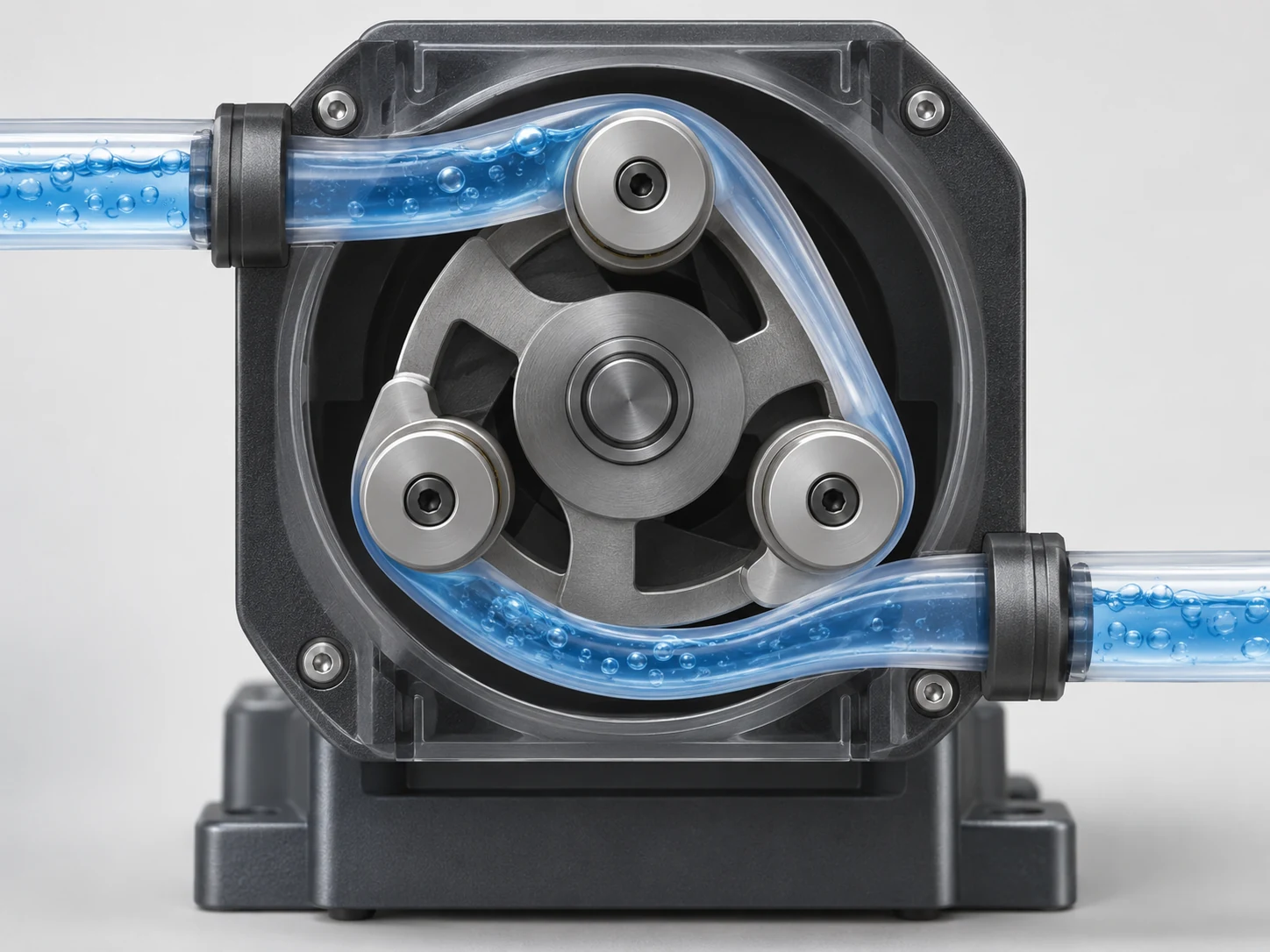
A complete peristaltic filling machine builds a fill cycle around that principle:
- Supply. Product is drawn from a tank or bulk container through the inlet tubing. Peristaltic pumps are self-priming.
- Container positioning. The operator places the container, or a conveyor indexes it under the nozzle and a sensor confirms it is present.
- Dosing. The controller runs the pump for a programmed number of rotations or a programmed time at a set speed.
- Ramping. Many controllers accelerate at the start of a dose and slow near the end to limit splashing and foaming.
- Drip control. A short reverse rotation at the end of the dose pulls liquid back from the nozzle tip.
- Discharge. The filled container moves on to capping, or the operator removes it.
Diving nozzles, which lower into the container and rise as it fills, are often added for foaming products. Nozzle selection is a topic in its own right, covered in our guide to filling machine nozzle types.
Main Components of a Peristaltic Filling Machine
- Pump heads: one per filling lane on most multi-head peristaltic filling systems, each with its own tubing.
- Pump tubing: the product-contact element that is compressed by the rollers.
- Drive and controller: stepper or servo motors with programmable dose volume, speed, ramping and suck-back.
- Fluid path: inlet tubing, connectors, manifolds if used, and filling nozzles.
- Container handling: manual placement, a filling stand, or an automatic conveyor with indexing.
- Sensors and interface: container detection, counters, and an HMI that stores recipes.
Product Contact and Contamination Control
The main reason buyers consider a peristaltic filling machine is the product-contact path. In a peristaltic pump the liquid touches the inner bore of the tubing and the downstream components it flows through, such as connectors and nozzles, but not the rotor or rollers. That brings practical advantages:
- Fewer product-contact parts to clean or validate, since there are no pump valves, seals or cylinders in the fluid path.
- Fast changeover. Swapping the tubing and nozzle set on a peristaltic filling machine is typically quicker than disassembling and cleaning a piston or gear pump.
- Dedicated or disposable fluid paths. Separate tubing sets can be kept for each product, and some systems use single-use assemblies.
- Reduced cross-contact points between products on multi-SKU lines.
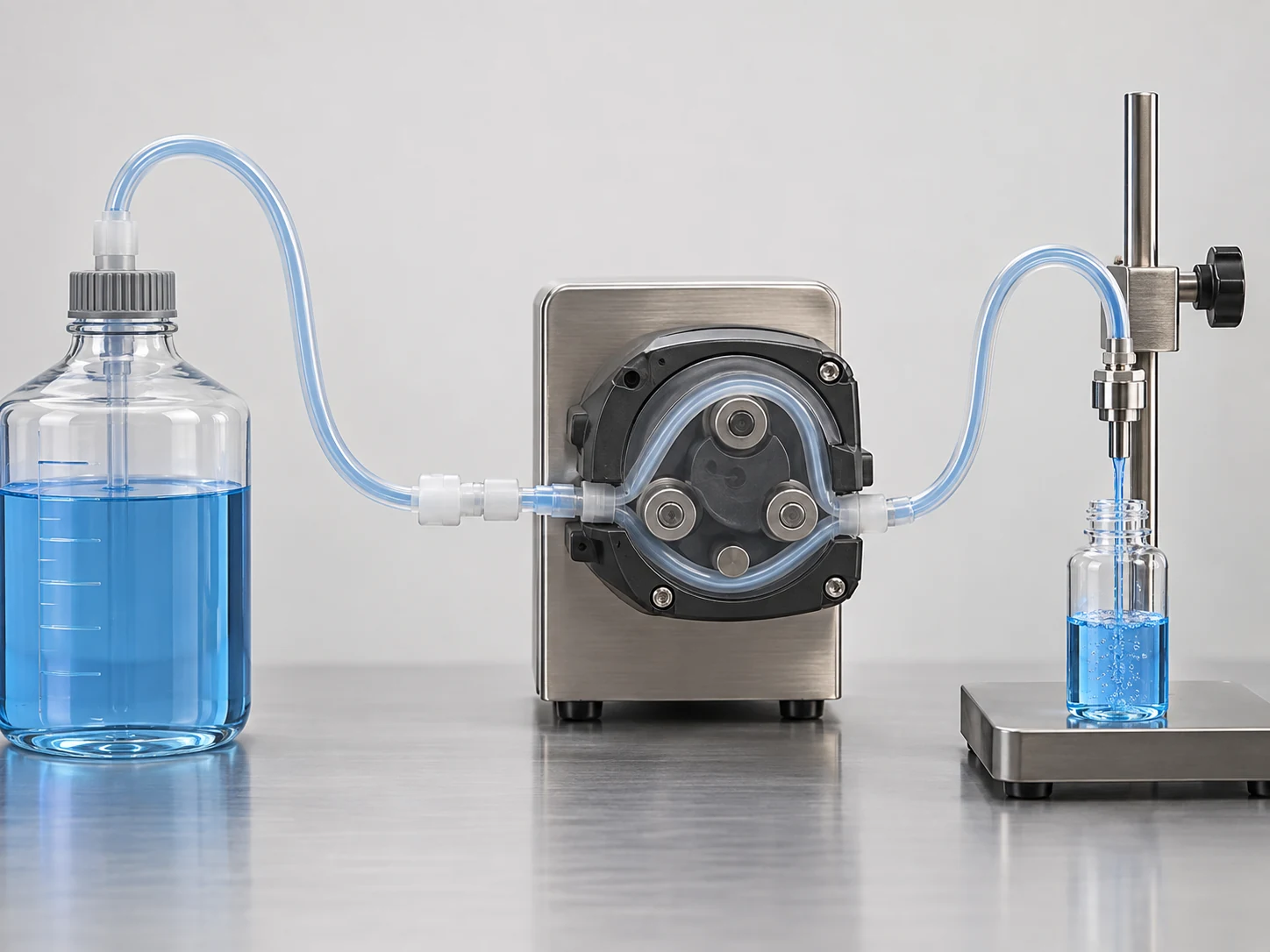
These advantages reduce risk; they do not remove it. Connectors, nozzles, the supply container and the filling environment are still part of the product path, and tubing can fail. The pump principle alone does not make a process sterile or free of contamination. That depends on the complete machine design, the environment, how the fluid path is prepared, and how the process is validated.
Which Products Suit Peristaltic Filling?
A peristaltic liquid filling machine is most often selected for thin to moderately viscous, particle-free liquids, especially where product value is high, batches are small or changeovers are frequent. Typical applications include:
- Pharmaceutical and nutraceutical liquids, including oral solutions and drops
- Diagnostic and laboratory reagents
- Essential oils, fragrances and perfumes
- Cosmetic serums, toners and similar light liquids
- Specialty chemicals, inks and dyes, subject to tubing compatibility
- Shear-sensitive liquids, since the squeezing action is relatively gentle
Assess suitability against five factors: viscosity, particulates, chemical compatibility with the tubing, fill volume, and the speed you need. A product that is compatible on the first three can still be a poor fit if the volume is large and the output target is high.
Viscosity: What Actually Limits a Peristaltic Filling Machine
Supplier guidance on viscosity is contradictory. Some vendors limit their peristaltic filling machine models to light, low-viscosity liquids, while pump manufacturers describe peristaltic pumps as able to handle viscous fluids. Both can be true, because pumping a viscous liquid and filling it quickly are different problems.
As viscosity rises, the tube takes longer to refill behind each roller, so the pump must run slower or it will draw in less than a full pocket of liquid. Larger-bore tubing restores flow but changes dose resolution. Motor load rises, and product may string from the nozzle at the end of a dose. The result is that a viscous product may be pumpable yet too slow to fill at your target rate.
There is no universal viscosity limit. The practical maximum depends on the pump head, tubing size and material, product rheology, fill volume and speed. For thick creams, gels and pastes, piston or lobe-pump filling is usually more practical, as explained in our viscous liquid filling machine guide. If your product sits in between, test it.
How Tubing Affects Performance
On a peristaltic filling machine, tubing is not an accessory. It is the metering element, and its properties decide flow, accuracy, speed and service life.
- Internal diameter: a larger bore moves more liquid per rotation and suits larger fills, but each roller pocket is a bigger volume step. Engineering literature notes that larger bores increase pulsation and dose error, which is why smaller bores are generally preferred for precise small doses.
- Wall thickness and hardness: these determine how fully the tube closes under the roller and how well it recovers. Poor recovery reduces the volume drawn in on each pass.
- Elasticity: the tube must return to its round cross-section millions of times. As elasticity declines, delivery changes.
- Chemical compatibility: the tubing is the main product-contact material, so it must resist the product, including solvents, oils or fragrance compounds, without swelling, softening or leaching.
- Temperature and pressure: both affect tube behavior and wear rate.
- Regulatory suitability: for food, cosmetic or pharmaceutical products, confirm the documentation the tubing supplier provides for your application.
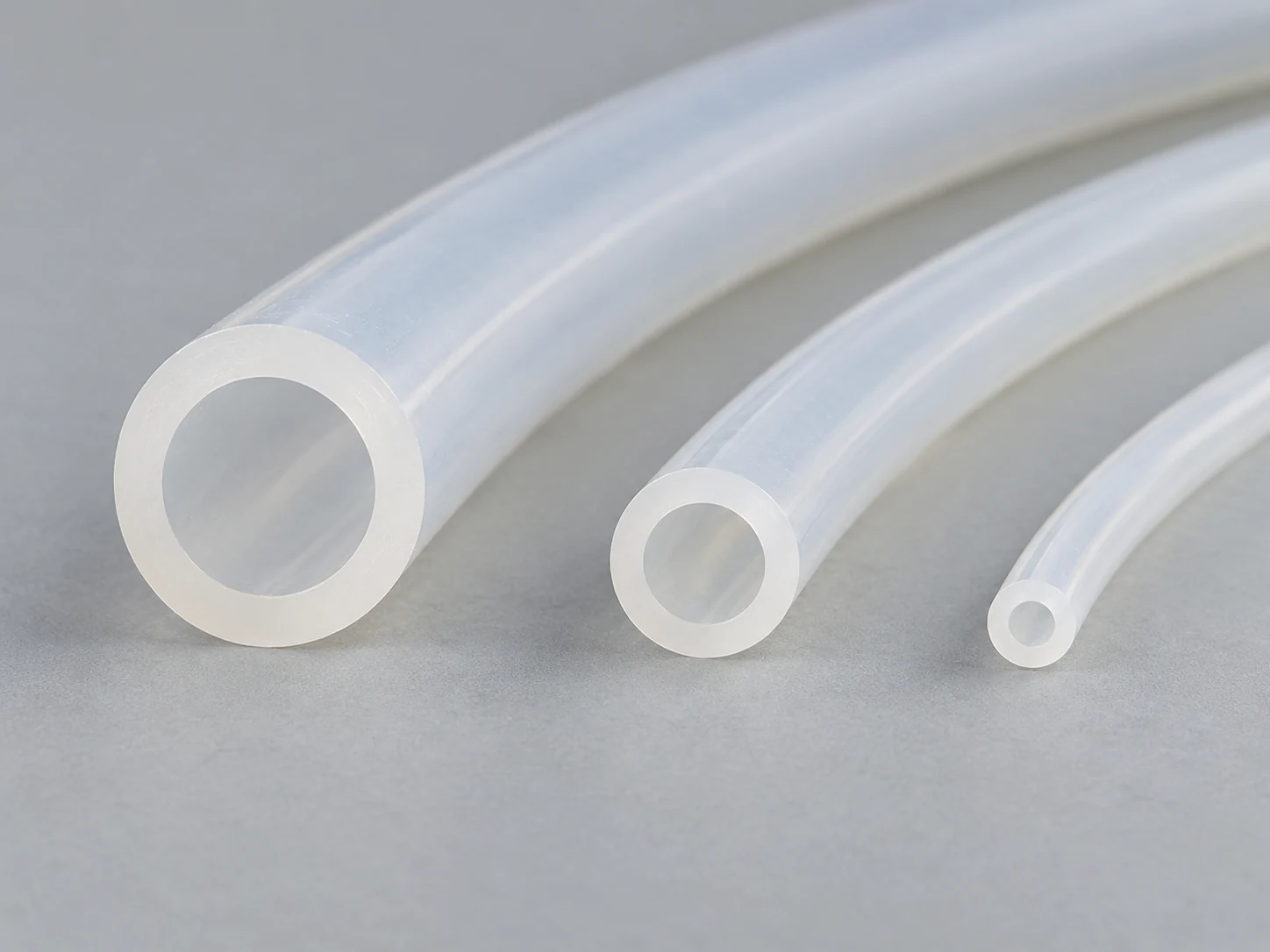
Do not assume one tubing material suits every product. Ask the machine supplier which tubing was used in their tests, and check compatibility data for your formulation.
Filling Accuracy and Calibration
Published accuracy figures are measured under specific conditions, usually water at a stated volume. They are not a guarantee for your product. Accuracy on a peristaltic filling machine depends on:
- Tubing bore, elasticity and wear
- Pump speed and ramp settings
- Product viscosity, density and temperature
- Supply level and inlet conditions, including air in the line
- Nozzle design and drip control
- Fill volume, since small doses are more sensitive to each roller step
- Container positioning and consistency
The only meaningful accuracy test uses your actual product, fill volume, tubing and intended speed.
Calibration links the peristaltic filling machine controller’s setting to the volume actually delivered. A typical approach is to set the target dose, dispense a series of samples, weigh them, adjust the calibration factor or pump parameters, and repeat until the results sit inside your tolerance. Verify across a statistically meaningful run, not a handful of fills. Many benchtop fillers connect to a balance for this purpose. Where your quality system requires it, calibration and verification should follow documented procedures with recorded results.
Tubing Wear and Replacement
Every roller pass flexes the tube, so tubing is the main wear component on a peristaltic filling machine. Over time it can stretch, flatten, crack or lose its ability to recover. As the bore changes, the volume trapped between rollers changes with it, and delivery drifts even though the motor turns exactly as programmed. New tubing can also shift slightly during its first hours of running as it settles into the pump head.
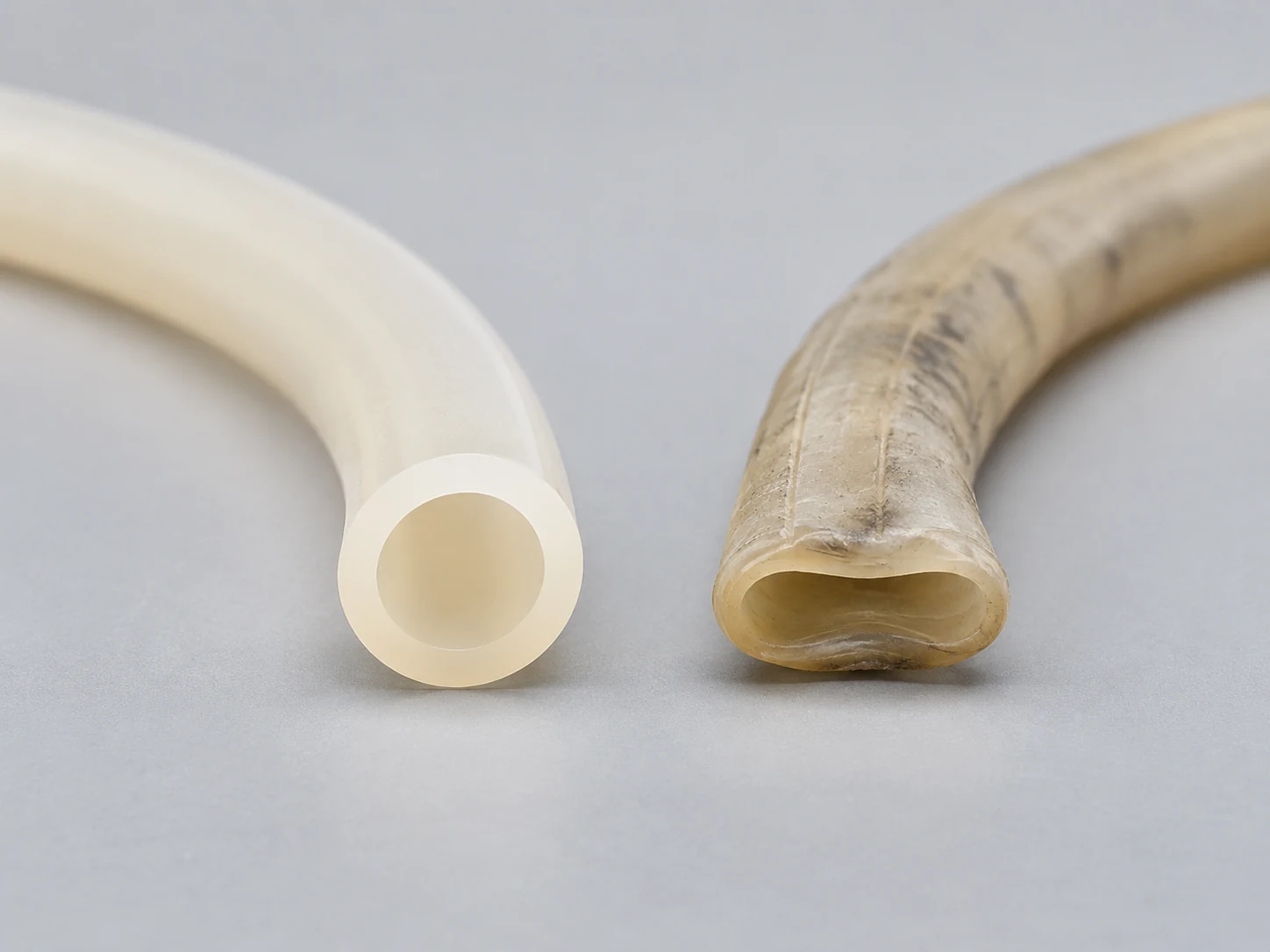
There is no universal replacement interval. Tubing life depends on tubing material and dimensions, operating hours, pump speed, roller compression, temperature, chemical exposure and how critical the product is. Practical controls include:
- Replacing tubing on run-time or cycle count rather than calendar dates
- Checking fill weights at set intervals during long runs and recalibrating when drift appears
- Recalibrating after every tubing change
- Inspecting tubing for flattening, surface wear and cracking at each changeover
- Keeping spare tubing sets on site for every product and pump head size
Production Speed and Filling Heads
Buyers often compare quoted bottles per minute, but that figure is shaped by four separate rates:
- Dosing speed: how fast the pump delivers one dose, set by flow rate, tubing size, viscosity and ramping.
- Machine cycle speed: dosing plus container indexing, nozzle movement and drip control.
- Line output: containers per minute across all heads.
- Acceptable output: containers within tolerance per hour over a sustained run, including stops for supply refills and checks.
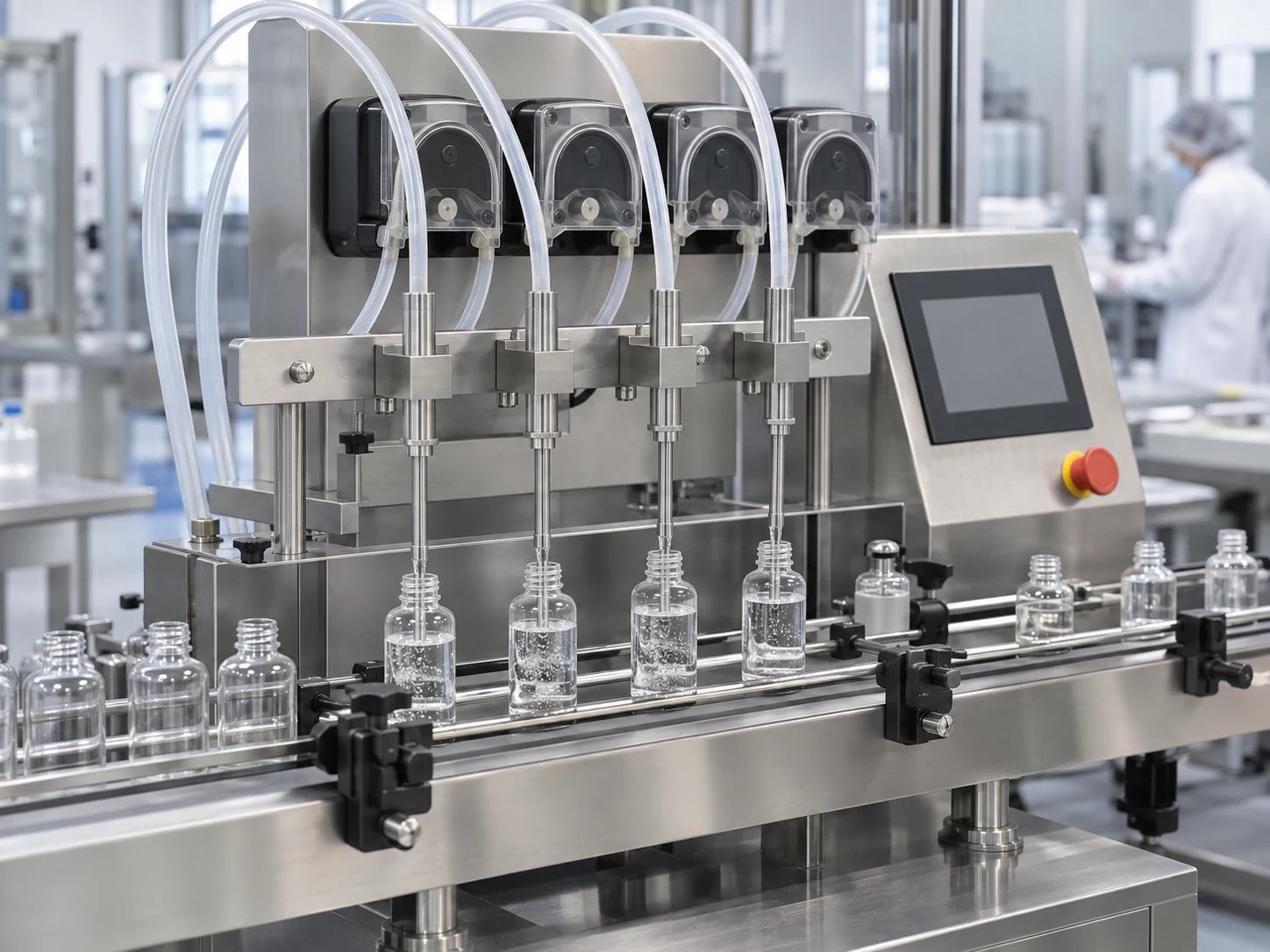
On an automatic peristaltic filling machine, adding heads increases line output, but not in a straight line. Every head needs its own tubing, calibration and verification. Heads must be synchronized with indexing, and the slowest head sets the pace. Changeovers, calibration time and spare tubing needs all multiply with head count. A peristaltic filling machine quoted at a high output with water may run noticeably slower on a thicker product or a larger fill. Ask for output measured with your product and volume. For lines that combine filling with capping and labeling, see our automatic filling machine solutions.
Peristaltic Filling Machine vs Piston Filling