
Top and Bottom Labeling Machine
We manufacture Top and Bottom Labeling Machines at our factory in Foshan, China, for boxes, trays, pouches, cards, and other flat packs. Send us your product dimensions, label size, and target output, and our engineers will specify the right machine for your application.

How Our Top and Bottom Labeling Machines Work
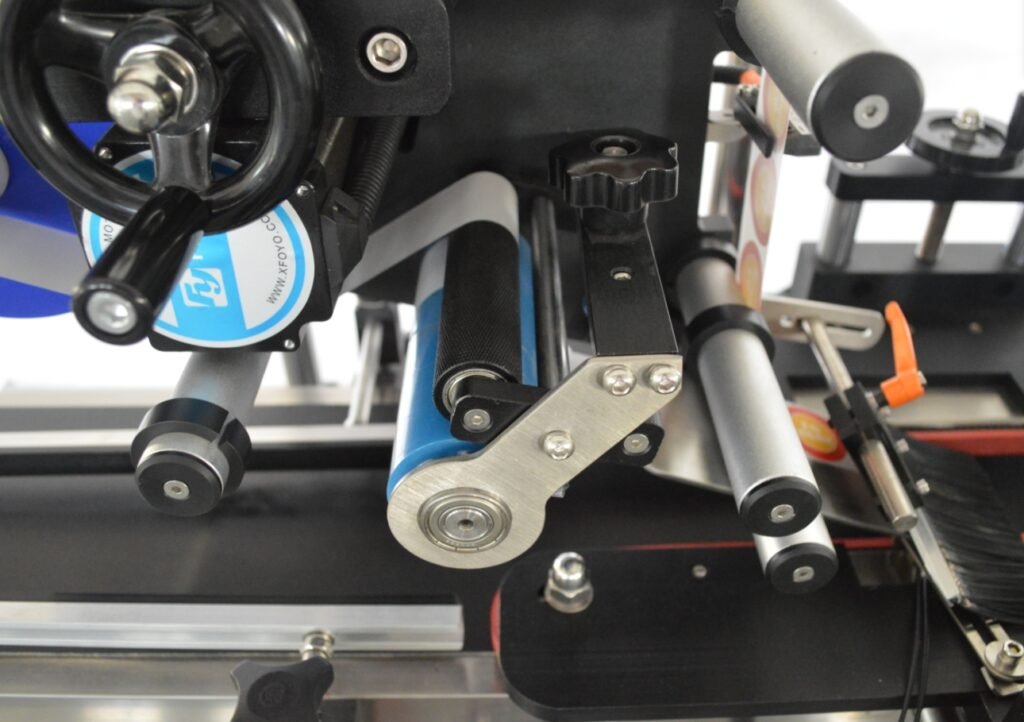
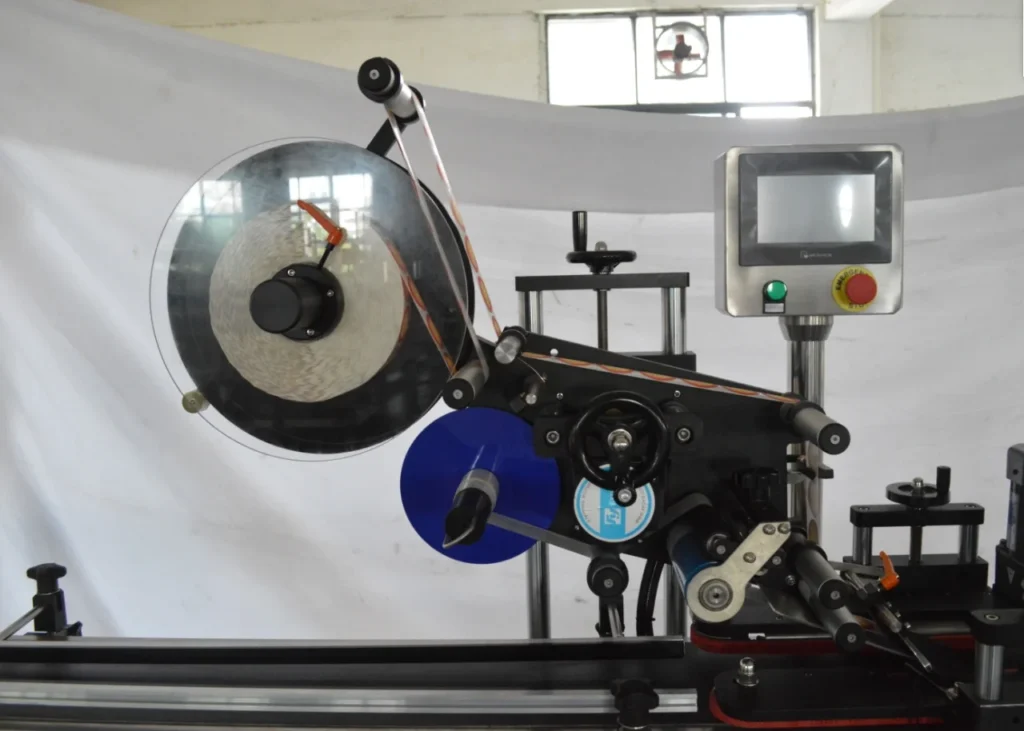
Products move flat along the conveyor of the Top and Bottom Labeling Machine, passing between two applicator heads, one positioned above the line and the other below. A sensor detects the product’s leading edge, allowing both heads to apply the upper and lower labels at the same position relative to that edge.
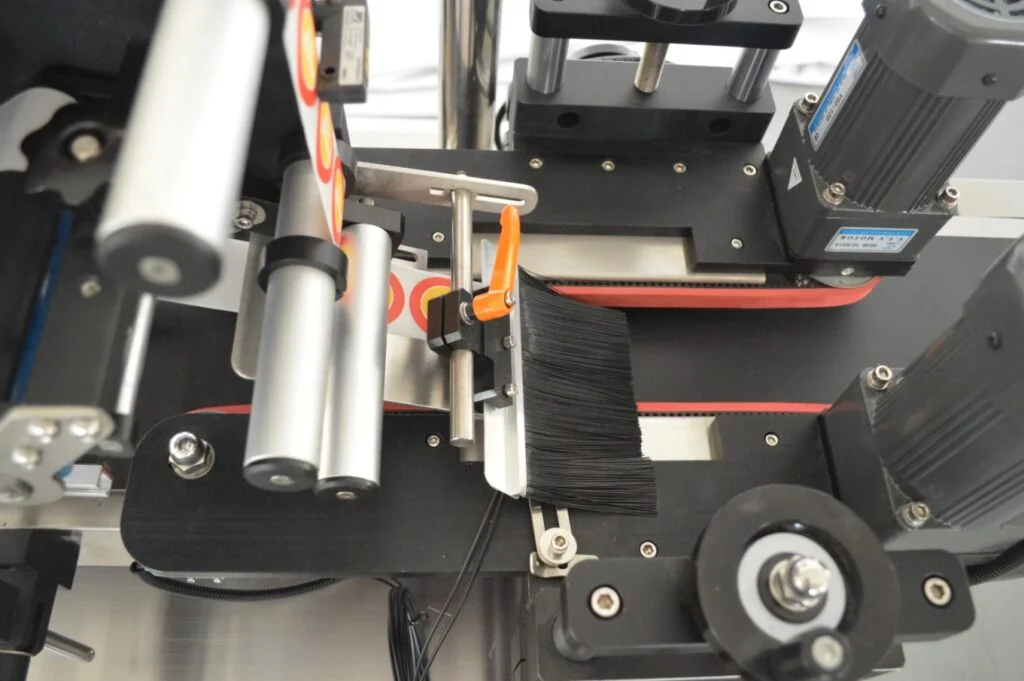
The main challenge with top and bottom labeling is not applying two labels, but keeping them accurately registered to each other. If the product shifts or skews between the two applicators, alignment can be lost. A top pressing belt keeps the product flat and stable as it moves through the machine, while both labeling heads operate from the same position signal for consistent placement. For more detail, see our guide to top and bottom labeling machines
Labeling Machine
What You Get on a Popper Top and Bottom Labeler
These are standard build features of the Top and Bottom Labeling Machines we ship, not just general functions of this machine type.
- Registered Both Faces: The upper and lower labeling heads use the same product-position signal, helping both labels align accurately with each other rather than independently to the conveyor.
- Top Pressing Belt: Keeps the product flat and stable between the two applicator heads, reducing the shifting or skewing that can cause label misalignment.
- Clear Label Sensing: Photoelectric sensing is configured for your label stock, including transparent labels where standard sensors may not detect the gap correctly.
- Change Parts Included: Guide rails and spacing components are set for each product format you plan to run, not only the first product.
- Recipe Storage: Product and label settings can be saved as recipes, making changeovers a selection process instead of a full recalibration.
- Tested on Your Product: We test your product and label at the specified output before shipment and provide the test result.
Top and Bottom Labeling Machine Specifications
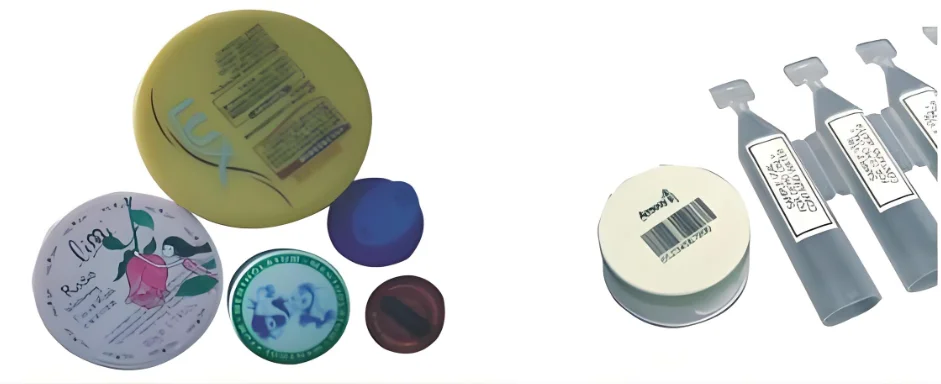
Our Top and Bottom Labeling Machine is built for accurate dual-side labeling of flat products such as boxes, trays, pouches, cards, and packs. Machine specifications can be configured according to product size, label dimensions, required output, and production-line requirements.
| Parameter | Specification |
|---|---|
Model |
Automatic Top and Bottom Labeling Machine – Custom Configuration |
Labeling accuracy |
±1.0 mm, excluding product and label tolerances |
Output rate |
50–180 products/min, depending on product dimensions and label size |
Product length range |
40–380 mm |
Product width range |
40–350 mm |
Product height range |
3–100 mm standard; larger sizes available by customization |
Label length range |
15–250 mm |
Label height range |
15–150 mm |
Label roll inner / outer diameter |
76 mm / up to 350 mm |
Label materials supported |
Pressure-sensitive paper and film labels, including transparent film with a clear-label sensor |
Conveyor width |
160–200 mm standard; wider/custom conveyor available |
Power supply |
AC 220 V, 50/60 Hz, approx. 0.8–2.0 kW depending on configuration |
Machine dimensions |
Approx. 2200 × 800 × 1500 mm; varies with conveyor and configuration |
Machine weight |
Approx. 300–350 kg depending on configuration |
Contact material |
SUS 304 stainless steel and anodized aluminum; no product-wetted parts |
Control system |
PLC + touchscreen HMI with stepper or servo-driven labeling heads; component brand confirmed with final configuration |
Top and Bottom Labeling Machine Price
The price of a Top and Bottom Labeling Machine depends on the final machine configuration rather than a fixed list price. Five main factors affect the quotation, so understanding them helps you compare suppliers based on the actual machine build instead of headline pricing alone.
| Factor | Effect on Price |
|---|---|
Output Rate |
Usually the biggest price factor. A high-speed Top and Bottom Labeling Machine requires faster servo drives, a longer conveyor, and heavier machine framing. |
Number of Product Formats |
Each additional product size may require dedicated guide settings, change parts, or handling adjustments, which are quoted according to the number of formats. |
Label Stock |
Transparent and metallised labels require specialized sensing. Shrink sleeve and RFID applications require different labeling systems and additional components. |
Level of Automation |
Semi-automatic machines with manual loading are generally the lower-cost option. Fully automatic systems with infeed, outfeed, and production-line integration cost more. |
Machine Construction and Certification |
Higher-grade stainless steel, additional guarding, and food, pharmaceutical, or other required certification can increase the cost compared with a standard machine build. |
For pricing across our wider equipment range, see our guide to filling machine cost. For a firm figure on this machine, send your product dimensions, label size and target output and we will quote against your specification.
Applications of the Top and Bottom Labeling Machine
A Top and Bottom Labeling Machine is selected primarily by product shape rather than industry. The product needs to travel flat at a consistent height and have suitable upper and lower surfaces for accurate label application on both faces.
Food trays, snack boxes, sauce containers, frozen food packs, bakery packaging, and ready-meal trays are well suited to a Top and Bottom Labeling Machine. The upper label typically carries branding, while the lower label can include nutrition information, barcodes, batch numbers, and date codes. Because both labels serve different functions, they need to stay accurately registered to each other rather than drift independently.
For products filled before labeling, the machine can be integrated with our bottle filling machine and sauce filling machine equipment.
Cartons, flat packs, pouches, blister cards, and boxed household goods are well suited to a Top and Bottom Labeling Machine. These applications usually run at high throughput with a consistent pack size, making a fully automatic fixed-format setup more practical than frequent product changeovers.
If pack height varies between SKUs, the applicator gap needs to be adjustable. We set this range during the machine build, so provide the tallest and shortest pack dimensions at the enquiry stage.
Pharmaceutical cartons, medical device trays, diagnostic kits, and blister packs can also be handled by a Top and Bottom Labeling Machine. These applications typically require tighter control than general packaging because labels may carry batch and expiry information that must remain accurate and verifiable.
Depending on the application, machine construction, documentation, and contact or exposed materials may also need to meet relevant pharmaceutical or medical packaging requirements.
We support the Top and Bottom Labeling Machine as part of a complete production and packaging line, helping you match the labeler with upstream and downstream equipment for smooth operation. For bottle-based products, our capping machines can be integrated before labeling, while our packaging machines can handle cartoning, wrapping, and other end-of-line processes. Where retail-ready protection is required, a shrink wrap packaging machine can also be added to the line.
Labels, Cards and When a Different Machine Fits Better
Standard paper and film labels run on the Top and Bottom Labeling Machine without special setup. Transparent labels require photoelectric sensing tuned to the label gap because standard sensors can read clear material as a continuous web. We configure this during the build, so share your label material at the enquiry stage.
Flat cards and carrier strips are also suitable for this machine, including RFID tags and inlays where a tag is applied to one face and a printed label to the other. If the product must be positioned consistently before labeling, see our guide to vertical and horizontal orientation.
When a Different Labeling Machine Is the Better Fit
A Top and Bottom Labeling Machine is designed for applying labels to the upper and lower faces of flat products. If your container is cylindrical, upright, or requires labels on the sides instead of the top and bottom surfaces, another machine from our labeling machine range may be more suitable.
Use a round bottle labeling machine for cylindrical containers, a single side labeling machine for one label on one face, or a two side labeling machine for front-and-back labeling on upright containers.
Where the Labeler Sits in Your Line
A Top and Bottom Labeling Machine typically runs after the product has been filled, sealed, or packed because the pack must be closed, stable, and flat before labels are applied to both faces. We can also supply the upstream equipment, including our filling machines, liquid filling machine systems for free-flowing products, and capping machines where containers need to be closed before packing. Downstream, our carton packaging machine and wider packaging machines range can handle secondary and end-of-line packaging.
Adding the labeler to an existing production line? Send us the make and model of the machines installed before and after it so we can match conveyor height, product pitch, and control signals. You can learn more about our manufacturing background on our about us page.
Frequently Asked Questions
Price is driven by output rate, the number of product formats you run, label stock, level of automation and contact material grade. A semi-automatic build sits at the entry point of our range and a fully automatic high-output line at the top.
Both applicator heads on the Top and Bottom Labeling Machine operate from the same product-position signal, helping the upper and lower labels stay aligned. A top pressing belt keeps the product flat and stable as it passes between the two heads, reducing the shifting or skewing that commonly causes label misalignment.
Yes. The Top and Bottom Labeling Machine can handle different pack heights within the range configured during the build. The applicator gap is adjustable, so share the tallest and shortest pack dimensions at the enquiry stage and we’ll set the machine to cover both.
Simply contact us through our form, email, or phone. Share your product size, label dimensions, target output, and line requirements, and our team will respond within 24 hours with a free, detailed quotation for your Top and Bottom Labeling Machine.
Both can be configured during the build. RFID tags and inlays work well with flat carrier strips, while transparent labels require photoelectric sensing tuned to the label gap. For RFID applications, see our guide to labeling machines that work with RFID tags.
Usually, misalignment happens when the product shifts between the two applicator heads or when the guide rails are set for a different pack size. On a Top and Bottom Labeling Machine, both product stability and correct guide settings are critical for accurate label registration. For more causes and fixes, see our labeling machine troubleshooting guide.
Yes. Our engineers handle complete on-site installation, staff training, routine maintenance, and fast troubleshooting to keep your production running smoothly.
With 10+ years of manufacturing experience, we deliver precision-built labeling machines, custom configurations, and reliable after-sales support. From machine selection and testing to installation guidance and spare parts support, we help manufacturers build dependable labeling solutions for long-term production.
Need a Top and Bottom Labeling Machine?
We manufacture and supply top and bottom labeling machines for boxes, trays, pouches, containers and flat products. Share your product size, label size and required capacity, and our team will recommend the right machine. Contact us or email info@fillingmachinepp.com.